How to Raise Seed Funding: A Practical Guide for Early-Stage Founders
Learn how to raise seed funding by defining the milestone, proving readiness, targeting the right investors, running a fundraising pipeline, and closing the round.
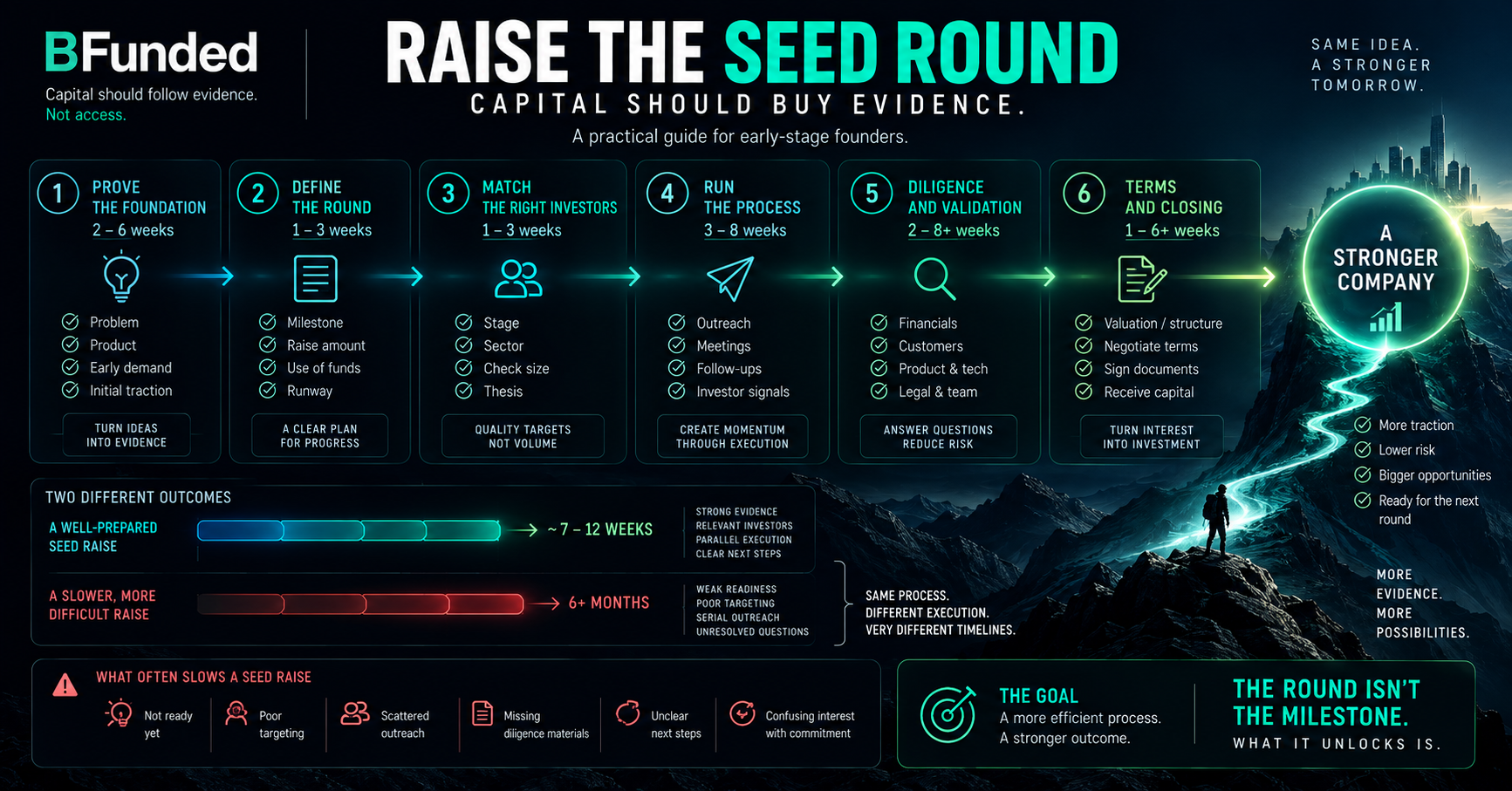
A seed round should not begin with:
“How much money can we raise?”
It should begin with:
“What does the company need to prove next, and what capital is required to get there?”
Seed funding is early-stage capital used to move a startup from its current evidence base toward a materially stronger company.
That could mean:
turning pilots into paying customers
proving retention
hiring a critical team
validating distribution
reaching meaningful revenue
completing a technical milestone
launching into a new market
building enough evidence for a later institutional round
The exact milestone depends on the company.
There is no universal seed-stage revenue threshold, round size, or company profile.
The seed stage sits in a wide zone between very early validation and a company beginning to show that something worth scaling exists. OpenVC’s current 2026 seed guide describes the distinction similarly: pre-seed tends to center on proving something is worth building, while seed increasingly asks whether there is evidence worth scaling.
That leads to a much better way to think about raising seed capital:
Evidence → Round → Investor Fit → Access → Process → Close
The money is the outcome.
The raise begins much earlier.
What Is Seed Funding?
Seed funding is capital raised by an early-stage company to reach its next meaningful stage of development.
It may come from:
angel investors
angel syndicates
seed funds
micro VCs
venture capital firms
accelerators
strategic investors
family offices
existing investors
other appropriate capital sources
Carta describes seed funding as early capital used to help a startup reach its next stage of growth, while noting that financing structures can include SAFEs, convertible instruments, and priced equity depending on the company and transaction.
The label seed is useful.
It is not a precise universal standard.
One company may raise seed capital with early revenue.
Another may raise with pilots.
A capital-intensive company may raise much earlier relative to commercial traction because significant capital is required to reach technical validation.
What matters is whether investors can understand:
what has already been proved
and
what the seed round will allow the company to prove next.
Pre-Seed vs Seed Funding
The line between pre-seed and seed has become increasingly blurry.
Round size alone does not reliably distinguish them.
A useful practical difference is the type of evidence investors are underwriting.
Pre-Seed
The company may still be proving:
the problem is real
the team can build
the product should exist
customers are willing to engage
the market is worth entering
Relevant evidence might include:
founder-market fit
customer interviews
prototypes
design partners
initial technical progress
early users
Seed
The company may increasingly be proving:
customers genuinely want the product
usage is meaningful
early revenue can repeat
retention is emerging
distribution has potential
the company has a credible path to scale
That does not mean every seed company has product-market fit.
And it does not mean seed investors require revenue in every sector.
The evidence expected depends on the business.
A biotech company, SaaS company, marketplace, and hardware startup should not be evaluated against one identical traction metric.
Stage tells investors where the company is. Evidence tells them whether the company deserves to move forward.
Step 1: Decide Whether Seed Funding Is the Right Capital
Before raising venture capital, ask whether venture capital actually fits the company.
Fundraising is a financing decision.
Not a status symbol.
Wefunder’s current 2026 fundraising guide makes the same point: founders should choose the funding route based on the company’s real constraints, including speed, dilution, governance, available proof, and how the capital will be used.
Seed equity may make sense when:
the opportunity could become very large
speed matters
outside capital materially accelerates execution
the company can use capital to remove major risks
dilution is justified by the progress created
the business fits the return expectations of the investors being targeted
It may be less appropriate when:
the business can reach profitability without external capital
the founder does not want outside ownership
growth does not require significant upfront investment
debt or revenue financing fits better
the company cannot explain how capital creates a stronger future state
The question is not:
Can we raise?
It is:
Should this company raise this type of capital now?
Step 2: Test Whether the Company Is Ready
A pitch deck is not enough.
Before launching a seed raise, founders should be able to explain:
why the problem matters
why the company has a right to win
what customers have already demonstrated
what traction means at this stage
how the market becomes large
how customers are reached
what major risks remain
why this round should exist
Our Startup Fundraising Readiness Checklist explains what should be in place before high-priority seed investor outreach begins.
The company does not need to be perfect.
It does need enough evidence to justify serious evaluation.
SeedLegals’ current 2026 investor guidance reflects a more selective fundraising environment in which investors are placing greater scrutiny on fundamentals, evidence of demand, distribution, and long-term value rather than simply rewarding product creation.
Step 3: Identify the Risk This Round Needs to Remove
This is one of the most important parts of a seed raise.
Ask:
What should be substantially less uncertain after this capital is spent?
Examples:
Demand Risk
Today:
Five pilots.
After the round:
Twenty recurring customers with measurable retention.
Distribution Risk
Today:
Founder-led sales.
After the round:
A repeatable sales motion with understood conversion and sales cycles.
Technical Risk
Today:
Working prototype.
After the round:
Production-ready system validated in commercial environments.
Team Risk
Today:
Two founders covering every function.
After the round:
Critical engineering, sales, or regulatory capability in place.
Market Risk
Today:
Strong initial wedge.
After the round:
Evidence the company can expand into adjacent customer segments.
A good seed round buys risk reduction.
Not simply time.
Step 4: Define the Milestone Before the Raise Amount
Founders often start with:
We want to raise $2 million.
Then attempt to justify the number afterward.
Reverse the process.
Start with:
What milestone should the company reach?
Then determine:
What resources are required to reach it?
Then:
How much runway does that require?
Then:
How much capital should be raised?
For example:
The company wants to reach $1.5M ARR with demonstrable retention and a repeatable enterprise sales process before the next institutional round.
Now estimate what is required:
hires
product
infrastructure
sales
marketing
compliance
operations
contingency
This produces a capital requirement connected to company progress.
Not an arbitrary fundraising target.
Step 5: Model the Runway
Your seed round should account for the time required to achieve the target milestone.
Build a month-by-month model including:
starting cash
revenue
payroll
product costs
infrastructure
sales and marketing
legal
operations
major hires
contingency
expected burn
runway
Do not build the model under the assumption that everything goes according to plan.
Ask:
What happens if revenue arrives six months later than expected?
What happens if hiring is faster?
What happens if another financing round takes longer?
Fundraising projections are not valuable because they perfectly predict the future.
They are valuable because they show that the founder understands the variables.
Step 6: Decide What Kind of Seed Investors You Need
“Seed investors” are not one category.
Different investors can play different roles.
Lead Investor
Potentially anchors a meaningful portion of the round and may help establish terms or attract other investors.
Institutional Seed Fund
May write larger checks and provide follow-on capacity.
Micro VC
Can be highly specialized and particularly active at early stages.
Angel Investor
May contribute smaller capital plus direct operating expertise or network value.
Strategic Investor
May bring customers, distribution, technical capability, or market access alongside capital.
Existing Investor
Already understands the company and may participate again or help introduce new investors.
The right mix depends on:
round size
required ownership
stage
sector
geography
strategic needs
check sizes
Do not build the round around investor logos.
Build it around what the company needs.
Step 7: Build the Investor List Around Fit
Once the raise is defined, create the target investor universe.
Filter investors by:
seed-stage activity
sector
typical initial check
geography
investment thesis
portfolio
recent activity
potential conflicts
specific partner
Our guide to building a startup investor list explains how to turn a broad investor universe into a prioritized group of realistic seed targets.
Current seed-fundraising guidance from OpenVC makes the same point: finding seed investors should center on a targeted pipeline of people who actually invest in companies like yours rather than sending a deck indiscriminately to hundreds of funds.
Investor discovery is easier than ever.
Investor relevance is still scarce.
Step 8: Understand What a Seed Investor Is Evaluating
Different investors use different frameworks.
But common questions include:
Founder
Why this team?
Problem
Does this customer pain actually matter?
Product
Does the solution work well enough to create value?
Traction
What behavior shows that the company is progressing?
Market
Can this become large enough to matter?
Distribution
How will customers repeatedly discover and buy the product?
Economics
Does the business have a plausible financial model?
Advantage
Why could this company win?
Round
What does this capital unlock?
Our guide to what investors look for in a startup breaks those evaluation questions down in greater depth.
At seed, investors are rarely expecting every risk to be resolved.
They are deciding whether the evidence is strong enough to underwrite the risks that remain.
Step 9: Prepare the Pitch Deck
The pitch deck should make the investment case legible.
A seed deck will commonly cover:
company / vision
problem
customer
solution
product
market
traction
business model
distribution
competition
team
raise
use of funds
Y Combinator’s long-standing seed fundraising guide similarly emphasizes the problem, customer, solution, market, traction, business model, team, competition, and what the investment will fund as core parts of a seed presentation.
The deck should not attempt to hide uncertainty.
It should explain:
what is known
what has been proved
and
what the company is going to prove next.
A polished slide cannot replace missing evidence.
Step 10: Prepare the Supporting Materials
The deck gets the conversation started.
Serious investors may require more.
Prepare a data room appropriate to the stage.
That may include:
Corporate
incorporation documents
cap table
previous financing documents
Financial
historical financials
forecast
burn and runway
Commercial
customer evidence
contracts
pipeline
retention or usage data
Product
roadmap
technical information where relevant
IP documentation where relevant
Team
founder information
key employees
equity arrangements
Fundraise
deck
round structure
use of funds
Do not overbuild an enterprise-grade diligence room when the company is extremely early.
But do not wait until an investor asks before discovering that key documents are missing.
Step 11: Choose the Financing Structure With Counsel
Seed rounds can use different investment structures.
Depending on the company and jurisdiction, common structures may include:
SAFE
convertible note
priced equity round
These structures have different implications for:
ownership
dilution
governance
conversion
valuation mechanics
future financing
Carta’s seed-funding guide covers SAFEs, convertible rounds, and priced financings as common structures founders may encounter during seed fundraising.
Do not choose a financing instrument because another startup used it.
Use qualified legal and tax professionals who understand your jurisdiction and circumstances.
This article is educational, not legal advice.
Step 12: Map the Best Access Path to Each Investor
Once the investor fits, determine how to reach them.
Possible paths:
Existing Relationship
You already know them.
Warm Introduction
Someone trusted can connect you.
Direct Submission
The investor accepts pitches directly.
Targeted Cold Outreach
No credible warm path exists, but fit is strong.
Our guide to warm introductions to investors explains why investor fit should be established before founders spend relationship capital asking for introductions.
Do not delay a strong seed raise for weeks simply because there is no warm introduction.
Access is a route.
It is not proof of merit.
Step 13: Run Outreach as a Process
Avoid:
One investor Monday.
Another investor next month.
Three more after one passes.
A seed raise works better when enough relevant investor activity occurs within a coordinated window.
That creates:
faster learning
better comparison
stronger process momentum
clearer investor signals
less dependency on one conversation
Track:
investor
partner
fit
access path
outreach date
response
meetings
next step
Fundraising becomes far harder when the founder reconstructs all of that from memory.
Step 14: Treat the First Meeting as Evaluation in Both Directions
A seed investor is evaluating the company.
The founder should also evaluate the investor.
During the meeting, understand:
why they care
what concerns them
what stage they typically enter
typical check
decision process
who else needs to participate
expected timeline
strategic value
next step
Do not leave with:
They loved it.
Leave with:
They want the retention cohorts by Friday and will decide whether to bring in their second partner next week.
Observable next steps are more useful than enthusiasm.
Step 15: Track Investor Signals
During the raise, investor behavior begins to provide additional information.
Potential signals include:
deck opened
repeat engagement
deck forwarded
specific questions
first meeting
second meeting
partner involvement
data requests
diligence
terms discussion
These signals are not guarantees.
They are context.
A founder should spend more time on high-fit investors who are actively progressing than on low-fit investors who merely sound positive.
That is why a seed raise needs a pipeline.
Step 16: Follow Up Based on Context
Do not run every investor through the same generic email sequence.
Follow-up should depend on what actually happened.
After cold outreach:
Short reminder where appropriate.
After a meeting:
Close the questions and send the promised materials.
During diligence:
Respond quickly and accurately.
During terms:
Resolve the open issues and move toward documentation.
The best follow-up answers:
What is the next useful action?
Not:
How many days have passed?
Step 17: Run Due Diligence Without Losing Momentum
Diligence is where interest becomes verification.
Investors may examine:
company structure
founders
financials
ownership
customers
product
market
legal matters
contracts
intellectual property
Your job is not to pretend that no risk exists.
It is to make the company understandable.
Answer clearly.
Organize documents.
Flag uncertainty.
Do not manufacture precision where the evidence is incomplete.
Serious investors can handle uncertainty.
They need to know what the uncertainty actually is.
Step 18: Negotiate More Than Valuation
Founders often focus almost entirely on valuation.
Terms can matter just as much.
Depending on the financing, pay attention to issues such as:
ownership
dilution
investor rights
pro rata rights
governance
board involvement
liquidation economics
conversion mechanics
closing conditions
The “highest valuation” does not automatically create the best financing outcome.
Consider:
capital
investor fit
terms
future financing implications
together.
Use qualified counsel.
Step 19: Do Not Count Verbal Interest as Closed Capital
Seed fundraising can create false confidence.
Investors say:
We're interested.
We should be able to do $250K.
Keep us a spot.
Those are positive signals.
They are not the same thing as completed financing.
Track the progression accurately:
Interested
↓
Terms
↓
Documentation
↓
Signed
↓
Funded
Our startup fundraising pipeline guide explains why founders should separate investor activity, formal commitment, and capital actually received.
Do not slow the rest of the raise because three investors sounded enthusiastic.
Keep operating until the financing is actually secure.
Step 20: Close the Round and Return to Building
Fundraising should have an end.
Once the required documents are complete and the capital is received:
update the cap table
confirm investor records
communicate with participants
update company planning
establish investor communication
execute the milestones the round was designed to fund
The founder's priority changes again.
From:
raising capital
back to:
creating the evidence that makes the next stage possible.
That is ultimately what the seed capital was for.
How Much Seed Funding Should You Raise?
There is no universal correct seed-round size.
Be cautious with internet benchmarks.
Round sizes change with:
sector
geography
market conditions
company maturity
capital intensity
investor type
A software company and biotech company can have completely different capital requirements at comparable conceptual stages.
Instead, determine:
Milestone
What do we need to achieve?
Time
How long should it realistically take?
Resources
What people and infrastructure are required?
Burn
What will that cost?
Contingency
What happens if it takes longer?
Then derive the raise.
OpenVC’s current seed guide similarly recommends modeling expected expenses and growth against the milestones the company needs to reach rather than selecting a seed amount purely from market convention.
How Long Does a Seed Round Take?
There is no fixed answer.
A well-prepared company with existing investor relationships can move quickly.
Other raises can take months.
Our guide to how long startup fundraising takes explains the full timeline from preparation through investor meetings, diligence, terms, and closing.
The important planning principle is:
Give the company enough runway for the raise to take longer than hoped.
Do not build a financing strategy that only works if every investor decides quickly.
What Usually Kills a Seed Raise?
Raising Before Enough Evidence Exists
More outreach cannot permanently fix weak fundability.
Raising Too Much Without Milestone Logic
A larger round can push the company toward investors expecting stronger maturity.
Targeting the Wrong Investors
A seed fund, growth fund, angel, and corporate investor do not evaluate opportunities identically.
Weak Distribution Logic
Investors understand the product but cannot see how customers arrive.
Confusing Attention With Traction
Press, waitlists, or downloads may not demonstrate repeat customer value.
Poor Financial Understanding
The founder cannot explain burn, runway, or assumptions.
Unclear Use of Funds
The capital is funding “growth” rather than a specific stronger company state.
Serial Outreach
The raise stretches indefinitely because conversations happen one at a time.
Lost Follow-Up
Strong conversations quietly die because nobody owns the next step.
Counting Soft Commitments
The founder stops building pipeline before the money is secure.
A Practical Seed-Round Checklist
Before launching, ask:
Company
✅Problem is clear.
✅Target customer is defined.
✅Evidence matches the stage.
✅Market opportunity is credible.
✅Team advantage is understandable.
Round
✅Milestone is defined.
✅Raise amount follows the milestone.
✅Use of funds is specific.
✅Runway is modeled.
✅Financing structure has professional review.
Materials
✅Deck is ready.
✅Financial model is consistent.
✅Cap table is current.
✅Data room is organized.
✅Main investor questions can be answered.
Investors
✅Investor list is qualified.
✅Check sizes fit.
✅Relevant partners are identified.
✅Access paths are mapped.
✅Priority targets are clear.
Process
✅Outreach plan exists.
✅Pipeline is ready.
✅Follow-up ownership is clear.
✅Diligence materials can be delivered quickly.
✅Founder responsibilities are covered while raising.
You do not need every part of the company to be finished.
You do need to know where the unfinished parts are.
How BFunded Approaches a Seed Raise
BFunded is specifically positioned as fundraising infrastructure for Seed and Pre-Seed founders.
The BFunded Raise Engine takes company information and fundraising materials, extracts factors such as stage, sector, raise, and traction, and uses them to build investor matches, a Raise Page, and a Founder Score.
The current product says it ranks thousands of investors and firms for fit, provides matched investor access, tracks investor activity, and surfaces the next move throughout the raise.
The philosophy is not:
Send the deck to everyone.
It is:
Evaluate the evidence.
Find the fit.
Create access.
Track the signals.
Move the right conversations forward.
That is a better model for seed fundraising because the founder does not need every investor.
They need enough relevant investors to create a credible path from evidence to capital.
Frequently Asked Questions
What is seed funding?
Seed funding is early-stage capital used to help a startup reach its next meaningful stage of development, such as proving demand, scaling traction, hiring a critical team, improving distribution, or reaching milestones required for later financing.
When is a startup ready for seed funding?
There is no universal threshold. A startup should generally have enough evidence appropriate to its sector and maturity to support serious investor evaluation and a clear explanation of what the seed capital will prove next.
Do you need revenue to raise a seed round?
Not always. Revenue can be powerful evidence, but other companies may raise based on product usage, pilots, technical validation, customer demand, or other stage-appropriate proof.
How much should a startup raise at seed?
Determine the milestone, resources, runway, and contingency required to reach the next materially stronger company state. Do not choose the amount only because other startups raised a similar number.
Who invests in seed rounds?
Seed capital may come from angels, angel groups, micro VCs, seed funds, venture firms, accelerators, strategic investors, family offices, and existing investors depending on the company.
What do seed investors look for?
Common areas include founder quality, problem importance, product, traction, market, distribution, economics, competitive advantage, and what the financing round will unlock.
Do I need a warm introduction to raise seed funding?
No. A warm introduction can create context, but high investor fit remains more important. Direct submissions and targeted cold outreach can also be appropriate where investors accept them.
How long does seed fundraising take?
It varies. Some strong, well-prepared processes move quickly; others take several months. Founders should plan enough runway to survive a longer process rather than assuming a fast close.
What financing structure is used for a seed round?
Depending on the company and jurisdiction, founders may encounter SAFEs, convertible notes, or priced equity rounds. The right structure should be reviewed with qualified legal and tax professionals.
When is a seed round closed?
Treat the financing as completed only when the applicable documents are executed and the required investment capital has actually been received.
The Bottom Line
A seed round is not successful because the company raised the biggest number.
It is successful when the capital creates a meaningfully stronger company.
Start with:
What have we proved?
Then:
What do we need to prove next?
Then determine:
how much capital that requires
which investors fit
how to reach them
and
how to run the process until the capital is actually secured.
The raise is not the milestone.
What the company becomes because of the raise is the milestone.
Keep reading
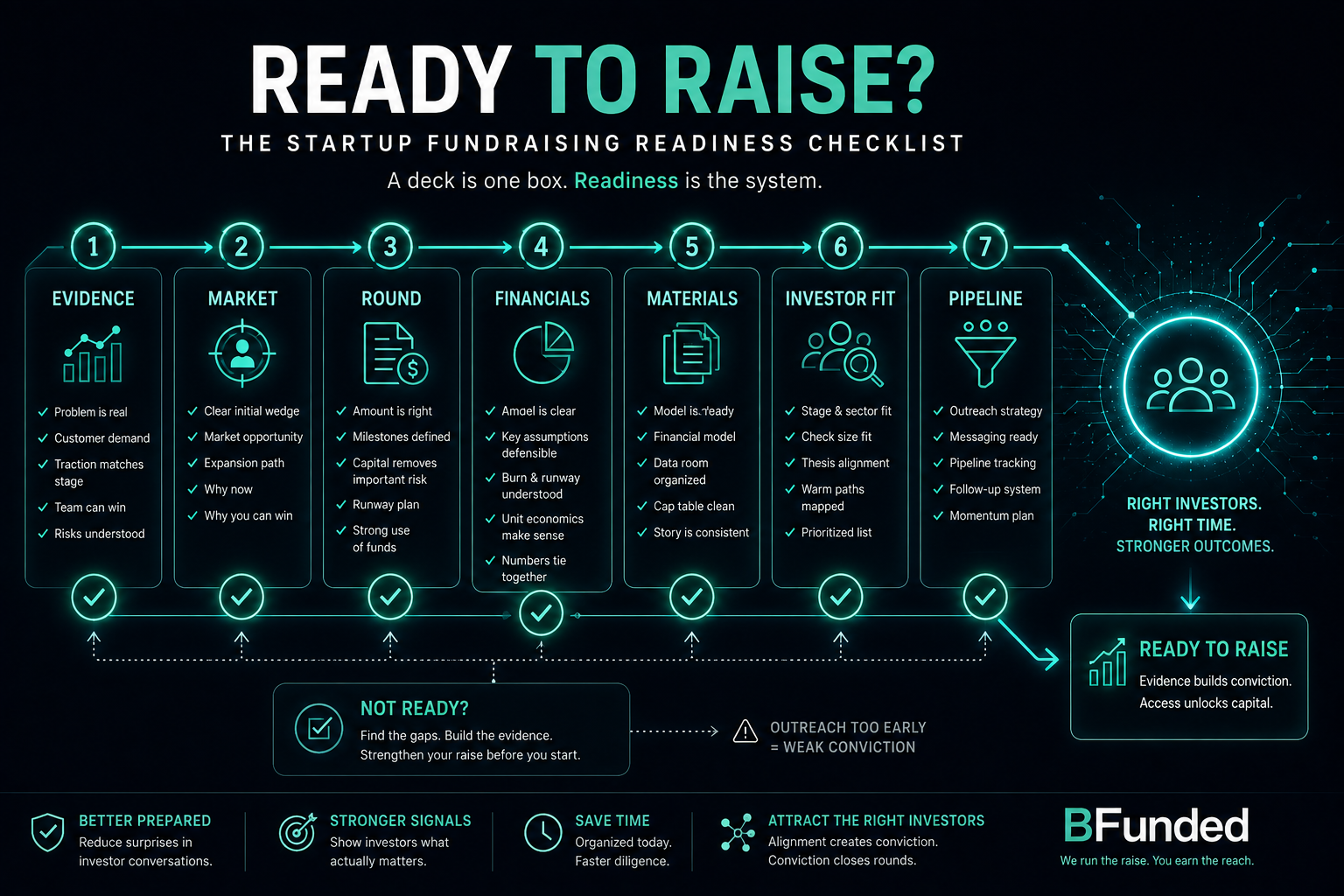
Startup Fundraising Readiness Checklist: Are You Actually Ready to Raise?
Use this startup fundraising readiness checklist to assess your evidence, pitch, financials, data room, investor strategy and fundraising process before outreach begins.
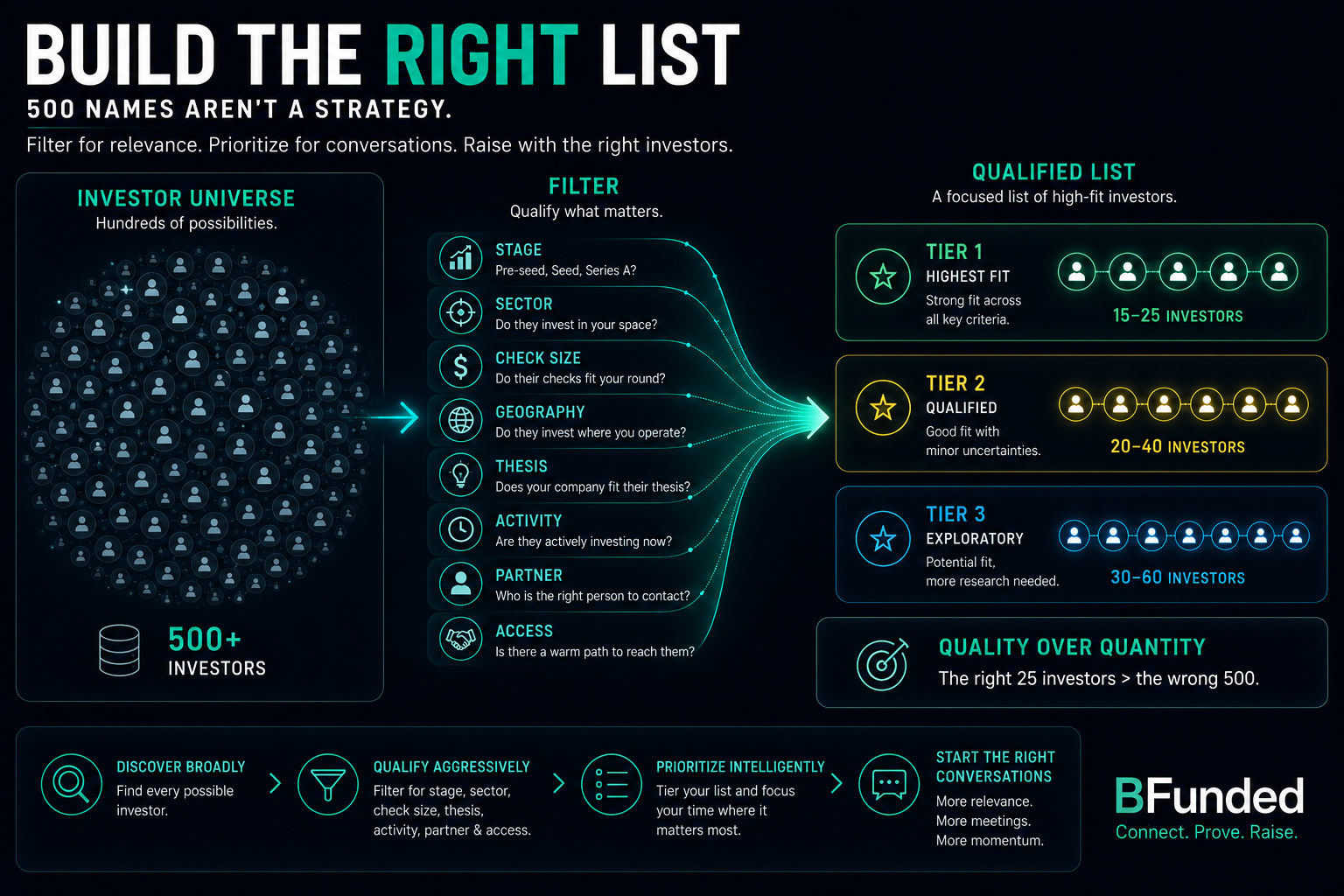
How to Build an Investor List That Actually Matches Your Raise
Learn how to build a startup investor list by filtering investors for stage, sector, check size, geography, thesis, activity, partner fit, and warm access.
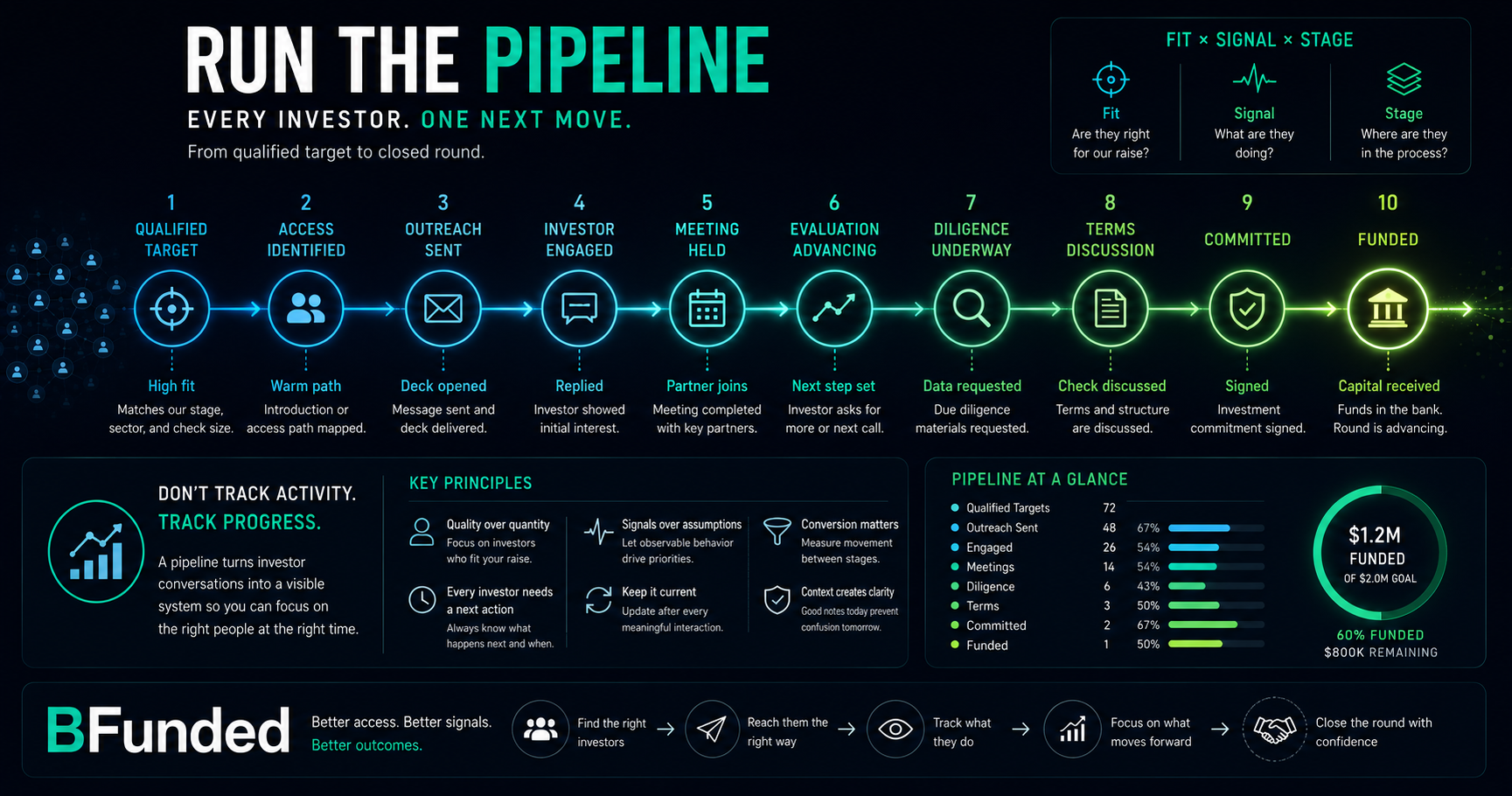
The Startup Fundraising Pipeline: From Investor Target to Closed Round
Learn how to build a startup fundraising pipeline that tracks qualified investors from outreach and meetings through diligence, terms, commitment, and funded capital.