Startup Fundraising Readiness Checklist: Are You Actually Ready to Raise?
Use this startup fundraising readiness checklist to assess your evidence, pitch, financials, data room, investor strategy and fundraising process before outreach begins.
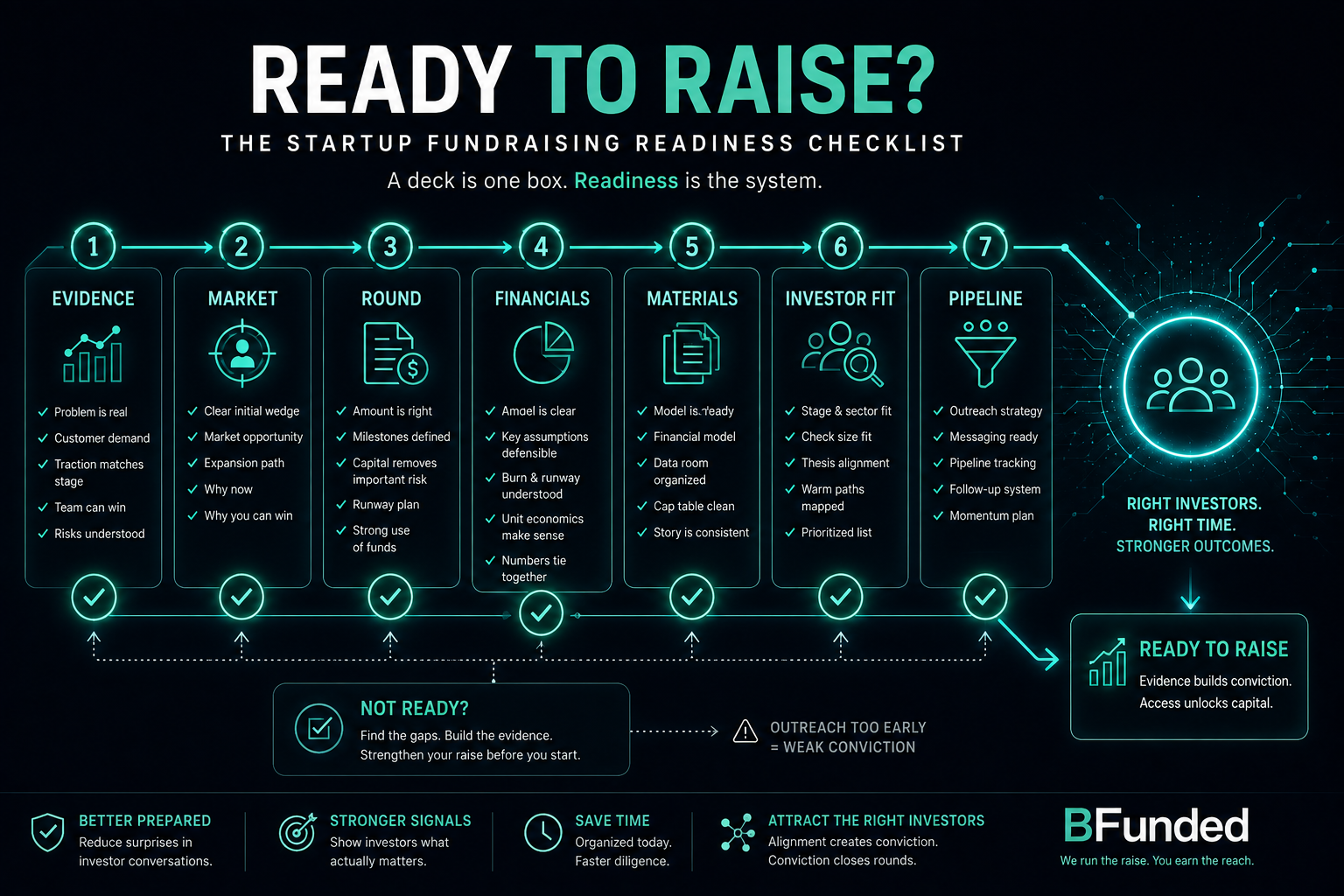
A pitch deck does not make a startup ready to raise.
Neither does an investor spreadsheet, a data room, or a founder deciding that the company needs money.
Fundraising readiness means the investment case, the company evidence, the materials and the fundraising process are all strong enough to withstand investor scrutiny.
That is an important distinction.
Many founders prepare the administration of a raise before they have prepared the substance behind it. They organise files, polish slides and start booking investor meetings — only to discover during those meetings that the market thesis is unclear, the traction does not support the stage, the round lacks a meaningful milestone or the wrong investors are being approached.
Current fundraising-readiness guidance increasingly makes the same point: readiness should be assessed before active outreach and should test both the investment case and the operational infrastructure behind the raise.
Use this checklist to find those gaps before the market finds them for you.
The Two Layers of Fundraising Readiness
Before going through the checklist, separate readiness into two layers.
Layer 1 — Is the Company Ready to Be Evaluated?
This is the underlying investment case.
Questions include:
Is the problem worth solving?
Is there credible evidence of demand?
Is the team suited to execute?
Does the market support a venture-scale outcome?
Is the business making meaningful progress?
Does the round remove an important risk?
This is closely connected to startup fundability.
Layer 2 — Are You Ready to Run the Raise?
This is the fundraising infrastructure.
Questions include:
Is the story clear?
Is the deck ready?
Are the financials understandable?
Is the cap table clean?
Is the data room prepared?
Do you know which investors fit?
Can you manage outreach and follow-up?
Are you ready for diligence?
A founder can pass one layer and fail the other.
A strong company can run a poor raise.
A highly organised founder can also run a polished process around a company that has not yet proved enough.
You want both.
If you have not already read it, BFunded's guide to startup fundability explains the first layer in more depth.
1. Can You Explain the Company Clearly?
Before investors inspect metrics, they need to understand what the company actually does.
A founder should be able to explain:
the problem
who experiences it
the solution
why the problem matters now
why this team is positioned to solve it
what makes the company worth becoming large
Try explaining the company in one or two sentences without listing product features.
If someone still needs five minutes of context before they understand the business, the fundraising narrative probably needs work.
This is not merely a copywriting problem.
Confusing positioning can reveal a deeper issue: the customer, problem or wedge may not be defined sharply enough yet.
Recent founder-readiness guidance similarly treats strategic clarity as one of the first conditions to test before raising.
Readiness Check
✅We can explain what we do in one or two sentences.
✅The target customer is specific.
✅The problem is easy to understand.
✅We can explain why the problem matters now.
✅We can explain why our team has a reason to win.
2. Does Your Evidence Match Your Stage?
Founders often compare themselves with startups that are much further along.
That creates bad fundraising expectations.
A pre-product founder may not have revenue.
A post-launch startup with meaningful usage should usually have more evidence than a prototype and a vision.
The important question is:
Does the proof you have make sense for the stage you are claiming?
Examples:
Pre-Product
Relevant evidence may include:
founder-market fit
customer discovery
technical credibility
prototype
design partners
unusually strong industry insight
Early Product
Evidence may begin shifting toward:
active users
pilots
initial payments
repeat usage
early retention
customer feedback
Seed / Post-Launch
Investors may expect more evidence around:
revenue
retention
growth
sales conversion
repeatability
economics
customer references
A current 2026 readiness guide from Bulletpitch makes a similar point: fundraising readiness depends less on one perfect milestone than on whether the available proof is appropriate to the company's stage.
Readiness Check
✅We know what evidence investors commonly expect at our stage.
✅Our strongest metrics reflect actual customer behaviour.
✅We can explain what our current traction proves.
✅We can explain what it does not prove.
✅Our fundraising story does not depend mainly on vanity metrics.
3. Is the Market Story Credible?
Investors need to understand both:
where the company starts
and:
how large it could eventually become.
A large TAM number alone does not establish either.
Your readiness test should include:
a specific initial customer
the size or importance of that wedge
why that customer needs the solution
why you can win there
how the opportunity expands over time
The best market narratives combine focus with ambition.
Too narrow, and the outcome may not justify venture investment.
Too broad, and the strategy may sound theoretical.
Readiness Check
✅We know exactly who we are targeting first.
✅We can defend the size of that initial opportunity.
✅We have a logical expansion path.
✅Our market sizing assumptions can be explained.
✅We are not relying on a huge top-down TAM slide alone.
4. Does the Round Have a Clear Purpose?
One of the most important readiness questions is also one of the simplest:
Why are you raising this amount now?
“Growth” is not enough.
Neither is:
“We need runway.”
The round should buy meaningful progress.
For example:
complete a technical milestone
convert pilots into recurring customers
reach a defined revenue threshold
validate a second acquisition channel
obtain regulatory approval
launch production
build a critical team capability
expand into a specific geography
Fundraising-readiness frameworks from Mercia Ventures and other current founder resources explicitly put strategic clarity and the milestone unlocked by capital near the beginning of the process.
A strong founder should be able to say:
We are raising X to achieve Y, which should remove Z risk before the next financing decision.
Readiness Check
✅We know exactly how much we are raising.
✅We know why that amount is appropriate.
✅The capital is tied to specific milestones.
✅We have a realistic runway plan.
✅We know what stronger evidence should exist when this capital is spent.
5. Are Your Financials Investor-Ready?
Investors do not expect early-stage projections to predict the future perfectly.
They do expect founders to understand the economics of the company.
Depending on your stage, you should be able to explain:
revenue
burn
runway
cash position
pricing
gross margin
customer acquisition costs
major operating costs
hiring assumptions
key financial risks
the logic behind the forecast
The goal is not precision theatre.
A model that predicts revenue to the exact dollar five years from now is not automatically credible.
What matters is whether the assumptions are understandable.
Readiness Check
✅Historical numbers reconcile with the financial model.
✅We know our current monthly burn.
✅We know our remaining runway.
✅Major model assumptions can be defended.
✅We can explain what changes if growth is slower than planned.
✅Use of funds matches the financial model.
6. Is Your Cap Table Clean and Understandable?
Fundraising can expose ownership problems very quickly.
Before outreach begins, make sure you understand:
founder ownership
existing shareholders
option pool
SAFEs or convertible instruments
previous financing
outstanding promises or side agreements
vesting arrangements
anything that could affect future dilution
A messy cap table does not always make a company unfundable.
But surprises during diligence can damage confidence and slow a round.
Current US-focused fundraising-readiness guidance also treats cap-table and corporate cleanliness as core diligence issues rather than paperwork to leave until the end.
Readiness Check
✅The cap table is current.
✅All issued securities are documented.
✅Founder equity is clear.
✅SAFEs / notes / options are correctly recorded.
✅There are no undocumented equity promises.
✅We understand dilution under the proposed round.
7. Is the Pitch Deck Ready?
Now we get to the pitch deck.
Not first.
A strong deck should make the investment case easier to evaluate.
It should normally make it easy for an investor to understand:
problem
solution
market
product
business model
traction
team
competition / advantage
go-to-market
round
use of funds
The deck should reflect the strongest available evidence.
Do not hide weak metrics behind design.
Do not overload slides to compensate for an unclear story.
And do not mistake a beautiful presentation for fundability.
Readiness Check
✅The investment case is understandable without narration.
✅The strongest evidence appears early enough.
✅Claims have supporting evidence.
✅The round and use of funds are clear.
✅There are no contradictions between the deck, model and data room.
✅The deck can be forwarded without requiring extra explanation.
8. Is Your Data Room Ready for Diligence?
A data room does not need to contain every document the company has ever produced.
It should help an interested investor verify the important parts of the business efficiently.
Depending on your stage, this may include:
Corporate
incorporation documents
shareholder information
cap table
prior financing agreements
board documents where relevant
Financial
financial statements
model
bank / cash summaries where appropriate
historical performance
Commercial
customer contracts
pipeline summaries
key partnerships
revenue evidence
Product / IP
IP ownership documentation
patents where applicable
technical documentation where relevant
Team
employment agreements
option information
key team details
Fundraise
deck
terms
use of funds
round structure
A current fundraising-readiness checklist from Incubetr specifically recommends having a basic organised data room ready before the active outreach process becomes complex.
Readiness Check
✅Core corporate documents are organised.
✅Financial information is consistent with the deck.
✅Customer evidence is accessible.
✅IP ownership is documented where relevant.
✅Sensitive material has appropriate access controls.
✅Files are named and structured so another person can understand them.
9. Do You Know Which Investors Actually Fit?
An investor list is not automatically an investor strategy.
Before you start outreach, every priority investor should have a reason to be there.
Evaluate:
stage
sector
cheque size
geography
portfolio
thesis
current investing activity
conflicts
relationship paths
A readiness checklist that ignores investor fit is incomplete.
Ugly Baby's current 2026 guide makes this same distinction: a fundraise can be operationally prepared while still having a poor target list if the stage, proof and investor type do not align.
Readiness Check
✅Investors match our stage.
✅Their typical cheque size fits the round.
✅Their thesis fits the company.
✅We know why each priority investor belongs on the list.
✅We have identified warm paths where possible.
✅Investors are prioritised instead of treated as one giant database.
Later, this will link directly to our upcoming Investor Fit guide.
10. Is Your Outreach Strategy Ready?
Do not start the fundraise by sending random emails one at a time.
You need a process.
Decide:
outreach sequence
who goes first
warm vs cold paths
messaging
batching
meeting availability
follow-up cadence
how activity will be tracked
Fundraising momentum matters because investor conversations influence each other indirectly.
A founder taking meetings over three concentrated weeks creates a different process from one taking sporadic calls over six months.
Current fundraising guides increasingly frame the raise as a structured operating process rather than a collection of individual pitches.
Readiness Check
✅Investors are prioritized.
✅Outreach messaging is prepared.
✅Warm intro requests are forwardable.
✅Outreach will happen in coordinated batches.
✅Every interaction has a clear owner.
✅No conversation relies on memory alone.
11. Can You Track the Fundraising Pipeline?
Once ten, twenty or fifty investor conversations begin, the raise becomes operational.
You need to know:
contacted
opened / viewed where trackable
replied
meeting booked
meeting completed
follow-up required
diligence
passed
committed
closed
This is one reason fundraising can become a second operating function for founders.
Investor-readiness guides increasingly recommend having an outreach tracker before the process becomes difficult to manage.
Readiness Check
✅Every investor interaction is recorded.
✅Pipeline stages are defined.
✅Follow-ups have dates.
✅Notes are captured after meetings.
✅The team can see current pipeline status.
✅Investor signals do not disappear inside inboxes.
12. Are You Ready for Investor Questions?
Founders often practise the pitch.
They should also practise the interrogation that follows.
Be ready to discuss:
customer acquisition
churn / retention
competition
pricing
market size
technical risk
regulatory risk
hiring
economics
founder ownership
failed experiments
major assumptions
why now
why this round
why you
Investors are not necessarily trying to catch you out.
They are trying to understand risk.
Do not invent an answer because silence feels uncomfortable.
A strong response can be:
“We don't know yet. Here is what we know, and here is the test we're running next.”
That often demonstrates better judgment than false certainty.
13. Are You Personally Ready to Fundraise?
There is one final readiness category founders often ignore.
The founder.
A raise can consume substantial attention.
You may have dozens of conversations, repeated rejection, unanswered emails, diligence requests and constant context switching.
Before launching, ask:
Who runs the company while I raise?
Which responsibilities need to be delegated?
How much founder time can the business actually afford to lose?
Are internal decision-makers aligned on terms?
What happens if the raise takes twice as long as expected?
What is the walk-away point?
Your startup should not collapse because its founder started fundraising.
That is one reason BFunded's current positioning emphasises running more of the fundraising infrastructure around the founder: “We Run the Raise, You Earn the Reach.”
The BFunded Fundraising Readiness Checklist
Before active investor outreach, a founder should ideally be able to check most of these boxes.
Investment Case
✅Problem is clear and important.
✅Customer is specific.
✅Founder / team advantage is credible.
✅Evidence matches company stage.
✅Market entry point is clear.
✅Expansion opportunity is credible.
Round
✅Raise amount is defined.
✅Use of funds is specific.
✅Capital unlocks measurable milestones.
✅Runway is planned.
✅Financing structure is understood.
Company
✅Financials are organised.
✅Cap table is current.
✅Key corporate documents are available.
✅IP ownership is clear where relevant.
✅Major risks are understood.
Fundraising Materials
✅Pitch deck is ready.
✅Financial model is consistent.
✅Data room is organised.
✅Investor FAQ / objection answers are prepared.
✅Materials tell the same story.
Investor Strategy
✅Investor list is filtered by fit.
✅Priority investors are ranked.
✅Warm paths are mapped.
✅Outreach messaging is ready.
✅Pipeline tracking is in place.
Founder Readiness
✅Team can operate while fundraising happens.
✅Founder time has been planned.
✅Decision-makers agree on the round.
✅There is a plan if fundraising takes longer than expected.
Are You Ready to Raise?
You do not need every box to be perfect.
Early-stage startups are unfinished by definition.
The purpose of a fundraising readiness checklist is not to create the illusion that risk has disappeared.
It is to reveal the gaps before investors reveal them for you.
If three missing boxes are administrative, fix them.
If the missing boxes are all evidence-related, the better decision may be to spend another 60 or 90 days strengthening the company before running outreach harder.
That difference matters.
A weak process can hide a strong company.
A polished process can also hide a weak investment case — temporarily.
The best founders know which problem they are dealing with.
How BFunded Approaches Readiness
BFunded's current model does not begin by opening its full investor network to every company with a deck.
Access is progressive.
Founders begin with a deck and website, move through BFunded's evaluation process, and unlock progressively larger groups of matched investors as additional evidence is demonstrated. BFunded currently describes five tests, from initial company materials through AI-assisted diligence, investor calls and initial closes.
The principle behind the system is simple:
capital should follow evidence.
That means readiness is not treated as:
“Do you have a pitch deck?”
It is closer to:
“What have you proved, what remains uncertain and which investors make sense given where the company is today?”
BFunded's About page describes this broader philosophy as evaluating founders rather than relying on the deck as the primary predictor of the raise.
Frequently Asked Questions
When should a startup start preparing to raise?
Preparation should begin before active outreach. Many readiness tasks — evidence gathering, financial organisation, cap-table cleanup and investor research — are easier to fix before meetings begin. Several current readiness guides recommend beginning the process months rather than days before fundraising becomes urgent.
What do I need before contacting investors?
At minimum, founders should have a clear investment case, pitch deck, defined round, understandable financials, basic diligence materials and a targeted investor list. The exact requirements depend on stage.
Do I need a full data room before the first investor call?
Not necessarily a late-stage diligence room, but having the core documents organised before outreach prevents delays once serious interest develops.
How do I know if my startup is fundable?
Fundability depends on the evidence available relative to your stage and the risks investors are being asked to take. Our Startup Fundability guide explains this in more detail.
Should I raise if I only have a few months of runway left?
That depends on the company and available alternatives, but fundraising from a position of urgency can reduce flexibility. Ideally, founders begin preparing before cash pressure forces the timing.
How many investors should be on my list before outreach?
There is no universal number. A smaller list of relevant investors can be more useful than a large list with poor stage, thesis or cheque-size fit.
What is the biggest fundraising-readiness mistake?
Treating fundraising readiness as an administrative checklist only. A complete readiness assessment must test the underlying investment case as well as the materials and process.
The Bottom Line
Do not ask only:
Is the deck ready?
Ask:
Is the company ready to be judged?
Then ask:
Are we ready to run the process?
Strong fundraising readiness requires both.
Because once outreach begins, investors are not only evaluating what you say.
They are evaluating whether the evidence underneath it holds.
Keep reading
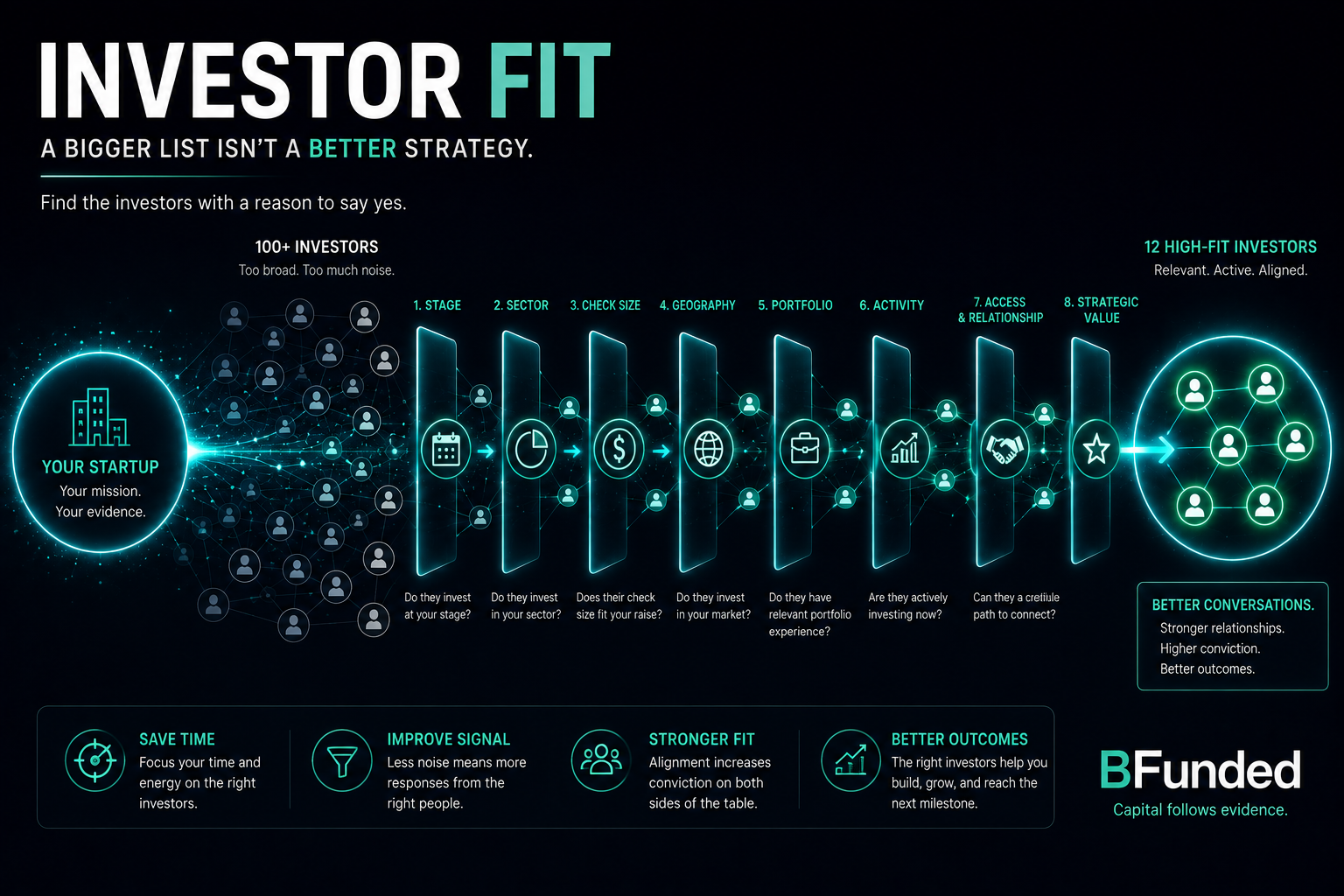
Investor Fit: How to Know Whether an Investor Actually Fits Your Startup
Investor fit goes beyond finding names. Learn how to evaluate startup investors by stage, sector, check size, thesis, portfolio, activity, access and long-term value.
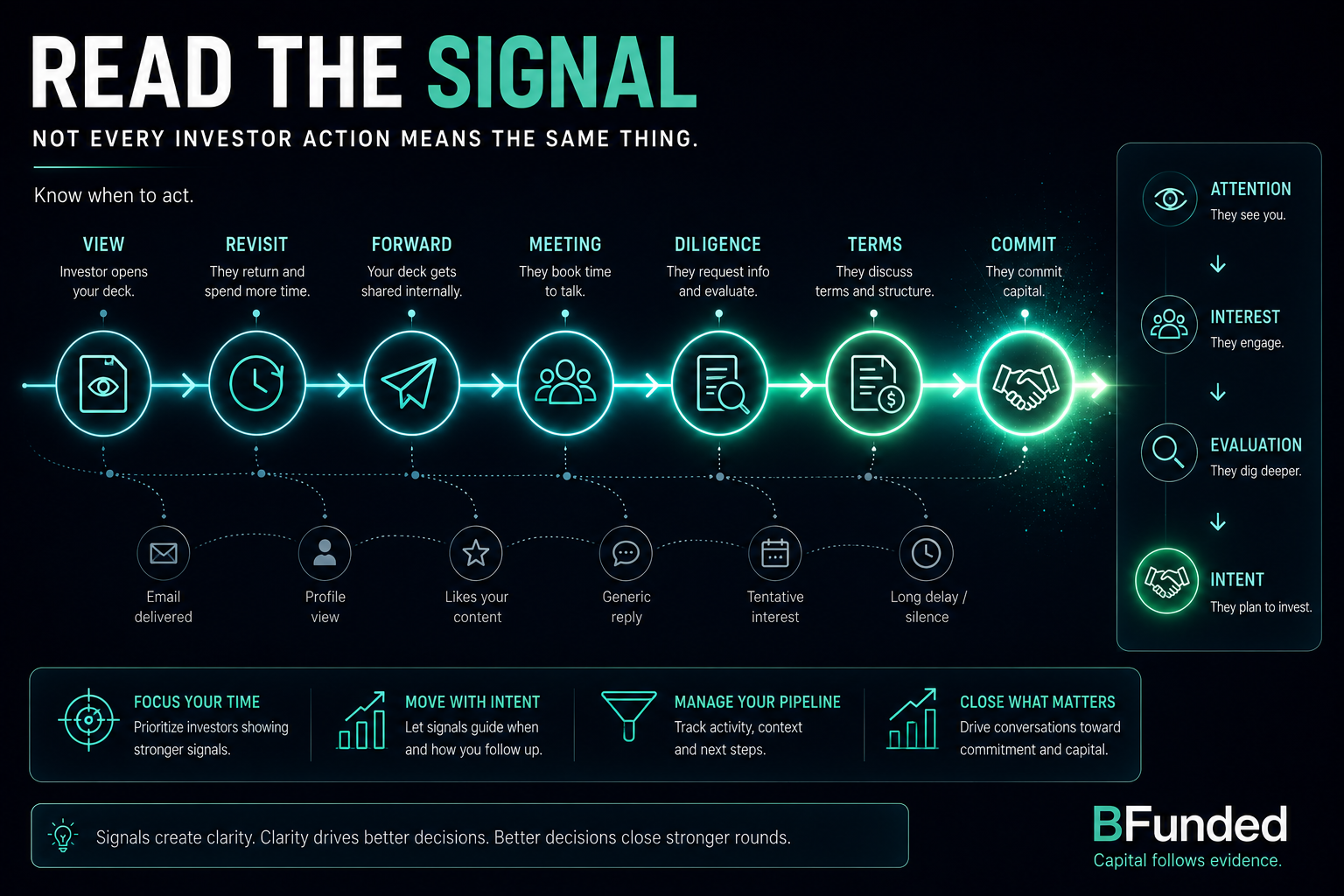
Investor Signals: How to Know When an Investor Is Actually Interested
Learn how to read investor signals during a startup raise, from pitch deck views and repeat engagement to meetings, diligence, terms, and actual commitments.
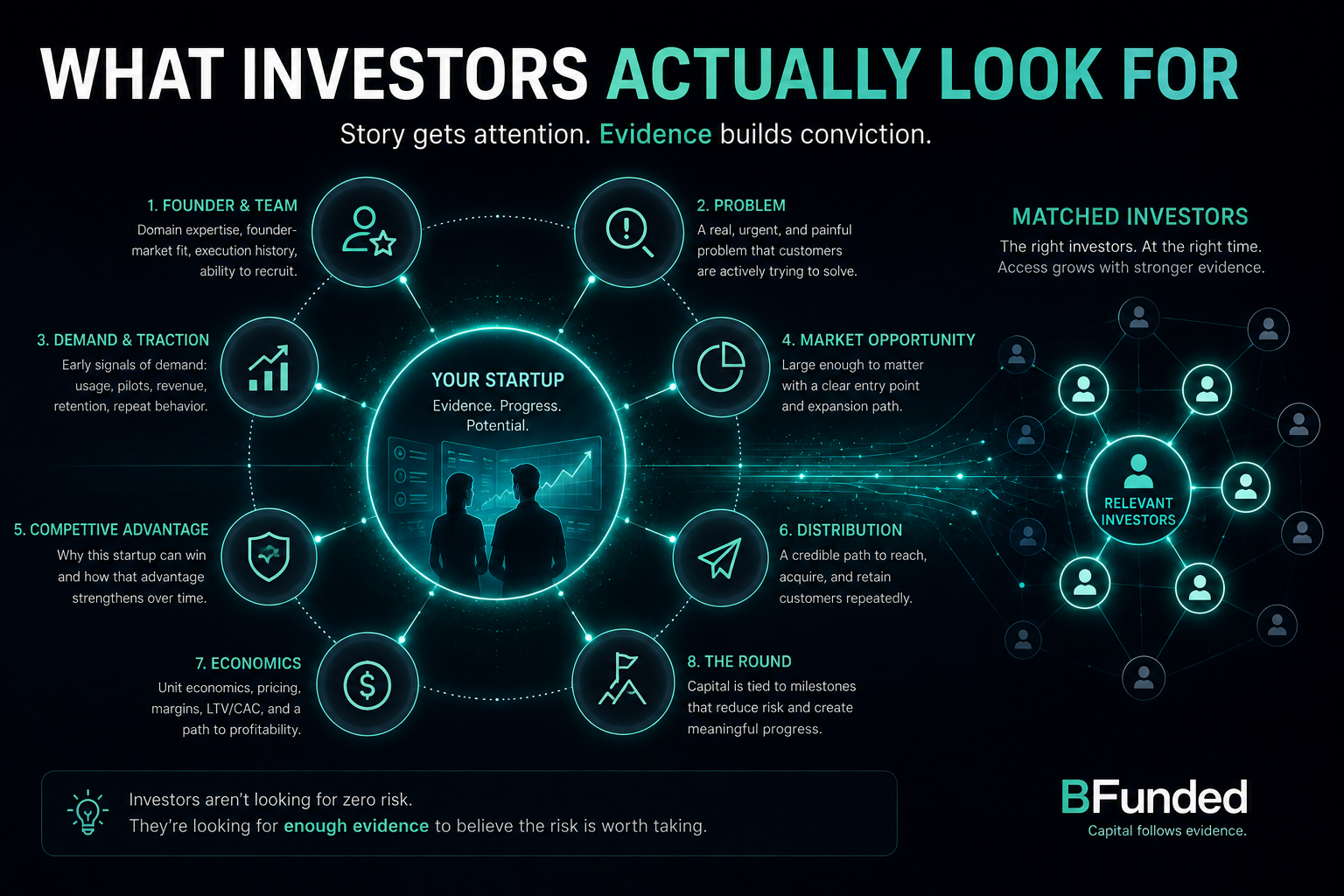
What Do Investors Look for in a Startup Before They Invest?
Investors don't expect startups to be risk-free. Learn the founder, market, traction, distribution and financial signals they evaluate before deciding to invest.