What Do Investors Look for in a Startup Before They Invest?
Investors don't expect startups to be risk-free. Learn the founder, market, traction, distribution and financial signals they evaluate before deciding to invest.
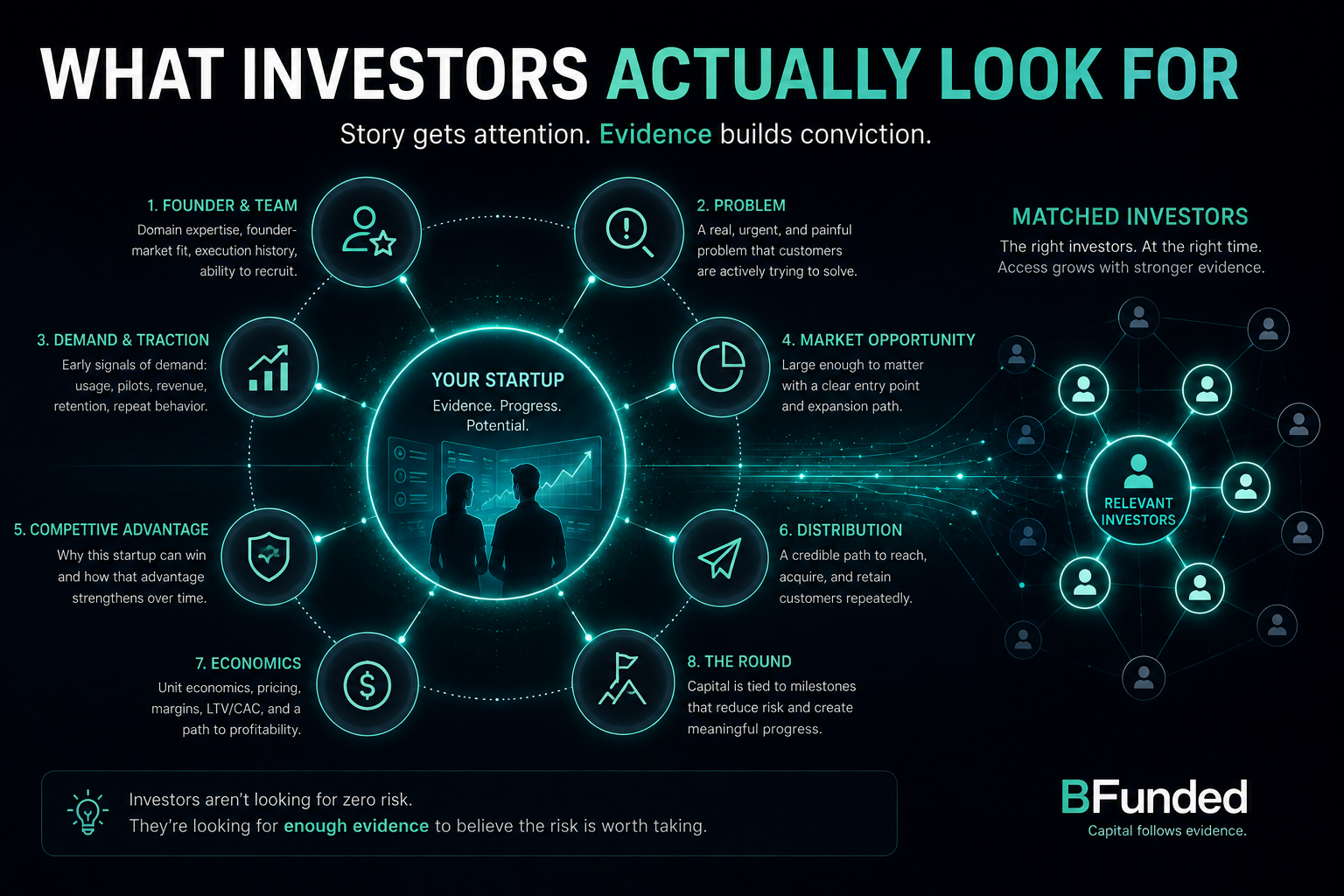
Investors are not looking for a startup with no risk.
They are looking for a startup where the remaining risk is understandable, the upside is meaningful, and the founder has enough evidence to justify taking the next step.
That distinction matters.
At the earliest stages, there may be little revenue, limited operating history and an unfinished product. Investors therefore have to make decisions using incomplete information.
They look for signals.
Does the founder understand the problem unusually well? Are customers behaving in a way that validates the thesis? Is the market large enough? Can the company reach customers repeatedly? Does this round create meaningful progress?
Different investors weigh those questions differently, but the underlying objective is similar:
Understand what the startup has already proved — and decide whether the remaining uncertainty is worth underwriting.
1. Is the Problem Real Enough to Matter?
Before evaluating the solution, an investor needs to believe the problem deserves solving.
That means more than demonstrating that a problem exists.
Investors want to understand:
who experiences it
how frequently it occurs
how painful or expensive it is
what customers currently do instead
why the status quo is inadequate
why the problem matters now
A startup solving a mild inconvenience has a different investment case from one eliminating a frequent, expensive or mission-critical problem.
The strongest evidence usually comes from behaviour.
Customers repeatedly using an inefficient workaround can be evidence.
Customers paying for an imperfect alternative can be evidence.
Buyers committing resources to pilots can be evidence.
A survey respondent saying an idea sounds useful is a signal too — but it carries less weight.
The question underneath all of this is simple:
Does the customer care enough to change behaviour?
Current investor guidance from Wefunder similarly frames early-stage evaluation around whether the problem is sufficiently real and whether customer behaviour supports the founder's claim.
2. Why Is This Founder or Team Positioned to Win?
At an early stage, there may be more evidence about the founder than the company.
That makes the team particularly important.
But investors are not simply looking for impressive CVs.
They are looking for evidence that this particular team has an advantage in solving this particular problem.
That might come from:
deep industry experience
technical expertise
firsthand experience of the problem
unusual customer insight
previous execution
relationships within the market
distribution access
speed of learning
ability to recruit strong people
a history of delivering under difficult conditions
This is often described as founder-market fit.
The strongest founder-market fit is usually specific.
A founder who spent ten years operating inside the industry may understand problems outsiders never see.
A technical founder may have solved part of the problem before.
A founder who previously sold to the same buyer may understand the procurement process, objections and trust requirements better than someone entering the market for the first time.
Investors also observe how founders deal with uncertainty.
Can they clearly distinguish what they know from what they believe?
Can they explain what failed?
Did the team change its approach when the evidence changed?
Early-stage investing requires trusting the founders to make hundreds of decisions that cannot be predicted during the first meeting.
That is one reason BFunded places so much emphasis on founder evidence rather than treating the pitch deck itself as the primary signal.
3. Is There Evidence That Customers Actually Want It?
A startup can have a convincing story without having convincing demand.
Investors therefore look for evidence from the market.
What qualifies as meaningful traction depends heavily on the business model and stage.
For a SaaS startup, useful evidence might include:
paid pilots
recurring revenue
customer retention
conversion
account expansion
shortening sales cycles
For a consumer product:
activation
repeat usage
cohort retention
referrals
purchase frequency
For a marketplace:
repeat activity on both sides
successful transactions
liquidity
fill rate
improving unit economics
For deep technology or regulated businesses:
technical milestones
independent validation
commercial pilots
regulatory progress
strategic customer commitments
The metric matters less than what it proves.
A waiting list can show curiosity.
Repeat usage can show value.
A letter of intent can show interest.
A paid contract demonstrates something stronger.
Ten thousand downloads may look impressive, but if almost nobody returns after a week, an investor may conclude that acquisition is working while the product is not yet retaining value.
Activity is not automatically traction.
Traction becomes meaningful when it reduces uncertainty about whether customers actually want the product.
4. Is the Market Large Enough — and Is There a Credible Way In?
Investors often care about market size because early-stage investing is built around asymmetric outcomes.
A successful company may need to become substantially larger than it is today.
But a huge total addressable market slide is not enough.
Investors need to understand two things:
How large could this become?
and:
Where does the company realistically start?
A credible market story connects the two.
For example:
A founder may begin by serving one narrow customer segment with a severe problem.
Winning that group creates data, credibility, distribution or product capabilities that make adjacent markets accessible.
That is often more believable than claiming the startup will immediately target an entire global industry.
Investors may ask:
Who is the first ideal customer?
How many of them exist?
Why does this segment need the product now?
What advantage allows the startup to win there?
What adjacent customers become available after that?
Why could the eventual outcome become large?
A strong investment case therefore needs both focus and scale.
The first market needs to be specific enough to attack.
The eventual market needs to be large enough to matter.
5. Is There a Genuine Competitive Advantage?
Investors know that a promising market attracts competition.
So another question follows quickly:
Why won't someone else win?
At the earliest stages, a startup may not yet have a traditional moat.
That is normal.
But investors still want to understand how an advantage might develop.
Possible sources include:
proprietary technology
proprietary data
network effects
customer switching costs
regulatory advantages
difficult distribution relationships
brand or community
superior economics
operational knowledge
speed of execution
access to customers competitors struggle to reach
“We are first” is rarely a durable advantage by itself.
Neither is:
“We have no competitors.”
If customers are already solving the problem somehow, there is competition — even if the alternative is a spreadsheet, manual labour or doing nothing.
A more useful founder response is:
Here is why we can win, and here is how that advantage becomes stronger as we grow.
6. Can the Startup Actually Reach Customers?
A great product does not automatically create a great company.
Customers still need to discover it, trust it and buy it.
That is why investors pay attention to distribution.
At an early stage, founders may not have a perfectly repeatable acquisition engine.
But investors will often look for signs that the team understands how the commercial motion works.
They may ask:
Where did the first customers come from?
Which acquisition channels have been tested?
Why did those customers convert?
Which channels failed?
How long does the sales process take?
Who makes the buying decision?
Can the process repeat without depending entirely on the founder?
What happens to acquisition cost as the company scales?
One successful campaign does not prove a distribution engine.
A handful of customers sourced through the founder's personal network may be useful early evidence, but investors will eventually want to understand what happens when that network is exhausted.
The founder does not need every answer.
They do need to demonstrate that distribution is being treated as a core business problem rather than something that will magically solve itself after funding.
7. Do the Economics Have a Path to Working?
Early-stage startups are rarely expected to be perfectly efficient.
Many should be investing aggressively rather than maximising short-term profitability.
But investors still need to understand the economic logic.
Depending on the company, that could include:
pricing
gross margin
contribution margin
customer acquisition cost
lifetime value
payback period
sales efficiency
manufacturing economics
servicing cost
burn
runway
The numbers do not need to be mature.
They need to be intellectually honest.
Investors generally prefer a founder who can say:
“We do not know this yet. Here is what we have measured, and here is how we will test it.”
over one who presents precise five-year projections built on assumptions that have never been validated.
Financial modelling is useful because it reveals how the founder thinks.
It should not be mistaken for evidence that the future will occur exactly as forecast.
8. What Will This Funding Round Actually Achieve?
Investors are not only evaluating the company.
They are evaluating the round.
The question is:
What does new capital allow this company to prove?
“Hiring and growth” is too vague.
A stronger use of funds might be:
completing a major technical milestone
converting five pilots into long-term contracts
reaching a specific level of recurring revenue
validating a second acquisition channel
hiring one critical executive
obtaining regulatory approval
reaching production
expanding into a clearly defined market
extending runway to a milestone that materially reduces risk
Capital should create progress.
Ideally, the company becomes meaningfully stronger before it needs to raise again.
One useful way to frame this is:
This round should buy evidence, not merely time.
9. Does the Deal Itself Make Sense?
A fundable company can still present an unattractive investment.
Investors also examine the structure of the round.
Depending on the situation, this can include:
valuation or valuation cap
security type
ownership implications
cap table
existing investors
liquidation preferences
previous financing
founder ownership
outstanding obligations
legal structure
disclosure quality
The objective is not necessarily to offer the cheapest possible deal.
Strong companies can justify strong terms.
But the structure should make sense relative to the company's stage, evidence and financing goals.
This becomes particularly important during due diligence.
Wefunder's current startup diligence framework describes team, problem, market, product, traction, financials, legal disclosures and deal terms as core areas investors may examine before investing.
What Counts as Strong Evidence?
Investors usually encounter many claims.
Evidence helps them decide how seriously each claim should be taken.
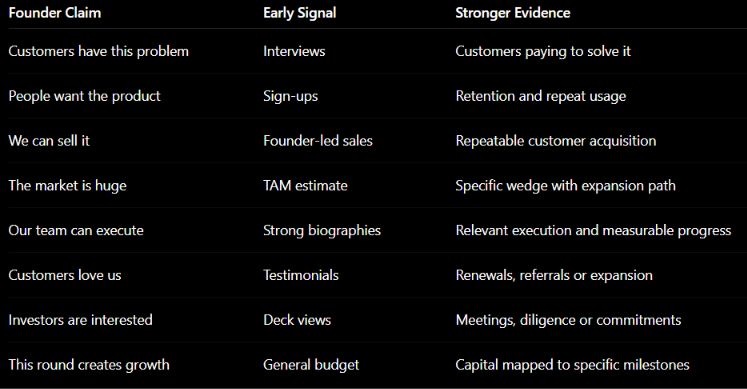
Not every company will have evidence in the strongest column yet.
That is expected.
The purpose of the framework is not to punish early-stage founders for being early.
It is to identify which uncertainty remains and what evidence should come next.
What Investors Look for Changes With Stage
The same startup would be evaluated differently at different points in its development.
Pre-Product
The biggest questions may be:
Does the team understand the problem?
Can they build the solution?
Why are they unusually suited to do it?
Is there meaningful customer pull?
Relevant evidence might include:
customer research, founder-market fit, prototypes, technical progress or design partners.
Early Product
The question begins to shift toward:
Does anyone actually want this?
Investors may look at:
usage, pilots, customer feedback, willingness to pay, early retention and conversion.
Post-Launch
Now there is more company behaviour to evaluate.
Questions may include:
Is demand repeatable?
Are customers staying?
Is revenue quality improving?
Is the sales process becoming clearer?
Are customers expanding?
Growth
At a later stage, the emphasis shifts again.
Investors may increasingly examine:
growth durability
margins
efficiency
expansion
acquisition predictability
organisational execution
A founder should therefore avoid asking:
“What traction number do investors want?”
without context.
A more useful question is:
What is the biggest remaining risk at our current stage, and what evidence would reduce it?
Why Investors Pass on Startups That Look Good on Paper
A startup can appear impressive and still fail to create conviction.
Common reasons include:
Lots of Attention, Little Retention
A viral launch can produce impressive sign-up numbers.
If users disappear quickly afterward, investors may question whether the company has created recurring value.
Huge Market, No Entry Point
A multi-billion-dollar market can be attractive.
But if the startup cannot explain who it will win first, the opportunity may still look theoretical.
Impressive Technology, Unclear Customer
Technical achievement alone does not automatically create a business.
Investors still need to understand who buys, why they buy and how the company reaches them.
Revenue Without Repeatability
Early revenue is positive.
But if every customer requires an entirely different product, pricing model or founder-led sales process, scaling may remain unresolved.
A Great Story With Thin Evidence
Good storytelling gets investors to pay attention.
It cannot indefinitely compensate for missing evidence.
This is where founders can confuse presentation quality with fundability.
A strong pitch deck makes evidence easier to understand.
It does not create evidence that does not exist.
If you have not read it yet, BFunded's guide to startup fundability explains this distinction in more depth.
What Investors Are Really Trying to Reduce
Most investor questions can ultimately be traced back to uncertainty.
They may be trying to understand:
Founder risk
Can this team execute?
Product risk
Does the solution work?
Demand risk
Will customers actually use or pay for it?
Market risk
Can this become large enough?
Distribution risk
Can customers be acquired repeatedly?
Economic risk
Can the business eventually support attractive economics?
Financing risk
Can this round get the company to a substantially stronger position?
The goal is not to eliminate every category.
That would be impossible at an early stage.
The goal is to demonstrate enough evidence that the unresolved risks become worth taking.
How BFunded Thinks About Investor Evaluation
BFunded was built around the idea that the founder and the evidence behind the company contain signals a pitch deck alone cannot capture.
Its current model assesses founders before progressively expanding their access to matched investors.
The objective is not to send every company to the largest possible investor list.
It is to identify stronger founder evidence first, then improve the quality of the match between the company and the investors who see it.
BFunded's current methodology progressively expands matched investor access as founders demonstrate additional evidence through its evaluation process.
This changes the question from:
How many investors can we reach?
to:
Which investors should see this company given what the founder has actually proved?
That distinction matters because investor fit still affects outcomes.
An excellent startup can be a poor opportunity for an investor whose stage, sector, geography, cheque size or investment thesis does not align.
Fundability gets the company ready to be evaluated.
Investor fit determines who should evaluate it.
Frequently Asked Questions
What is the most important thing investors look for in a startup?
There is no single universal factor. At the earliest stages, the founder and team can carry significant weight because there is less operating data. As the company matures, customer behaviour, traction, distribution, economics and execution become increasingly important.
Do investors care more about the founder or the idea?
At a very early stage, founders may matter more because products and strategies often change. However, a strong founder cannot make an unattractive market automatically investable. Investors usually evaluate founder quality alongside the problem, market and evidence available.
Do you need revenue before approaching investors?
No. Many pre-seed and seed companies raise before significant revenue. They still need relevant evidence, which might include technical progress, customer validation, product usage, pilots or other signals appropriate to the company's stage.
What traction do investors want to see?
There is no universal traction threshold. The best evidence is usually the evidence that reduces the biggest unresolved risk in the company at its current stage.
Do investors care about pitch deck design?
Clear presentation matters because investors need to understand the opportunity quickly. But design is secondary to the quality of the underlying business and evidence. A polished deck cannot create missing traction, demand or founder-market fit.
Why would an investor pass on a startup with good traction?
The investor may see concerns elsewhere, such as market size, economics, team, valuation, distribution or deal structure. The company may also simply fall outside that investor's mandate.
What does due diligence involve?
Due diligence can include reviewing the team, product, market, traction, financials, cap table, legal structure, disclosures and deal terms. The depth varies depending on the investor, company and size of the investment.
How can founders become more attractive to investors?
Identify the most important unresolved risk and create evidence that reduces it. That could mean improving retention, securing customers, validating technical feasibility, building a stronger team, clarifying distribution or creating a more meaningful financing plan.
The Bottom Line
Investors do not need a startup to look perfect.
They need to understand why this founder, why this problem, why now, what has already been proved and what new capital can unlock next.
A compelling story gets attention.
Evidence creates conviction.
And the strongest founders know the difference.
Keep reading
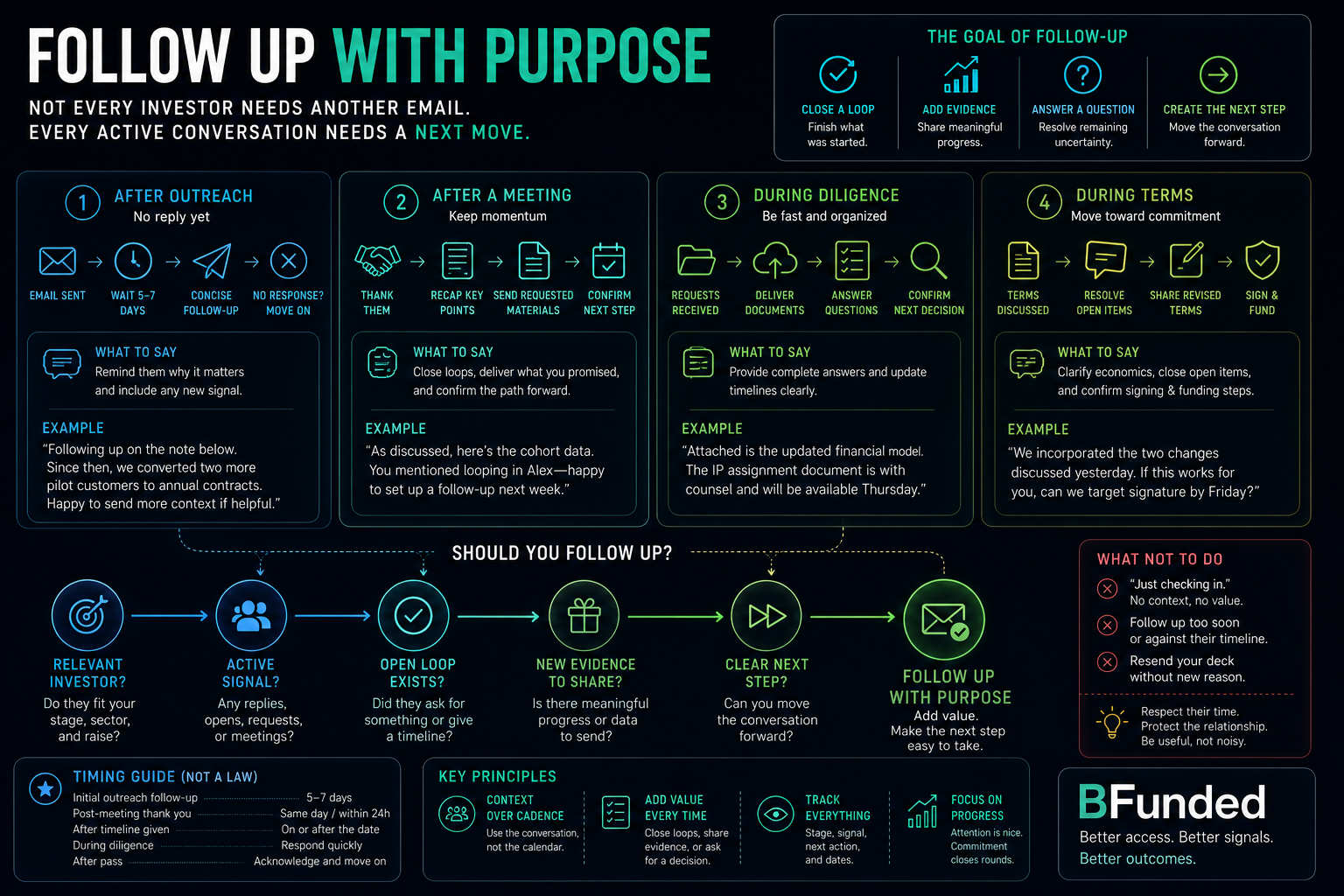
How to Follow Up With Investors Without Chasing Them Blind
Learn how to follow up with investors after outreach, meetings, diligence, and term discussions using context, investor signals, and clear next actions.
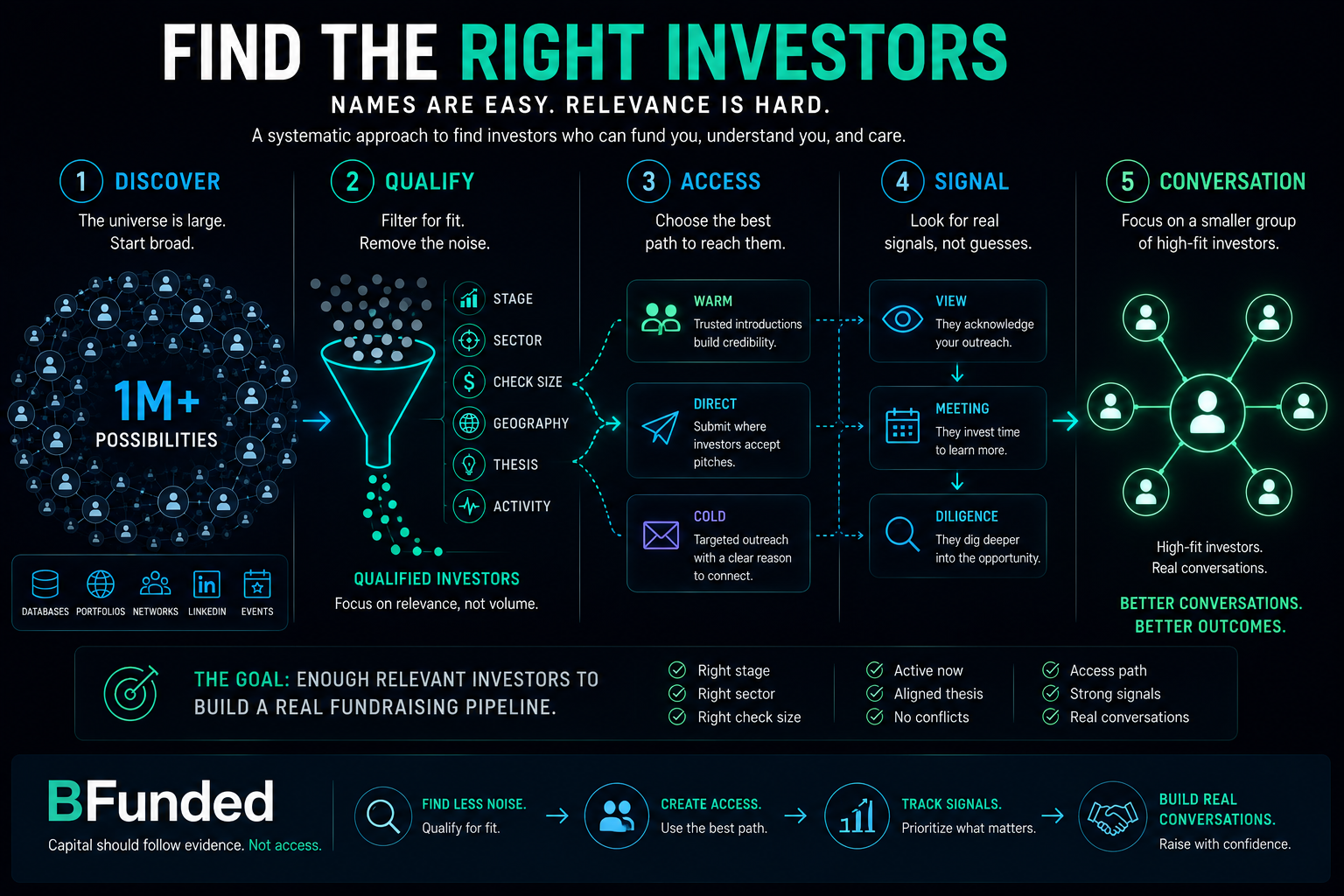
How to Find Investors for Your Startup Without Wasting Months on the Wrong Ones
Learn how to find investors for your startup by qualifying stage, sector, check size, activity, investor fit, access paths, and fundraising signals before outreach.
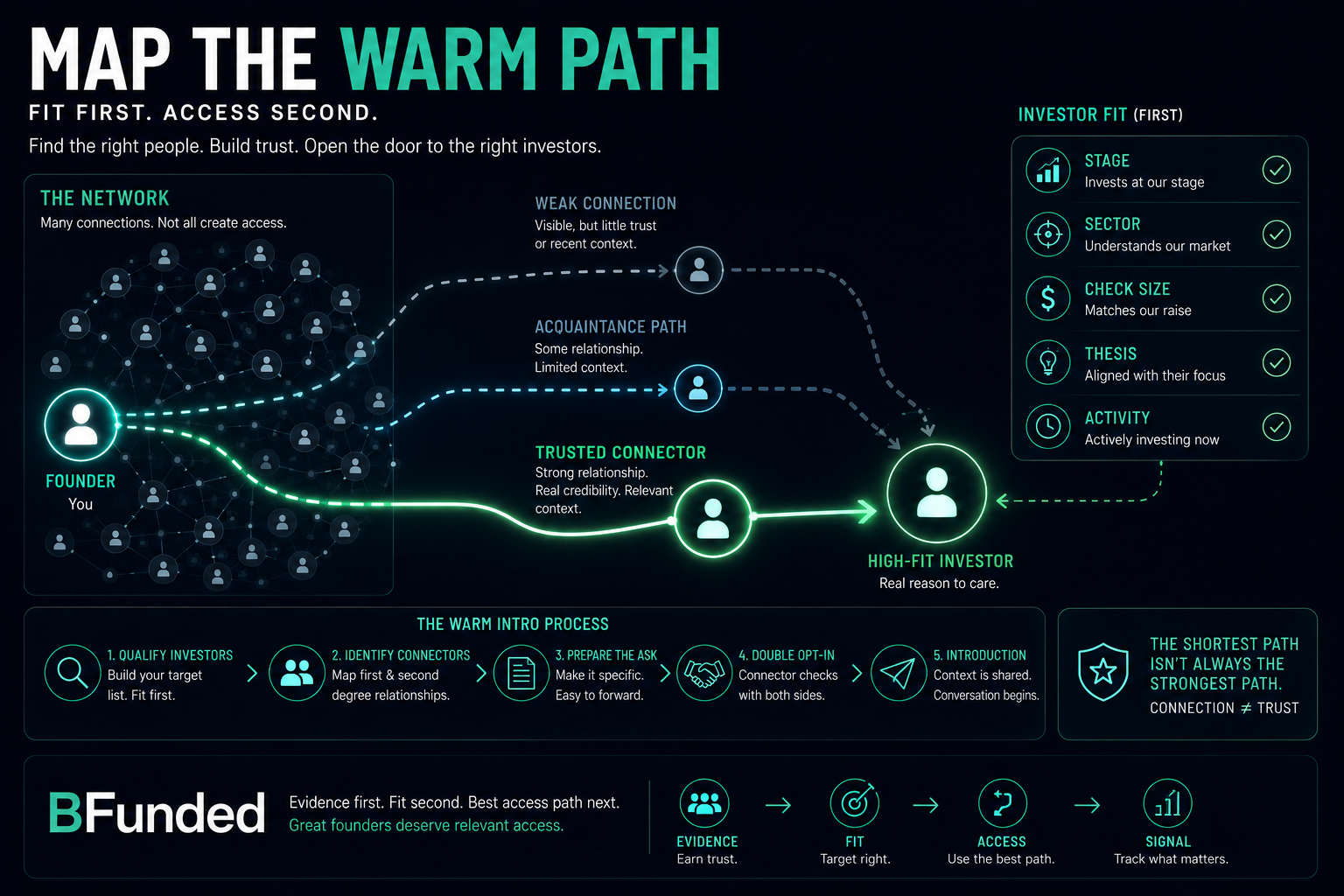
How to Find Warm Paths to the Right Startup Investors
Learn how to find warm paths to startup investors by qualifying investor fit first, mapping trusted connectors, creating forwardable intro requests, and tracking introductions through the raise.