The Startup Fundraising Pipeline: From Investor Target to Closed Round
Learn how to build a startup fundraising pipeline that tracks qualified investors from outreach and meetings through diligence, terms, commitment, and funded capital.
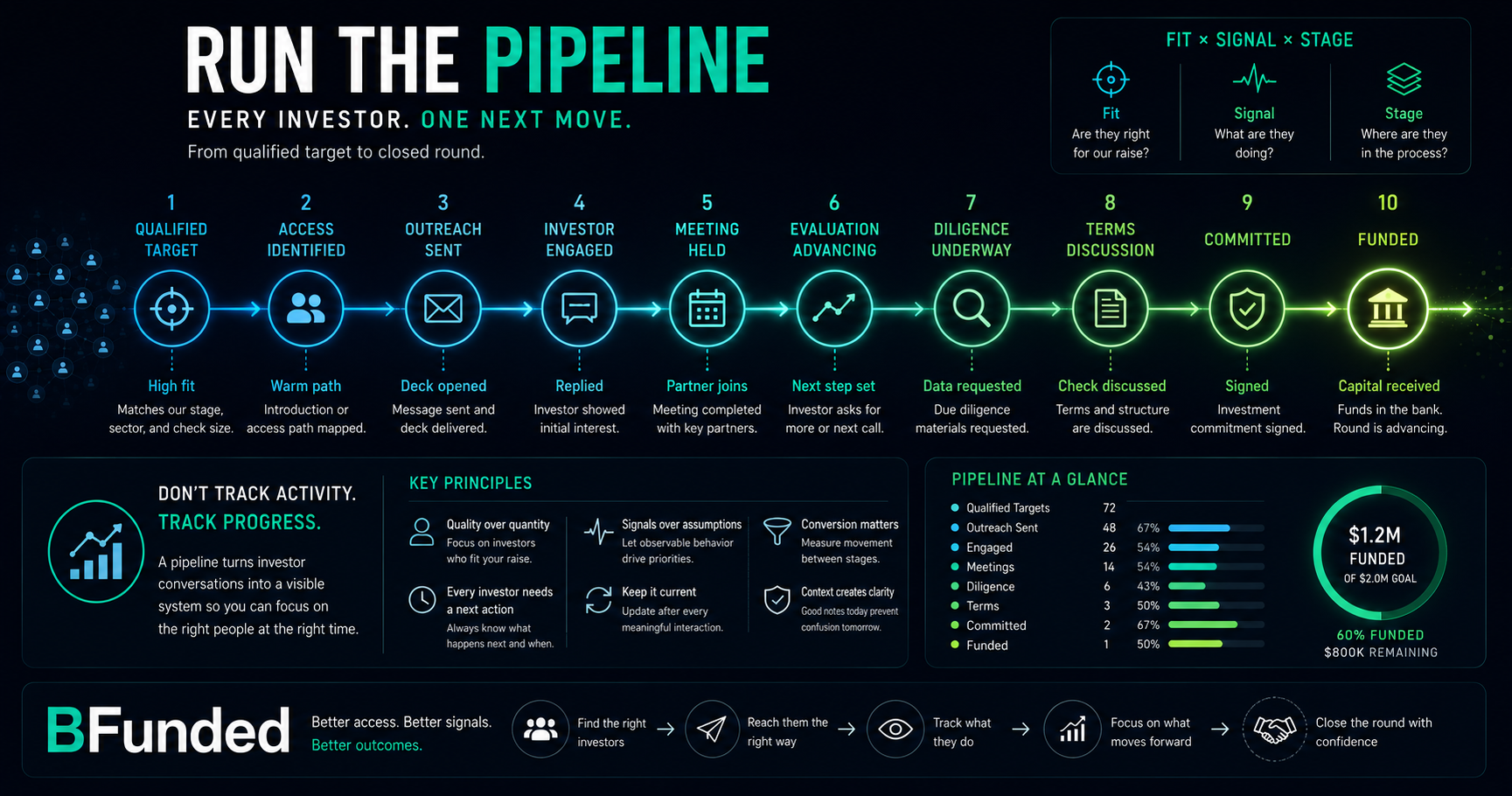
Fundraising gets difficult when every investor conversation lives somewhere different.
One introduction is in WhatsApp.
Three follow-ups are buried in email.
Someone viewed the deck twice.
Another investor asked for financials.
A partner meeting is next Thursday.
One investor said they were “very interested” three weeks ago.
Another has started diligence.
Without a system, all of that activity begins to look like progress.
A startup fundraising pipeline turns investor activity into a structured process from qualified target to actual investment.
It tells you:
who belongs in the raise,
where each investor currently sits,
what happened last,
what needs to happen next,
and which conversations deserve founder attention.
The goal is not to create another dashboard for founders to manage.
The goal is to make the raise visible enough that important investor conversations do not disappear into noise.
What Is a Startup Fundraising Pipeline?
A fundraising pipeline is a structured view of investors moving through the raise.
It begins before outreach.
At one end are qualified investor targets.
At the other end are investors who have actually committed and funded.
Between them sit the stages that create evidence of increasing investor interest.
A simple version might look like:
Qualified Target
↓
Outreach
↓
Engaged
↓
Meeting
↓
Evaluation
↓
Due Diligence
↓
Terms
↓
Committed
↓
Funded
OpenVC’s current investor-pipeline guide similarly frames fundraising as a progression that takes investors from prospects through engagement and ultimately toward actual investment rather than treating meetings as isolated events.
The specific stages can vary.
The principle does not.
Every investor should have a current state and a clear next action.
Why Founders Need a Fundraising Pipeline
Fundraising can become a second operating function.
As the number of investors grows, founders need to manage:
targeting
introductions
outreach
responses
meetings
notes
document requests
follow-ups
diligence
terms
commitments
The problem is not simply volume.
It is context.
An investor who opened your deck once six weeks ago should not receive the same attention as an investor who requested financials yesterday and booked a second partner meeting.
A pipeline preserves that context.
It helps answer:
Who matters right now?
Without one, founders often distribute their time according to whichever email arrived most recently.
That is not strategy.
Stage 1: Qualified Investor
The pipeline should not begin with every investor you can find.
It should begin with investors who survived basic qualification.
At minimum, check:
stage
sector
check size
geography
thesis
recent activity
portfolio fit
relevant partner
Our guide on building a startup investor list explains how to turn a broad investor universe into a qualified target list before outreach begins.
This distinction is important because poor targets create misleading pipeline data.
If 100 investors receive outreach but 60 never invest at your stage, the pipeline does not have an outreach problem.
It has a qualification problem.
Pipeline quality starts with investor fit.
Stage 2: Access Path Identified
Once an investor qualifies, determine how the founder can realistically reach them.
Possible paths include:
Existing relationship
The founder already knows the investor.
Warm introduction
A trusted connector can make the introduction.
Direct submission
The investor accepts pitches through a form, platform, or designated channel.
Targeted cold outreach
The founder contacts the investor directly.
Our guide to warm introductions to investors explains why the relationship path should be mapped only after the investor has already qualified for the raise.
Add the access method directly to the pipeline.
That prevents teams from repeatedly asking:
Do we know anyone here?
every time the investor resurfaces.
Stage 3: Outreach Sent
Once the investor has been qualified and the access path selected, outreach begins.
Track:
date contacted
channel
person contacted
message used
connector where relevant
materials sent
next follow-up date
Do not mark an investor as “active” simply because an email was sent.
Outreach proves only one thing:
The founder attempted contact.
Waveup’s current 2026 outreach guide similarly recommends treating investor outreach as the front end of a wider fundraising pipeline rather than assuming the first message itself represents investor interest.
That distinction keeps the pipeline honest.
Stage 4: Investor Engaged
An investor becomes more interesting when they take an observable action.
Examples include:
replying
opening the deck
revisiting materials
accepting an introduction
asking a specific question
requesting more information
This is where founder activity begins turning into investor activity.
But not all engagement is equal.
A deck open is weaker than a detailed reply.
A generic:
“Interesting, keep us posted.”
is weaker than:
“Can you send retention by cohort?”
The pipeline should therefore record both:
stage
and:
signal
Those are related but different.
Our guide to investor signals explains why deck views, meetings, diligence, and terms represent different levels of investor intent.
Stage 5: First Meeting
A first meeting is a meaningful progression.
The investor is now willing to spend direct time evaluating the founder and company.
Track:
meeting date
participants
key questions
concerns
requested information
decision process
next action
After every meeting, the founder should know:
What specifically happens next?
Avoid statuses like:
Great call
or:
They seemed excited
because those are impressions, not pipeline stages.
Better:
Partner review scheduled
Financial model requested
Follow-up after October metrics
Passed — too early
The pipeline should describe observable reality.
Stage 6: Process Advancing
A meeting is valuable.
An investor choosing to advance after the meeting is stronger evidence.
That might mean:
second meeting
partner meeting
product demo
customer reference request
technical review
additional data request
investment committee discussion
At this point the investor is spending additional organizational resources on the opportunity.
That matters.
But founders should still avoid assuming the round is closing.
Advancement is evidence of continued evaluation, not commitment.
Stage 7: Due Diligence
Due diligence means the investor is testing whether the claims behind the investment case hold up.
Requests may include:
financial model
cap table
corporate documents
customer data
contracts
cohort metrics
IP documentation
team information
references
legal documents
Create a clear diligence status.
For example:
Diligence requested
↓
Materials sent
↓
Questions outstanding
↓
Diligence complete
Do not let diligence requests live across dozens of emails without one clear owner.
An investor can still pass here.
Diligence is a strong signal.
It is not money in the bank.
Stage 8: Terms Discussion
The conversation changes materially when the investor begins discussing the structure of an investment.
Topics might include:
check size
valuation
valuation cap
SAFE terms
ownership
board rights
allocation
pro rata
lead participation
closing timing
This is a high-intent stage.
But verbal enthusiasm still needs to be separated from formal commitment.
Track what has actually happened.
For example:
Terms discussed
is different from:
Term sheet received
which is different again from:
Financing document signed.
Precision matters.
Stage 9: Committed
A founder should define exactly what counts as commitment.
Depending on the financing structure, that may include:
signed SAFE
signed subscription agreement
signed term sheet
written allocation confirmation
other formal investment documentation
Do not count:
“We should be good for $100K.”
the same way as:
signed commitment for $100K.
OpenVC’s current pipeline framework also distinguishes active investor conversations from actual commitments rather than counting verbal interest as closed capital.
This prevents founders from mentally closing the round too early.
Stage 10: Funded
The final stage is simple.
Capital received.
Once funds have actually arrived, update the pipeline.
Track:
investor
amount
date
security
final allocation
remaining round
Now the pipeline can answer the question that ultimately matters:
How much of the round is actually funded?
Not:
How many meetings happened?
Not:
How many investors said they liked the company?
Not:
How many decks were opened?
Funded capital.
You Also Need a “Passed” Stage
A healthy fundraising pipeline contains rejection.
Do not delete investors who pass.
Move them to:
Passed
and record why.
Pass reasons might include:
stage mismatch
check size
geography
thesis
portfolio conflict
traction too early
round too small
valuation
no conviction
timing
no response after follow-up
This information is useful.
Patterns reveal problems.
If ten investors pass because:
too early
that is meaningful.
If five say:
wrong check size
your targeting may be wrong.
If investors repeatedly question retention, the problem may sit inside the investment case itself.
A pipeline should capture rejection as data rather than treating it as something to hide.
The Core Fundraising Pipeline Fields
A useful pipeline does not need 100 fields.
Start with enough information to make decisions.
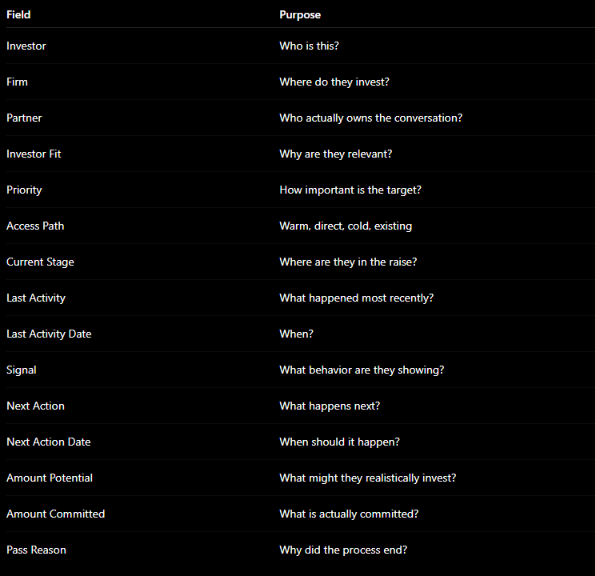
The exact tool matters less than the discipline.
A spreadsheet can work.
A CRM can work.
Fundraising software can work.
The system fails when investor context lives only in the founder's memory.
Separate Pipeline Stage From Investor Signal
This is worth emphasizing.
Stage tells you where the investor sits in the formal process.
Signal tells you what the investor is doing.
For example:
Investor A:
Stage: First meeting
Signal: Deck forwarded internally
Investor B:
Stage: First meeting
Signal: No activity for three weeks
Same stage.
Very different context.
Another example:
Investor C:
Stage: Diligence
Signal: Multiple data requests + partner meeting scheduled
Investor D:
Stage: Diligence
Signal: Silence after documents were sent
Again:
same stage,
different momentum.
Combining stage and signal creates much better prioritization.
Every Investor Needs a Next Action
A pipeline without next actions becomes a reporting tool.
A good pipeline should help operate the raise.
Every active investor should have one.
Examples:
Send metrics
Request intro
Book meeting
Send financial model
Follow up Friday
Prepare partner meeting
Answer diligence questions
Review terms
Confirm allocation
If the next action is:
Wait
define what you are waiting for and when you will reassess.
Otherwise, “wait” can become three weeks of forgotten pipeline.
Follow-Up Should Depend on Context
Not every investor needs the same automated cadence.
Consider:
Investor A
Cold email sent.
No reply.
Investor B
First meeting complete.
Requested September metrics.
Investor C
Partner meeting done.
Asked for cap table.
Investor D
Diligence started.
Waiting on one legal document.
Sending all four the same generic seven-day follow-up makes little sense.
Follow-up should reflect:
stage
prior conversation
investor request
signal
timing
next decision point
This is why fundraising pipeline management is more than email automation.
It is context management.
Prioritize With Fit × Signal × Stage
One useful decision model is:
Investor Priority = Fit × Signal × Stage
Not as literal multiplication.
As a framework.
High Fit + Strong Signal + Advanced Stage
Highest attention.
High Fit + Weak Signal + Early Stage
Important, but do not overinvest yet.
Low Fit + Strong Signal
Understand why they are engaged before spending major founder time.
Low Fit + Weak Signal
Usually low priority.
This protects the founder from one of the most common fundraising traps:
letting excitement determine attention.
The investor who sounds enthusiastic is not always the investor closest to investing.
Run the Raise in Batches
Fundraising often becomes inefficient when conversations happen one at a time over many months.
A more structured process can create:
clearer comparison between investor responses
better founder learning
stronger momentum
faster iteration
more synchronized decisions
Waveup's current outreach framework recommends batching meetings and managing the raise as a coordinated pipeline rather than firing isolated outreach and waiting indefinitely.
The exact cadence will depend on:
company
stage
investor universe
founder availability
market conditions
But the principle is useful:
Create process density.
Do not let every investor conversation exist on its own timeline unless it has to.
Measure Conversion Between Pipeline Stages
Once enough activity exists, begin looking at conversion.
For example:
Qualified → Outreach
How much of the target list have you activated?
Outreach → Response
Does the messaging or access path generate engagement?
Response → Meeting
Are investors willing to spend time?
Meeting → Second Step
Does the investment case create continued interest?
Diligence → Terms
Are major concerns killing the process?
Terms → Funded
Are commitments actually closing?
Do not obsess over tiny samples.
Five investor conversations are not enough to build universal benchmarks.
But repeated patterns inside your own raise can expose where the process is breaking.
Diagnose the Pipeline Before Changing the Pitch
Suppose:
200 poor-fit investors receive outreach.
Only 5 reply.
The founder may conclude:
Our pitch is bad.
But the actual problem may be targeting.
Or:
40 high-fit investors take meetings.
Nobody advances.
Now the problem may sit deeper in:
traction
market
founder story
economics
round structure
evidence
Or:
Several investors enter diligence.
Nobody commits.
Now the issue may be:
diligence findings
terms
valuation
legal structure
financing risk
The pipeline helps identify where the system is breaking.
That leads to better decisions than simply changing the deck every time an investor passes.
Update the Pipeline Immediately
Fundraising context decays fast.
After every meaningful event, update:
stage
notes
signal
next action
date
Do it after the meeting.
Not three days later.
Small details matter:
what the investor questioned
which partner joined
what they requested
what timeline they gave
whether another decision-maker is involved
These details shape the next interaction.
What Should Not Be in the Active Pipeline?
Not every discovered investor belongs there.
Keep separate:
Research Universe
Potential investors not fully qualified.
Target List
Qualified investors not yet activated.
Active Pipeline
Investors where access/outreach/conversation is underway.
Closed / Passed
Completed outcomes.
This prevents a 1,000-name database from creating the illusion of a 1,000-investor fundraising pipeline.
A pipeline should represent real process, not theoretical possibility.
How BFunded Approaches the Fundraising Pipeline
BFunded is designed around the idea that founders should not have to assemble this process from disconnected tools.
The current BFunded Raise Engine combines company setup, investor matching, Founder Score, network access, a tracked Raise Page, introductions, and investor activity inside one fundraising workspace.
Its current product also surfaces operational events such as:
deck forwards
meetings booked
investments confirmed
score changes
expanded network reach
and presents a specific “next move” around the raise.
That reflects a broader philosophy:
The founder should understand the raise.
They should not have to become a full-time fundraising operator to keep it moving.
A better system connects:
Investor Fit
↓
Access
↓
Signal
↓
Next Action
↓
Commitment
The pipeline is where those pieces become one operating process.
Frequently Asked Questions
What is a startup fundraising pipeline?
A startup fundraising pipeline is a structured system for tracking investors from qualified target through outreach, meetings, evaluation, diligence, terms, commitment, and funded investment.
What stages should an investor pipeline include?
A practical pipeline can include qualified, access identified, contacted, engaged, first meeting, advanced evaluation, diligence, terms, committed, funded, and passed. The exact stages should match how your raise actually operates.
Is a fundraising CRM necessary?
No specific software is mandatory. A well-maintained spreadsheet can work for a small raise. What matters is consistently tracking investor fit, stage, activity, next action, and commitments.
When should I add an investor to the pipeline?
Ideally after they have been qualified for stage, sector, check size, thesis, geography, and other relevant fit factors. Keep unqualified names in a research universe rather than the active pipeline.
What is the difference between an investor signal and a pipeline stage?
A pipeline stage describes where the investor is in the process. A signal describes observable investor behavior, such as repeat deck views, forwarding, requests, meetings, or diligence activity.
Should I track investors who pass?
Yes. Record the pass and the reason where available. Repeated pass reasons can reveal targeting problems or weaknesses in the investment case.
How often should the fundraising pipeline be updated?
Update it after every meaningful investor interaction. At minimum, active investors should always have a current stage, last activity, next action, and next-action date.
How do I prioritize investors in the pipeline?
Consider investor fit, current signal strength, process stage, potential check size, and strategic importance. Do not allocate founder attention equally across every investor.
When is an investor considered committed?
Define commitment clearly for your financing structure. A signed financing document or formal allocation is stronger than verbal interest. Funds received should be tracked separately as actually funded.
Why does a startup fundraising pipeline matter?
It reduces lost context, missed follow-ups, false optimism, and wasted founder attention by turning investor conversations into a visible operating process.
The Bottom Line
Fundraising is not a collection of meetings.
It is a process.
The investor list tells you who might matter.
Investor fit tells you who belongs.
Access tells you how to reach them.
Signals tell you what they are doing.
The pipeline tells you what happens next.
And the close tells you what actually converted.
If every investor has:
a reason to be there
a current stage
a visible signal
and
a next action
the raise becomes much easier to operate.
Not necessarily easy.
But visible.
And visibility makes better decisions possible.
Keep reading
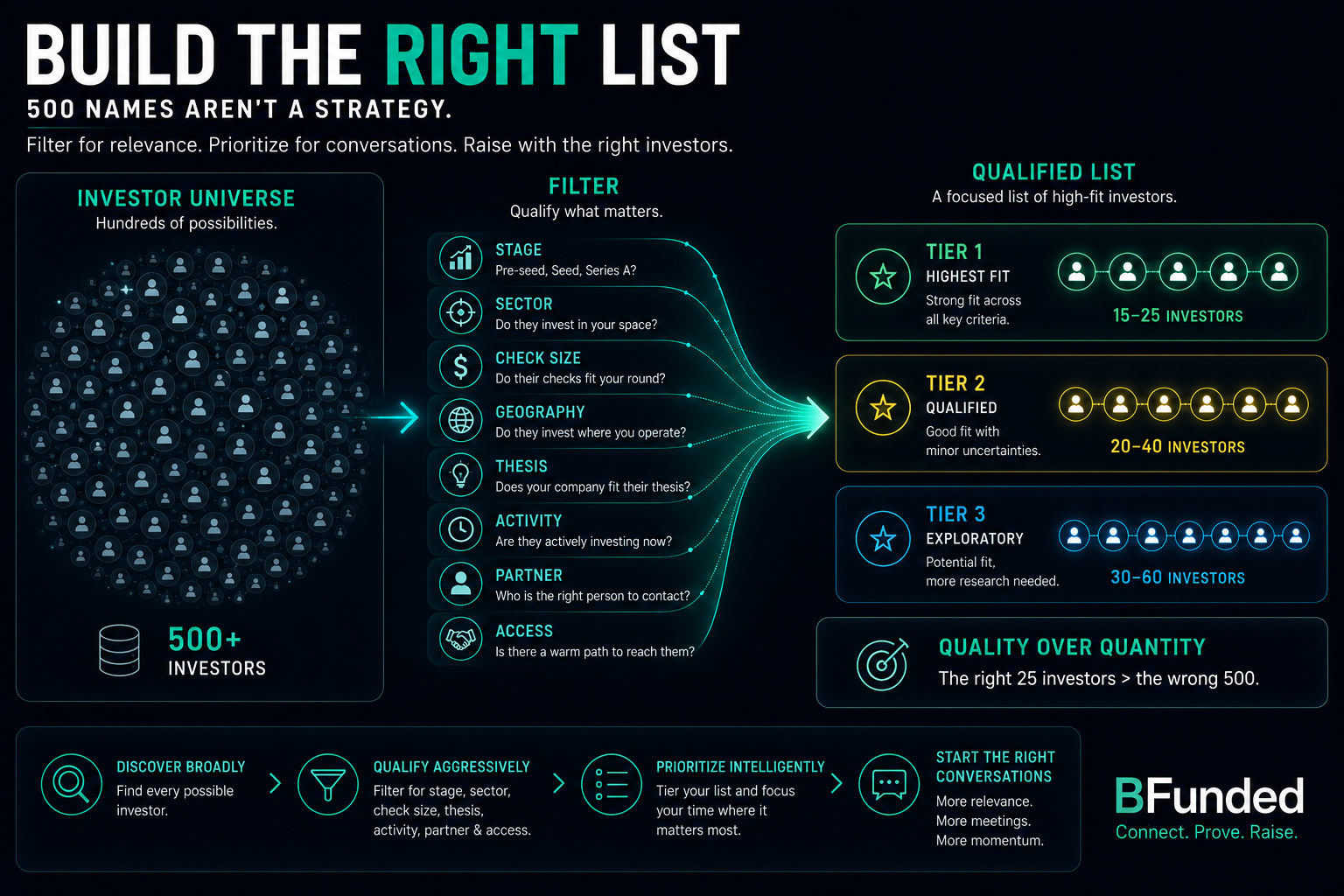
How to Build an Investor List That Actually Matches Your Raise
Learn how to build a startup investor list by filtering investors for stage, sector, check size, geography, thesis, activity, partner fit, and warm access.
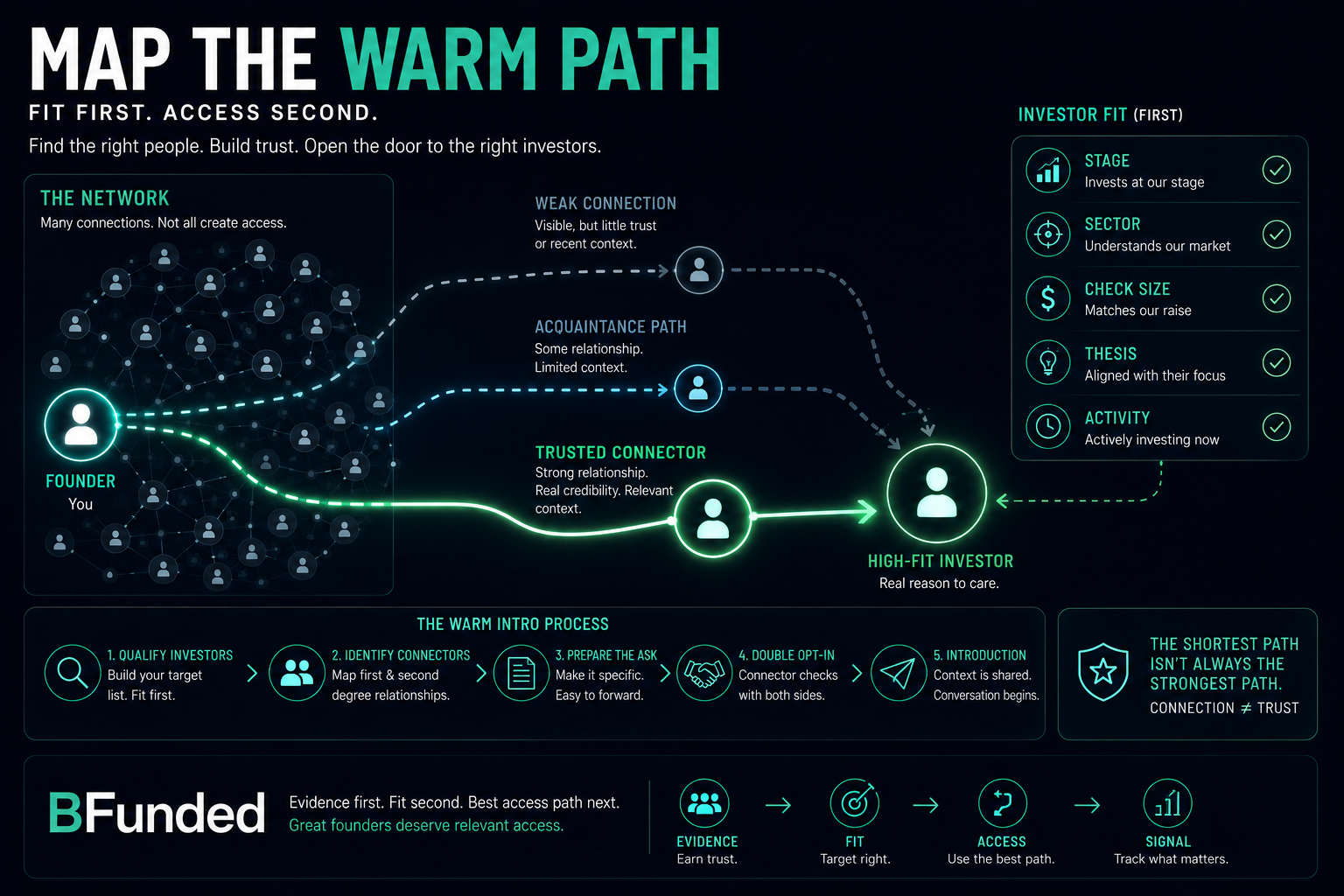
How to Find Warm Paths to the Right Startup Investors
Learn how to find warm paths to startup investors by qualifying investor fit first, mapping trusted connectors, creating forwardable intro requests, and tracking introductions through the raise.
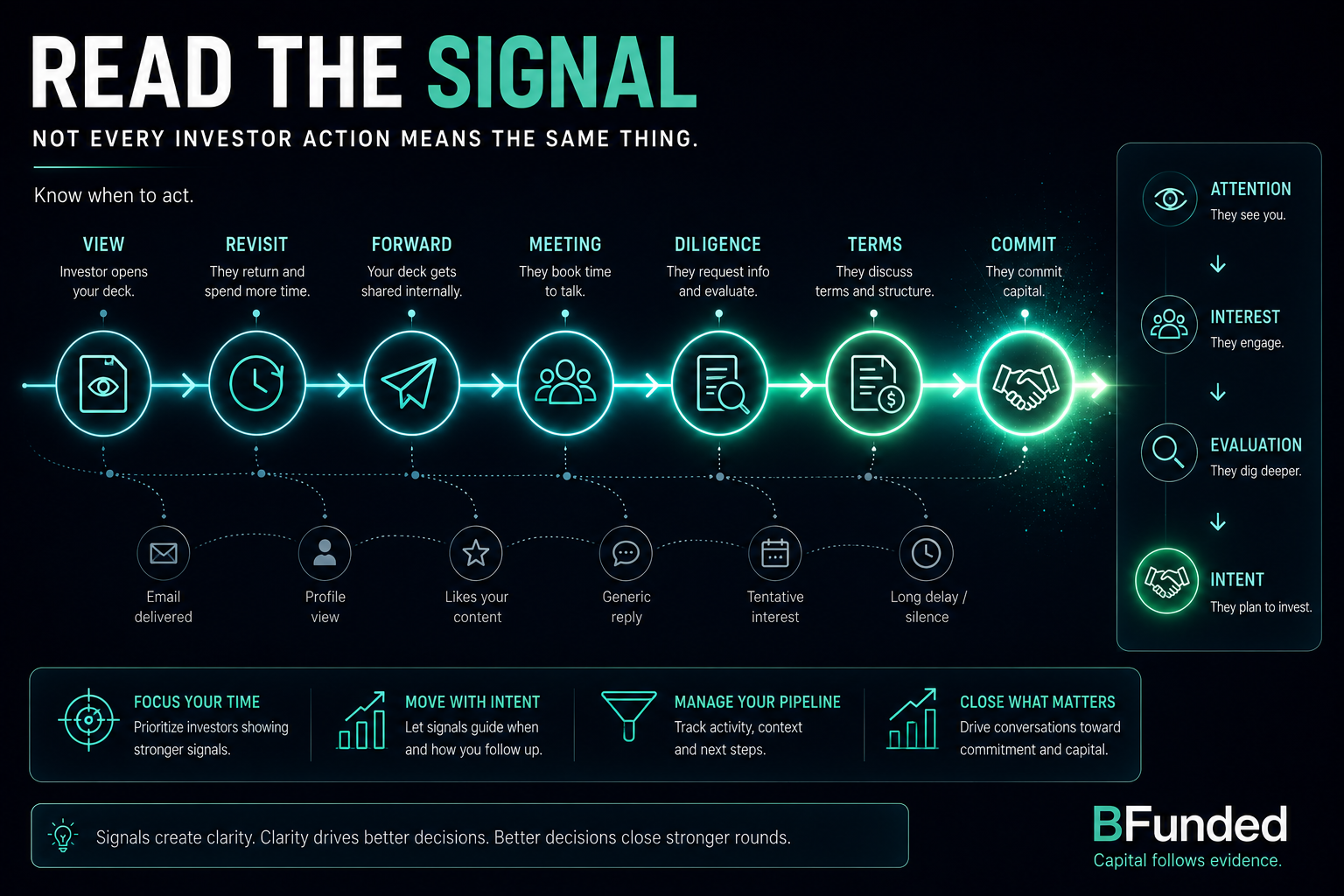
Investor Signals: How to Know When an Investor Is Actually Interested
Learn how to read investor signals during a startup raise, from pitch deck views and repeat engagement to meetings, diligence, terms, and actual commitments.