How Long Does Startup Fundraising Take? A Realistic Raise Timeline
How long does startup fundraising take? Learn what happens from preparation and investor outreach through meetings, diligence, terms, and closing — and what usually causes delays.
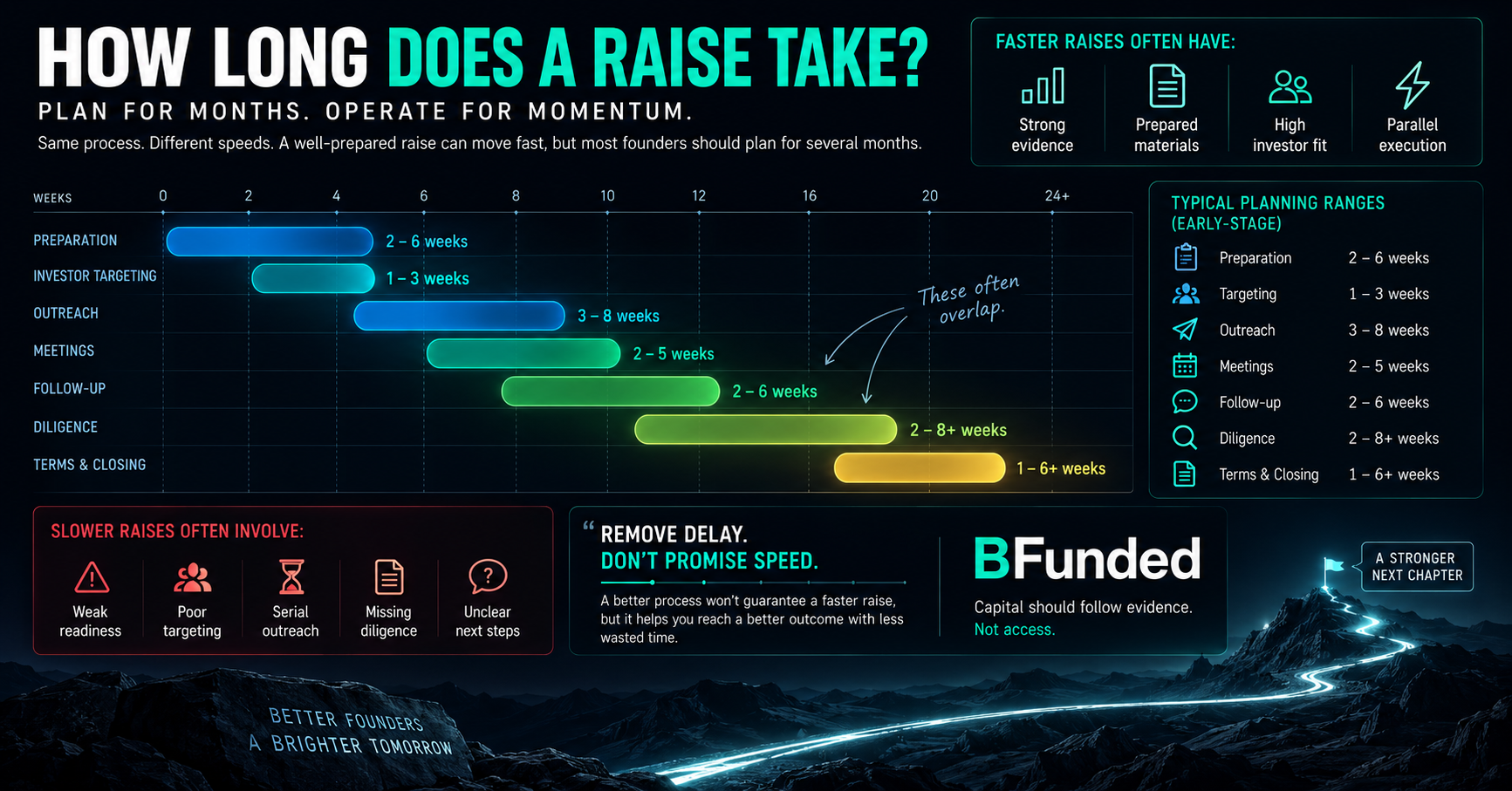
Startup fundraising can take a few weeks.
It can also take six months.
Sometimes longer.
That is why asking:
“How long does fundraising take?”
does not have one honest answer.
The timeline depends on the company, stage, investor network, traction, market conditions, round structure, diligence requirements, and how well the raise is prepared before outreach begins.
A tightly run seed round with strong evidence and existing investor relationships can move quickly.
A founder who begins without a qualified investor list, clear materials, or sufficient traction may spend months discovering problems during the raise that should have been solved before it.
A realistic way to think about startup fundraising is:
Preparation
→ Investor Targeting
→ Outreach
→ Meetings
→ Diligence
→ Terms
→ Closing
Each stage can accelerate the round.
Each stage can also become the reason it stalls.
So, How Long Does Startup Fundraising Usually Take?
There is no universal benchmark.
OpenVC's fundraising strategy guidance recommends that founders plan for roughly six months, while acknowledging that some rounds close in weeks and others take nine months or more.
At the other end of the spectrum, Waveup's current 2026 fundraising plan describes successful, tightly coordinated seed raises closing in roughly 7–12 weeks, with intensive investor meetings compressed into a defined sprint.
Those numbers are not necessarily contradictory.
They describe different situations.
One is a planning horizon.
The other is an example of an optimized successful process.
Founders should generally prepare for the longer case while operating toward the shorter one.
A useful planning range for an early-stage raise is often:
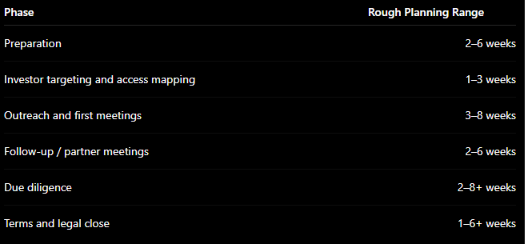
These phases frequently overlap.
That is important.
A good fundraising process does not necessarily finish investor research, then begin outreach, then finish every meeting, then start diligence.
Many workstreams run in parallel.
That is one of the biggest opportunities to reduce unnecessary fundraising time.
Fundraising Time Starts Before the First Investor Email
Founders often measure a raise from:
the day outreach starts
to:
the day money arrives.
Operationally, the process begins earlier.
Before approaching investors, the company may need to prepare:
fundraising strategy
round size
use of funds
pitch deck
financial model
data room
cap table
investor targets
founder narrative
diligence materials
outreach system
If those are unfinished when outreach begins, preparation does not disappear.
It simply happens while investors are already evaluating the company.
That can slow the raise considerably.
Our Startup Fundraising Readiness Checklist explains what should be prepared before active investor outreach begins.
Phase 1: Fundraising Preparation
Typical planning range: 2–6 weeks
This stage establishes whether the raise is ready to run.
Founders should clarify:
What Are You Raising?
Define:
round size
instrument
target investor type
use of funds
milestone the capital should unlock
What Is the Investment Case?
Investors should be able to understand:
problem
customer
solution
market
traction
business model
team
advantage
why now
Is the Evidence Ready?
The company should know which claims are supported by:
customers
revenue
retention
pilots
product usage
technical milestones
partnerships
market validation
Are the Materials Ready?
At minimum, this may include:
deck
financial model
cap table
basic data room
investor-facing company information
Preparation time varies significantly.
A founder with organized financials, an existing deck, and a clean cap table may move quickly.
A company discovering missing contracts, inconsistent financial numbers, or ownership problems can take much longer.
What Slows Preparation Down?
Common delays include:
Unclear Round Size
The founder knows the company needs capital but cannot explain how much or why.
Weak Use of Funds
The round is described as:
hiring and growth
instead of being tied to measurable milestones.
Inconsistent Financials
Numbers in the deck do not match the model.
Cap Table Problems
Old SAFEs, undocumented equity promises, or incorrect ownership records need to be resolved.
Weak Fundability
The materials are ready, but the company has not yet produced enough evidence for the stage.
The last issue is particularly important.
You cannot operationally optimize your way out of an investment case that still needs to become stronger.
Phase 2: Build and Qualify the Investor List
Typical planning range: 1–3 weeks initially, then ongoing
The founder now needs enough investors to create a real process.
Research includes:
stage
sector
check size
geography
thesis
portfolio
partner
current activity
potential conflict
Our guide to building a startup investor list explains how to qualify investors before the first high-priority outreach wave.
Investor research does not have to end completely before fundraising begins.
The list can continue developing.
But the first investor wave should not be a collection of random names.
Poor targeting wastes time later.
If 70% of the investors contacted cannot realistically invest in the company, the founder may spend several weeks learning something that better qualification could have discovered immediately.
Phase 3: Map Access Paths
Often overlaps with investor research
After identifying the right investors, determine how to reach them.
Possible paths include:
existing relationship
warm introduction
direct submission
targeted cold email
inbound investor interest
This stage can be fast when the founder already has a strong network.
It can take longer when connectors need to be identified and introductions coordinated.
But do not delay the entire raise indefinitely trying to manufacture warm introductions.
If:
investor fit is strong
the investor accepts direct contact
no credible warm path exists
targeted cold outreach can be perfectly reasonable.
The objective is the best available access path, not warmth at any cost.
Phase 4: Investor Outreach
Typical planning range: 3–8 weeks for the main outreach window
This is where the raise becomes externally active.
Founders begin:
sending outreach
activating introductions
sharing materials
booking first meetings
The biggest mistake here is spreading outreach too thinly across time.
Imagine:
Week 1: two investors.
Week 4: three more.
Week 8: another two.
Week 12: five more.
The founder may technically be fundraising for three months while never creating enough simultaneous activity to understand whether the market is responding.
A coordinated outreach window can produce better information faster.
Waveup's current fundraising plan recommends front-loading investor meetings into a concentrated process rather than allowing them to drift indefinitely.
The exact number of meetings is less important than the principle:
create enough process density to generate signal.
How Quickly Should You Know Whether Outreach Is Working?
You should not expect to know the final outcome after one week.
But early patterns can emerge quickly.
Watch:
response rates
intro acceptance
deck engagement
meeting bookings
repeated investor objections
second-meeting conversion
If high-fit investors consistently ignore the raise, investigate.
Possible causes include:
weak message
weak evidence
poor timing
wrong investor segment
unclear positioning
Do not automatically solve low response by doubling the number of investors.
First determine whether the problem is volume or relevance.
Phase 5: First Meetings
Often concentrated over 2–5 weeks
The founder now begins converting investor interest into direct evaluation.
The first meeting is usually about:
founder
company
market
traction
round
fit
But the founder should also learn:
how the investor makes decisions
who else needs to be involved
what questions remain
what the next step is
what timeline the investor expects
A first meeting without a next step can become an expensive ambiguity.
After each meeting, update the pipeline immediately.
Our startup fundraising pipeline guide explains how to track each investor from qualified target through commitment and funded capital.
Phase 6: Follow-Up and Partner Meetings
Typical planning range: 2–6 weeks, often overlapping with first meetings
Some investors pass immediately.
Others continue.
The process may expand to include:
second meetings
additional partners
technical experts
product demos
customer discussions
financial reviews
investment committee preparation
This is where investor timelines begin diverging.
One fund may decide quickly.
Another may require multiple internal steps.
The founder's job is to understand:
What does this investor require to make a decision?
Then maintain momentum without blindly chasing them.
Our investor follow-up guide explains how to use context, signals, and next actions instead of blind calendar reminders.
Phase 7: Due Diligence
Typical planning range: 2–8+ weeks
Diligence is one of the most variable parts of the process.
An early SAFE from an angel may involve relatively light review.
An institutional priced round can involve significantly more.
Investors may examine:
Corporate
incorporation
ownership
cap table
previous securities
Financial
historical financials
model
burn
runway
revenue
Commercial
contracts
customers
pipeline
retention
Product and Technology
architecture
IP
technical risks
roadmap
Team
founders
key employees
references
employment arrangements
Legal
contracts
disputes
regulatory issues
intellectual property
Preparation strongly affects speed here.
If the founder has to locate every document only after it is requested, diligence becomes slower.
If everything is already organized and consistent, the process can move more efficiently.
Diligence Time Is Not Entirely Under the Founder's Control
Even perfect founder preparation cannot determine an investor's internal schedule.
A fund may need:
partner approval
investment committee
reference calls
specialist review
legal review
additional market work
That is why founders should distinguish:
things we can accelerate
from:
things we can only monitor.
Good fundraising operations reduce avoidable delay.
They cannot remove every external dependency.
Phase 8: Terms
Typical planning range: 1–4+ weeks
Once an investor has enough conviction, the conversation may move toward:
check size
valuation
valuation cap
ownership
investor rights
board involvement
pro rata
security type
closing conditions
Simple early-stage instruments can move faster.
Complex priced rounds can take longer.
Legal advice may be required.
Founder and investor expectations also matter.
A large gap around valuation or control can extend the process substantially.
This is why “we have an interested investor” should not automatically be translated into:
the round is closing next week.
Interest and execution are different stages.
Phase 9: Documentation and Closing
Typical planning range: days to several weeks
A round is not finished when an investor verbally says:
We're in.
The final steps may still include:
documentation
signatures
investor verification where applicable
legal review
closing conditions
wire instructions
capital transfer
Track the difference between:
interested
terms agreed
signed
and
funded.
Only the last one puts capital in the company.
A Realistic Early-Stage Fundraising Timeline
A well-prepared early-stage process might look something like:
Weeks 1–4
Preparation and investor research.
Weeks 3–6
Warm-path activation and first outreach.
Weeks 5–10
First meetings and follow-up conversations.
Weeks 7–14
Partner meetings and diligence begin for serious investors.
Weeks 10–16+
Terms, documentation, and closing.
Some raises move faster.
Some will move materially slower.
OpenVC explicitly advises founders to plan for a six-month journey because network strength, company attractiveness, market conditions, and investor timing create substantial variability.
Planning conservatively protects the founder.
Operating efficiently creates the opportunity to beat the plan.
What About Seed vs Series A?
Later-stage rounds usually require more evidence and deeper diligence.
That can lengthen the process.
Waveup's current stage guidance lists broader planning windows of several months across pre-seed, seed, and Series A, with later institutional rounds generally requiring more extensive review.
But founders should be cautious with any universal stage benchmark.
Company quality matters.
Investor competition matters.
Sector matters.
Round structure matters.
Existing relationships matter.
A highly competitive institutional round can sometimes move faster than a difficult pre-seed raise.
Stage influences the process.
It does not determine the exact calendar.
Do Not Confuse “Time Between Rounds” With “Time to Raise”
These are two completely different metrics.
Time to raise means:
How long did the active fundraising process take?
Time between rounds means:
How long did the company operate between one financing and the next?
Carta's January 2026 startup funding guide notes that companies have been waiting materially longer between major funding rounds, including a median gap of roughly 2.1 years between seed and Series A for companies raising Series A in Q4 2024.
That does not mean the Series A fundraising process itself took 2.1 years.
It means companies spent longer building between rounds.
This distinction matters for runway planning.
Start Fundraising Before You Are Desperate
If you believe the raise could take several months, do not begin with eight weeks of cash remaining.
A founder negotiating while approaching zero runway has fewer options.
Fundraising preparation should start while the company still has enough time to:
improve evidence
pause if necessary
adjust the round
change targeting
survive delays
The goal is not merely:
How many months will investors take?
It is:
How much time can the company afford the process to take?
That is a much more important planning question.
What Makes Fundraising Take Longer?
Several problems repeatedly extend timelines.
1. Starting Before the Company Is Ready
Investors identify evidence gaps during meetings.
The founder then goes back to building.
Momentum disappears.
2. Poor Investor Targeting
Weeks are spent contacting investors who never fit.
3. Building the Investor List While Raising
Every day becomes:
research one investor,
email them,
wait,
research another.
4. No Access Strategy
High-priority targets sit untouched because nobody maps the available path.
5. Spreading Meetings Too Far Apart
The company never creates enough simultaneous activity to build process momentum.
6. Weak Follow-Up
Promised information arrives late.
Next steps remain unclear.
7. Unprepared Diligence
Documents need to be created, corrected, or located after requests arrive.
8. Confusing Interest With Commitment
The founder stops creating pipeline because several investors sound positive.
Then none close.
9. Legal or Structural Problems
Cap table, incorporation, IP, contracts, or financing structure create unexpected delays.
10. Raising From a Position of Urgency
The founder has too little runway to fix problems as they emerge.
What Can Actually Make a Raise Faster?
There are no guaranteed shortcuts.
But founders can remove unnecessary friction.
Be Fundable Before You Launch
Stronger evidence reduces the number of fundamental questions that need to be resolved mid-process.
Prepare Before Outreach
Deck, financial model, data room, cap table, and target list should not be built from scratch after meetings begin.
Target High-Fit Investors
Relevant investors require less explanation about why the opportunity belongs in their mandate.
Map Access Early
Do not spend three weeks discovering after outreach that a portfolio founder could have made the introduction.
Run Parallel Workstreams
Research can continue while meetings happen.
Diligence preparation can happen before diligence begins.
Batch Investor Activity
A concentrated process improves learning and momentum.
Track Investor Signals
Know which conversations are actually progressing.
Give Every Investor a Next Move
Do not let active opportunities sit without a clear action.
Respond Quickly During Diligence
Speed matters when the investor is actively evaluating.
Know When to Stop Chasing
Low-signal investors can consume enough time to delay stronger opportunities.
Speed Is Not the Only Goal
A fast raise is not automatically a good raise.
Closing in three weeks with:
the wrong investor
bad terms
excessive dilution
a strategic mismatch
can create much larger problems later.
The real objective is:
efficiently reach a good financing outcome.
That includes:
the right capital
the right investors
workable terms
enough runway
minimal unnecessary founder distraction
Do not optimize the raise simply for the shortest calendar.
Optimize for the strongest outcome with the least avoidable waste.
How BFunded Approaches Fundraising Time
BFunded is designed around reducing operational fragmentation in the raise.
The BFunded Raise Engine combines investor matching, network access, a tracked Raise Page, introductions, investor activity, and next actions inside one fundraising workflow.
This matters because many fundraising delays are not caused by investors alone.
They come from:
poor targeting
lost follow-ups
disconnected information
unclear next steps
slow preparation
weak pipeline visibility
A better system can reduce that operational waste.
It cannot guarantee that an investor will decide faster.
It cannot guarantee a round will close.
And it should not pretend that every founder can raise on the same timeline.
The objective is more practical:
Make sure the founder's time is spent moving the right conversations forward.
Frequently Asked Questions
How long does startup fundraising usually take?
There is no universal timeline. Founders should often plan for several months. OpenVC recommends planning around six months, while some tightly run successful early-stage raises can close considerably faster.
How long does a seed round take?
It varies substantially. Some tightly coordinated seed processes can close in roughly two to three months, while broader founder guidance often recommends allowing several months and maintaining enough runway for delays.
Can a startup raise funding in one month?
Yes, but it should not be treated as the default expectation. Existing investor relationships, strong traction, competition for the deal, simple financing structure, and prepared diligence can all accelerate a round.
When should I start preparing to raise?
Before the company urgently needs the money. Preparation can begin weeks or months before outreach so the founder has time to strengthen evidence, organize materials, build the investor list, and map introductions.
How long does investor due diligence take?
It can range from days for some simple early-stage checks to many weeks for more complex institutional rounds. Company complexity, investor process, and diligence readiness all affect timing.
Does fundraising take longer at Series A?
Often, because institutional rounds can involve deeper metrics review, partner meetings, investment committees, legal negotiations, and formal diligence. However, strong competitive deals can still move quickly.
What usually slows fundraising down?
Common causes include poor investor targeting, weak readiness, scattered outreach, missing diligence documents, unclear follow-ups, investor inactivity, legal issues, and insufficient traction.
Should founders raise from multiple investors at the same time?
Running multiple relevant conversations in parallel can help create a more efficient fundraising process and reduces dependence on one investor.
When is a round actually finished?
When the required financing documents are complete and the investment capital has actually been received—not when an investor merely expresses interest.
The Bottom Line
Fundraising does not take a fixed number of weeks.
It takes as long as the unresolved decisions in the raise require.
Some of those decisions belong to investors.
Some belong to the founder.
The founder cannot control every investment committee calendar.
But they can control whether:
the company is ready
the investor list is qualified
meetings are coordinated
diligence is prepared
follow-ups are clear
and
every active investor has a next move.
Plan for fundraising to take months.
Build the process so it does not take longer than it needs to.
Keep reading
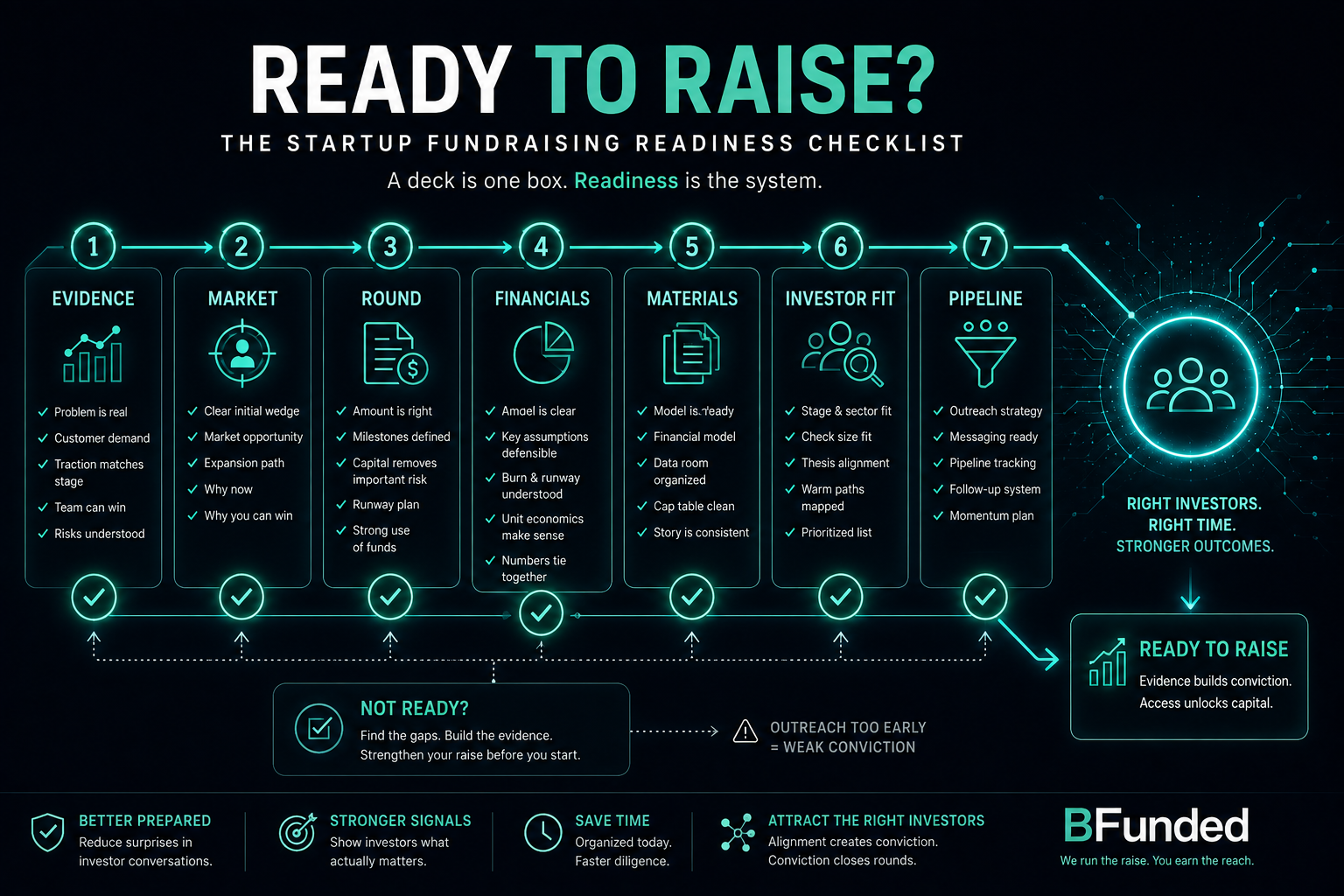
Startup Fundraising Readiness Checklist: Are You Actually Ready to Raise?
Use this startup fundraising readiness checklist to assess your evidence, pitch, financials, data room, investor strategy and fundraising process before outreach begins.
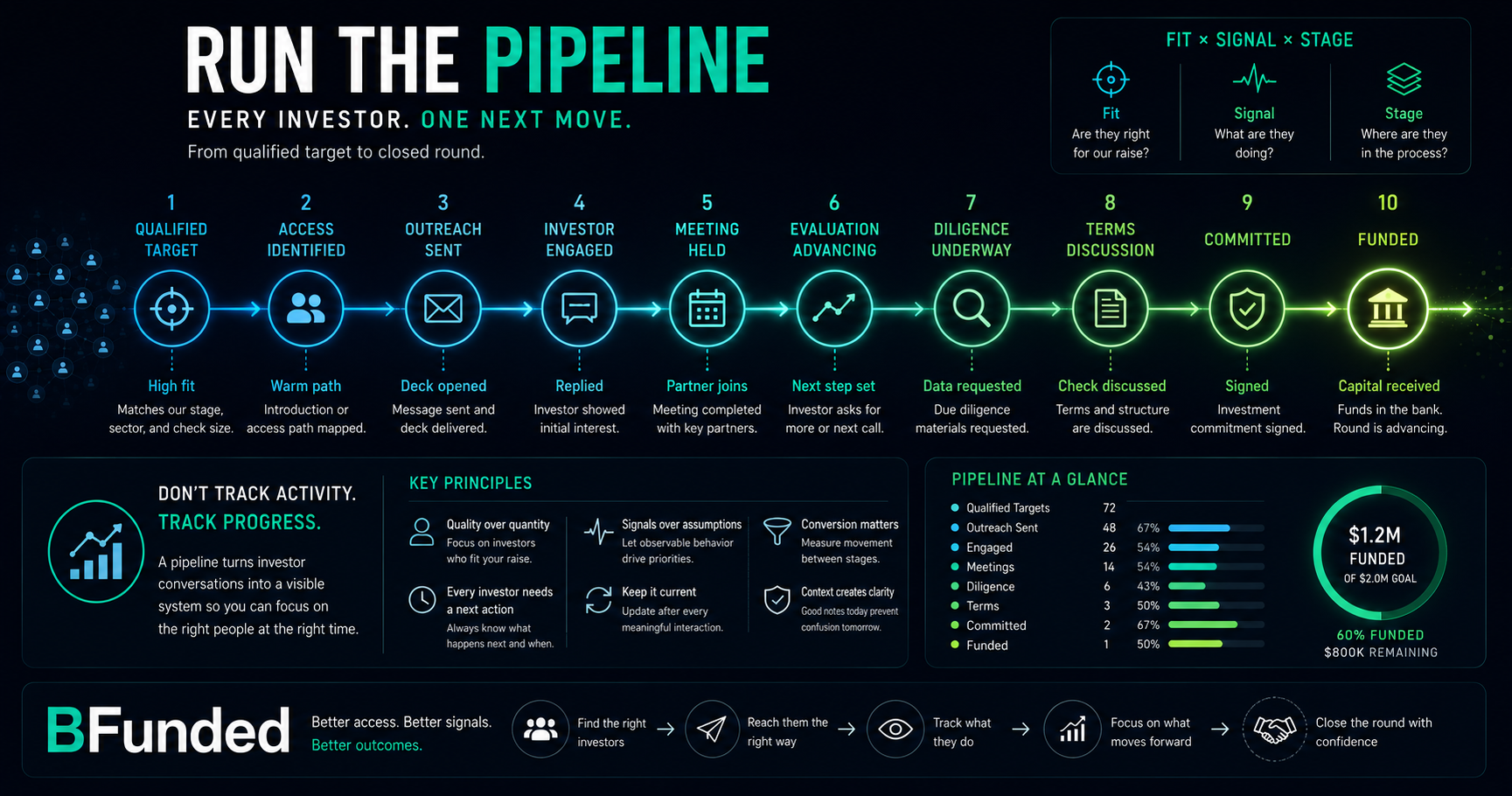
The Startup Fundraising Pipeline: From Investor Target to Closed Round
Learn how to build a startup fundraising pipeline that tracks qualified investors from outreach and meetings through diligence, terms, commitment, and funded capital.
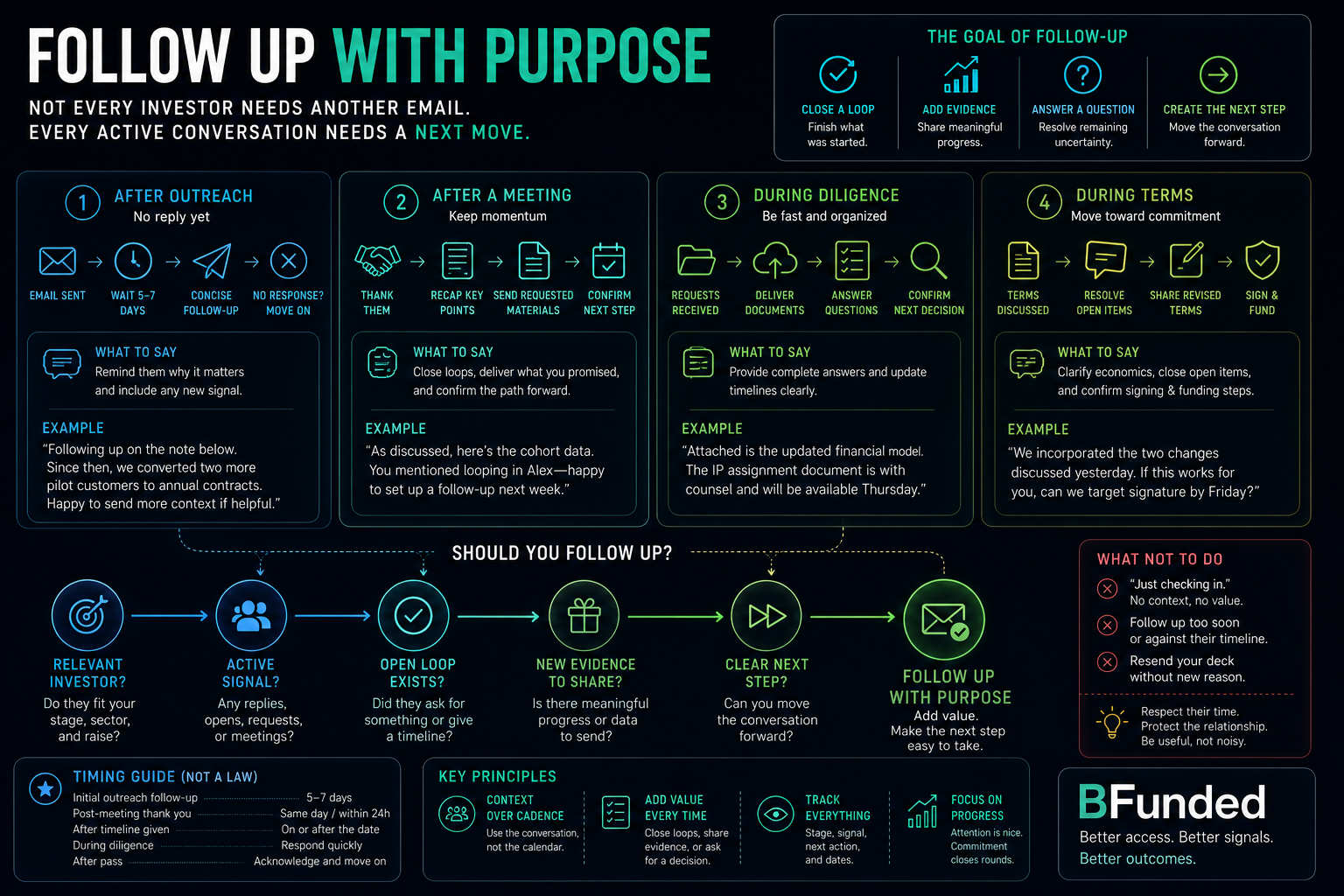
How to Follow Up With Investors Without Chasing Them Blind
Learn how to follow up with investors after outreach, meetings, diligence, and term discussions using context, investor signals, and clear next actions.