How to Find Warm Paths to the Right Startup Investors
Learn how to find warm paths to startup investors by qualifying investor fit first, mapping trusted connectors, creating forwardable intro requests, and tracking introductions through the raise.
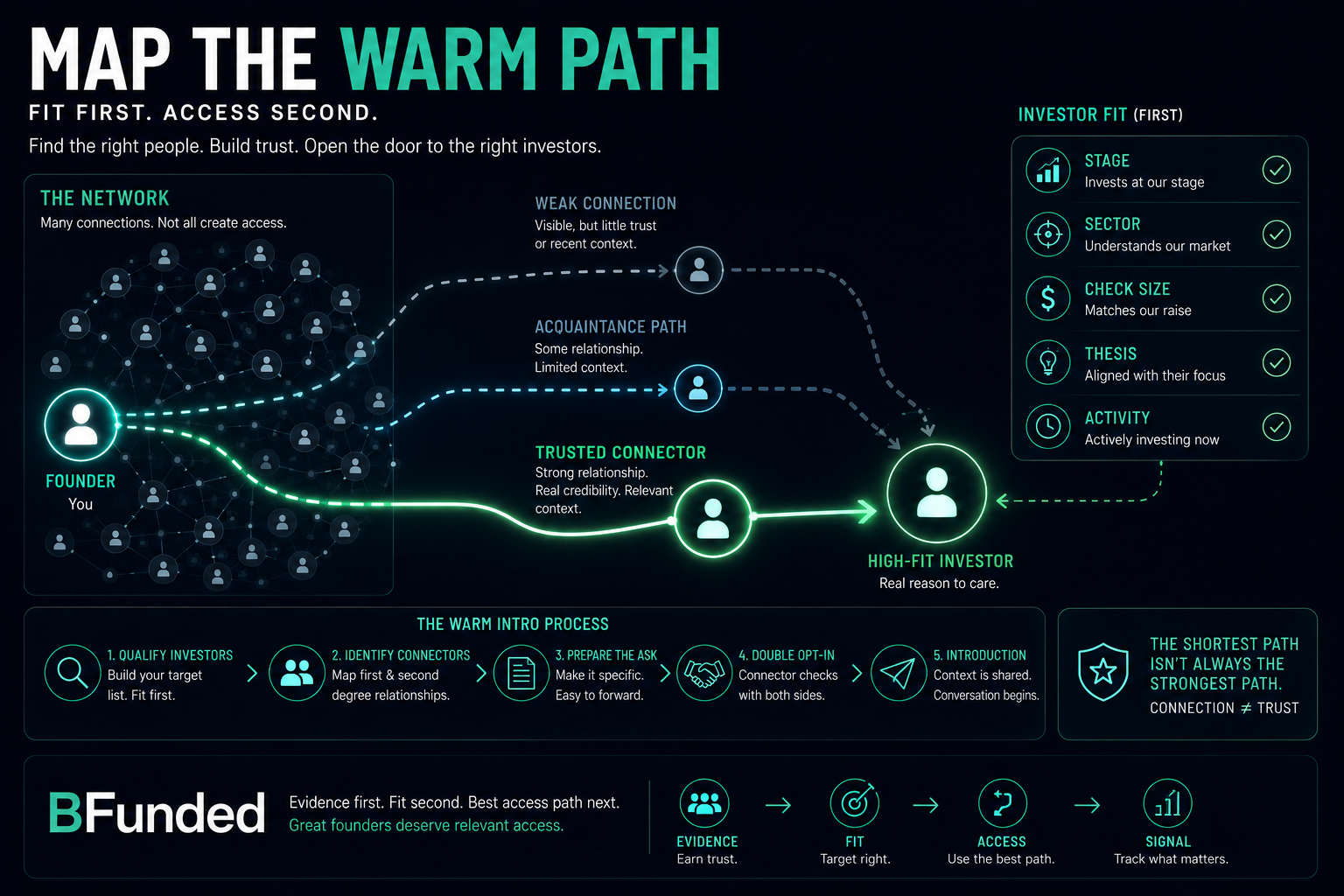
A warm introduction can get an investor to pay attention.
It cannot make the investor relevant.
And it cannot make the company fundable.
That distinction is where many founders get investor networking wrong.
They start by asking:
Who do I know who knows investors?
A better sequence is:
Which investors actually fit this raise?
Then:
Who can help us reach them?
A warm path is a credible relationship route from the founder to a relevant investor through someone both sides know or trust.
That person might be:
another founder
an existing investor
an advisor
a customer
an operator
an attorney
an accountant
an accelerator mentor
an industry expert
a mutual professional connection
The value of the introduction comes from context and transferred trust.
But the best warm introduction still starts with investor fit.
Do not map relationships to everyone. Map the shortest credible paths to the investors who already have a reason to care.
What Is a Warm Introduction to an Investor?
A warm introduction happens when a third party connects a founder with an investor.
That third party is the connector.
Instead of the founder arriving as an unknown name in an inbox, the investor receives the opportunity through someone with an existing relationship.
A typical structure is:
Founder → Connector → Investor
The connector may provide only a small amount of context:
who the founder is
what the company does
why the investor may care
why the connector believes the conversation is worth having
OpenVC's current warm-introduction guide describes this as a third-party connection and recommends a double opt-in process, where the connector first confirms that both parties want the introduction before connecting them.
That matters because introductions spend social capital.
A connector is effectively saying:
I believe this conversation may be worth your time.
Founders should treat that trust carefully.
Why Warm Introductions Work
Cold outreach starts with almost no context.
The investor has to answer several questions immediately:
Who is this founder?
Is the company credible?
Is the opportunity relevant?
Why should I spend time on this now?
A trusted introduction answers part of that before the investor even opens the deck.
It can provide:
Context
The investor understands why the founder is being introduced.
Credibility
Someone the investor already knows is willing to attach their reputation to the connection.
Prioritization
The message may stand out from a crowded inbox.
Relevance
A good connector can explain why the opportunity fits the investor.
OpenVC's June 2026 outreach playbook recommends treating warm introductions as one of several investor-access paths alongside existing relationships, inbound interest, and cold outreach—and specifically advises founders to assign an access path only after building the target investor list.
That order is important.
The introduction should improve access to a qualified investor. It should not determine who qualifies.
Warm Introductions Are Not Proof of Fundability
There is a structural problem with treating introductions as the default test of startup quality.
Founders do not begin with equal networks.
One founder may have:
worked at a famous startup
attended an elite university
previously raised venture capital
lived in a major venture hub
worked with well-connected advisors
Another founder may have built an equally strong company without any of those advantages.
BFunded's current About page explicitly argues that the warm introduction has historically become an imperfect stand-in for merit because it often measures access rather than founder quality.
That is why a warm intro should be understood as:
an access mechanism
not:
an investment signal by itself.
The startup still needs evidence.
The investor still needs fit.
The company still needs to survive diligence.
A connector can open the door.
They cannot make the investment decision.
Step 1: Qualify the Investor First
Do not begin network mapping with:
Who can introduce us to VCs?
Begin with a qualified investor list.
For each target, confirm:
stage
sector
check size
geography
thesis
portfolio
recent activity
relevant partner
possible conflicts
Only then should you investigate access.
This prevents one of the most common networking mistakes:
letting your network determine your investor strategy.
If your friend happens to know a Series B healthcare investor, that does not make them a good target for your pre-seed fintech company.
Our guide on building a startup investor list explains how to qualify the investor universe before assigning access paths.
The sequence should be:
Fit → Access
not:
Access → Hope there is fit.
Step 2: Identify the Specific Investor, Not Just the Firm
A vague request is difficult for a connector to act on.
For example:
Do you know anyone at Sequoia?
is much harder to help with than:
Do you know Jane Smith, who covers fintech seed investments at Example Ventures?
Research:
the relevant partner
their investment focus
portfolio
recent investments
stage
geographic focus
why your company fits
This gives the connector something specific to evaluate.
It also prevents them from spending political capital introducing you to the wrong person inside the firm.
Your Investor Fit criteria should already have identified the most relevant partner before you ask your network for help.
Step 3: Map Your First-Degree Network
Now look at the people you already know directly.
Potential connectors include:
Existing Investors
Current angels, syndicate members, or previous backers may have the highest incentive to help because they already benefit if the round succeeds.
Founders
Founders often know other investors because they have raised themselves.
Portfolio founders can be particularly useful when they know the target investor directly.
Advisors
Strong advisors may have relationships across the industry and investor community.
Customers
A senior customer or strategic buyer may know investors active in the sector.
Operators
Executives, former colleagues, and industry leaders may have strong investor relationships that are invisible from public databases.
Professional Advisors
Attorneys, accountants, bankers, and consultants can have wide professional networks.
Accelerators and Incubators
Mentors and program directors frequently interact with investors.
Industry Experts
Someone respected in the field may provide strong contextual credibility even if they are not traditionally part of the venture ecosystem.
Do not dismiss a connection because the person is not themselves an investor.
The question is:
Do they have a trusted relationship with the investor we want to reach?
Step 4: Map Second-Degree Connections
Your network is larger than the people in your phone.
Consider:
You → Person you know → Target investor
LinkedIn can help surface these relationships manually.
Some fundraising tools also attempt to map connections automatically.
OpenVC's Intro Finder, for example, identifies mutual connections between founders and investors and shows potential paths based on connected networks.
But a visible mutual connection does not automatically mean a usable introduction.
You still need to evaluate:
how well you know the connector
how well they know the investor
whether the relationship is current
whether the connector has enough context to recommend you
whether asking them is socially appropriate
A connection graph is not the same as a trust graph.
The relationship quality matters.
Step 5: Rank the Strength of Each Path
Suppose three people could theoretically introduce you to the same investor.
Which path should you use?
Consider both sides of the relationship.
Strong Path
You trust the connector.
The connector knows the investor well.
They understand your company.
They are comfortable recommending the conversation.
Medium Path
You know the connector reasonably well.
They know the investor professionally but not deeply.
They can provide context but may not strongly endorse the opportunity.
Weak Path
You barely know the connector.
They barely know the investor.
The connection exists mostly because LinkedIn says it does.
A weak warm path can be less useful than good cold outreach.
SeedForge's August 2026 warm-intro playbook makes a similar distinction, emphasizing that the best connectors tend to be people who have genuine credibility with the investor rather than simply visible social-network proximity.
So add a Path Strength field to your investor list:
Strong / Medium / Weak / None
Now access becomes something you can prioritize rather than guess.
Step 6: Choose the Right Connector
Do not automatically choose the most famous person available.
Choose the person whose relationship with the investor creates the most useful context.
A strong connector usually has one or more of these advantages:
Investor Trust
The investor respects their judgment.
Founder Knowledge
They know you or the company well enough to make a credible recommendation.
Sector Relevance
They understand why the opportunity matters.
Recent Relationship
Their investor relationship is active rather than historical.
Appropriate Incentive
They genuinely want to help the founder and feel comfortable making the introduction.
The strongest connector may be a portfolio founder the investor already backed.
Or it may be a respected customer.
Or an operator the investor regularly asks for sector advice.
Connection quality matters more than connector status.
Step 7: Ask for a Specific Introduction
Do not send:
Hey, do you know any investors who might be interested?
That creates work for the connector.
They now have to:
understand the company
decide which investors fit
search their network
create the pitch
decide whether they are comfortable endorsing it
Instead, make the ask specific.
For example:
I'm raising a $1M seed round for a B2B compliance platform. I noticed you're connected with Jane Smith at Example Ventures. She has backed two companies in regulatory software and typically invests at seed. Would you be comfortable asking whether she'd be open to an introduction?
Now the connector only needs to answer:
Yes or no.
Draftboard's August 2026 guide to investor introductions makes the same point: vague requests create vague outcomes, while a request tied to a specific person is much easier for a connector to evaluate and act on.
Make the request easy to process.
Step 8: Give the Connector a Forwardable Note
Never make the connector write your pitch for you.
Provide a short note they can forward with minimal editing.
A useful forwardable note can contain:
Who You Are
One line about the founder.
What the Company Does
One clear sentence.
Evidence
One or two meaningful proof points.
The Raise
Stage and amount.
Why This Investor
The specific reason the opportunity may fit.
For example:
Daffa is building ExampleCo, a compliance automation platform for mid-market financial teams. The company has five paid pilots and $18K MRR after six months. They're raising a $1M seed round, and I thought of Jane because of Example Ventures' investments in regulatory software and enterprise automation.
Short.
Specific.
Easy to forward.
SeedForge and Draftboard both recommend giving the connector ready-to-forward context rather than asking them to invent the introduction themselves.
Step 9: Use Double Opt-In
A strong introduction should generally respect both sides.
The connector can ask the investor:
Would you be open to an intro to this founder?
Then, after the investor agrees, connect both parties.
This reduces awkward introductions where one party never wanted the meeting.
OpenVC's current warm-introduction guide explicitly describes double opt-in as the preferred format for investor introductions.
It also protects the connector.
They are facilitating a mutually relevant conversation, not forcing two people into an email thread.
Step 10: Make the Connector Look Good
This principle is underrated.
When someone introduces you, your behavior reflects on them.
Respond quickly.
Be prepared.
Know the investor.
Do not make the connector regret the introduction.
That means:
answer the investor promptly
propose clear meeting times
understand their portfolio
know why they fit
avoid generic pitches
follow through
behave professionally even if they pass
A connector who has a good experience introducing you may make another introduction later.
A connector who feels that their trust was wasted probably will not.
Every warm introduction either strengthens or weakens your network.
Step 11: Track Warm Paths in the Investor Pipeline
Warm introductions should not disappear into email threads.
Add access fields to the fundraising pipeline.
For example:
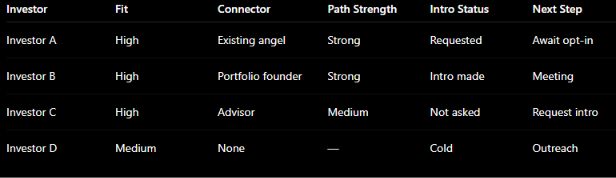
Useful statuses might include:
path identified
connector contacted
connector agreed
investor opt-in requested
introduction made
meeting booked
passed
follow-up
Now warm access becomes an operating process rather than scattered relationship memory.
Step 12: Read What Happens After the Introduction
The introduction itself is not the outcome.
What happens next creates the real fundraising signal.
For example:
Intro accepted
The investor was willing to hear more.
Meeting booked
The opportunity received direct time.
Second meeting
The conversation advanced.
Diligence
The investor began serious evaluation.
Terms
The conversation moved toward investment structure.
Our guide to investor signals explains how those actions should be interpreted differently as the raise progresses.
Do not report:
We have ten warm introductions.
as though that means:
We have ten interested investors.
Track what happened after the door opened.
Warm Path vs Cold Outreach
Cold outreach is not failure.
Many investors explicitly accept cold submissions.
OpenVC currently supports direct deck submissions, founder email outreach, investor forms, and warm-intro discovery depending on the individual investor's preferences.
So the decision should not be ideological.
Use the strongest appropriate access path available.
Existing Relationship
Use when you already know the investor.
Strong Warm Path
Use when someone credible can introduce you.
Inbound
Use when the investor discovers and approaches you.
Targeted Cold Outreach
Use when the investor fits but no credible warm path exists.
The mistake is not cold outreach.
The mistake is poorly targeted cold outreach sent because nobody checked for a better path first.
When a Cold Email Is Better Than a Weak Introduction
Consider this:
Option A
A highly relevant investor.
No mutual connection.
Founder sends an excellent targeted email.
Option B
A weakly relevant investor.
Founder can get introduced through a distant acquaintance.
Which is better?
Often Option A.
Warmth does not repair weak fit.
Similarly, a meaningless LinkedIn connection can create an awkward introduction without providing real credibility.
Do not force warmth where trust does not exist.
A cold email can be honest:
We haven't met, but I'm reaching out because you've invested in X and Y, and we're building Z.
That is a perfectly legitimate fundraising path.
Fit is the foundation. Access is the route.
Do Not Burn Connections Too Early
Some warm paths are valuable.
Use them carefully.
If the company is not ready for investor scrutiny, it may be smarter to strengthen the raise before asking respected connectors to spend credibility on it.
Before using your best introductions, confirm:
deck is clear
evidence supports the story
financial model is consistent
round is defined
major investor questions have answers
target investor actually fits
This is why fundraising preparation should happen before the most valuable access paths are activated.
A strong connection cannot compensate indefinitely for weak readiness.
Do Not Ask One Connector for Twenty Introductions at Once
This can turn a relationship into unpaid fundraising labor.
A better approach is to identify the few introductions where that connector has unusually strong relevance.
For example:
An advisor knows five investors.
But only two are excellent fits.
Ask for the two.
Quality protects the relationship.
It also makes the connector more confident that you have done the research rather than outsourcing investor targeting to them.
Do Not Overuse the Same Network
The same five people may know many investors.
That does not mean they should carry the entire round.
Expand the connection map.
Look through:
customers
partners
founders
employees
advisors
previous colleagues
university networks
accelerators
industry organizations
existing investors
Different networks may open different investor segments.
This is especially valuable when the company sits across multiple sectors.
The Best Warm Path May Not Be the Shortest Path
Imagine:
Path A
Founder → casual acquaintance → investor
One hop.
Path B
Founder → trusted advisor → portfolio founder → investor
Two hops.
Path B may be stronger.
Why?
Because trust can compound along a credible relationship chain.
The question is not simply:
How many degrees away is the investor?
It is:
How much credibility survives the path?
This is why network mapping should include relationship strength rather than connection count alone.
A Simple Warm-Path Score
Founders can use a basic framework to prioritize introduction opportunities.
Score each category from 0 to 2:
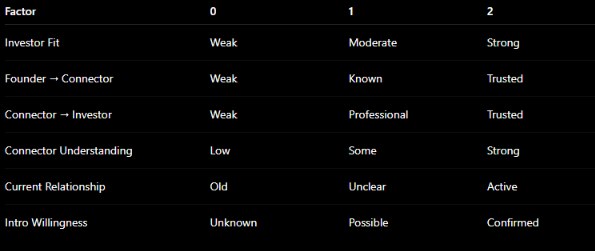
Maximum score: 12
This is not a scientific prediction.
It is a prioritization framework.
A path scoring 11 probably deserves more attention than one scoring 3.
The value is forcing the team to distinguish:
visible connection
from:
credible introduction path.
What Makes a Good Introduction Request?
Before pressing send, check whether your request answers these questions:
Who?
Which exact investor?
Why Them?
Why does this investor fit?
Why You?
What evidence makes the company worth seeing?
Why This Connector?
Why are you asking this person specifically?
What Do You Need?
A meeting?
Permission to send the deck?
A specific introduction?
Is It Easy to Forward?
Can the connector act without rewriting your message?
If those answers are clear, the request is much easier to accept.
Common Warm-Introduction Mistakes
Mistake 1: Searching the Network Before Defining Investor Fit
This lets relationships determine strategy.
Mistake 2: Asking for “Any Investors”
The connector should not need to build your target list.
Mistake 3: Choosing the Most Famous Connector
Trust matters more than fame.
Mistake 4: Assuming Every LinkedIn Connection Is Warm
A visible relationship can be extremely weak.
Mistake 5: Making the Connector Write the Pitch
Give them a forwardable note.
Mistake 6: Skipping Double Opt-In
Respect the investor's time and the connector's reputation.
Mistake 7: Using Introductions Before the Raise Is Ready
Do not spend valuable access while the investment case is still obviously incomplete.
Mistake 8: Treating the Introduction as Investor Interest
The introduction created access.
The investor's subsequent behavior creates the signal.
Mistake 9: Ignoring Cold Outreach When No Warm Path Exists
A relevant cold approach can outperform an irrelevant warm introduction.
How BFunded Thinks About Warm Introductions
BFunded's position on investor access is intentionally different from much of traditional venture fundraising.
The company argues that innovation should not depend on already knowing someone.
Its current mission is:
Capital should follow evidence. Not access.
The BFunded About page says founders should be matched to investors suited to back them rather than being judged primarily by whether they arrived through an existing relationship.
That does not mean relationships have no value.
They do.
A trusted introduction can reduce friction and create valuable context.
But the sequence should be:
Evidence
↓
Investor Fit
↓
Best Available Access Path
↓
Investor Signal
↓
Conversation
The network should help strong founders reach relevant investors.
It should not determine which founders deserve to be considered in the first place.
Frequently Asked Questions
What is a warm introduction to an investor?
A warm introduction is a connection between a founder and investor made by a third party who has an existing relationship with one or both sides and provides context for the conversation.
Are warm introductions necessary to raise venture capital?
No. Warm introductions can improve access, but many investors accept direct submissions and targeted cold outreach. Founders should use the strongest credible path available rather than assuming every investor requires an introduction.
Who is the best person to ask for an investor introduction?
Someone who knows the investor well, understands your company, and is genuinely comfortable recommending the conversation. Portfolio founders, existing investors, advisors, customers, and respected operators can all be strong connectors.
What is a double opt-in introduction?
The connector asks both the founder and investor whether they are comfortable being introduced before connecting them. OpenVC's current warm-intro guidance recommends this approach.
Should I ask someone to introduce me to multiple investors?
You can, but prioritize the introductions where the connector has particularly strong relationships and where investor fit is high. Avoid turning the connector into your outsourced fundraising team.
What should I send someone who is making an introduction?
Provide a short forwardable note explaining who you are, what the company does, the strongest evidence, the round, and why the specific investor is relevant.
Is a warm intro better than a cold email?
A strong warm introduction can provide trust and context, but investor fit remains more important. A targeted cold email to a highly relevant investor can be better than a weak introduction to someone who does not fit the raise.
How do I find warm investor connections?
Start with a qualified investor list, then map existing investors, founders, advisors, customers, operators, professional advisors, accelerators, and second-degree professional connections to each target.
Does a warm introduction mean the investor is interested?
No. It means the investor agreed to or received a connection. Their behavior afterward—meetings, requests, diligence, or terms—provides stronger evidence of actual interest.
The Bottom Line
Do not begin fundraising by asking:
Who can introduce us to investors?
Ask:
Which investors should we actually meet?
Then map the strongest credible path to each one.
Some will already know you.
Some will have a trusted connector.
Some will discover the company inbound.
Others will require cold outreach.
That is fine.
The objective is not to make every investor relationship warm.
The objective is to put strong founder evidence in front of the right investor through the best available path.
Because access can open the conversation.
Evidence still has to carry it.
Keep reading
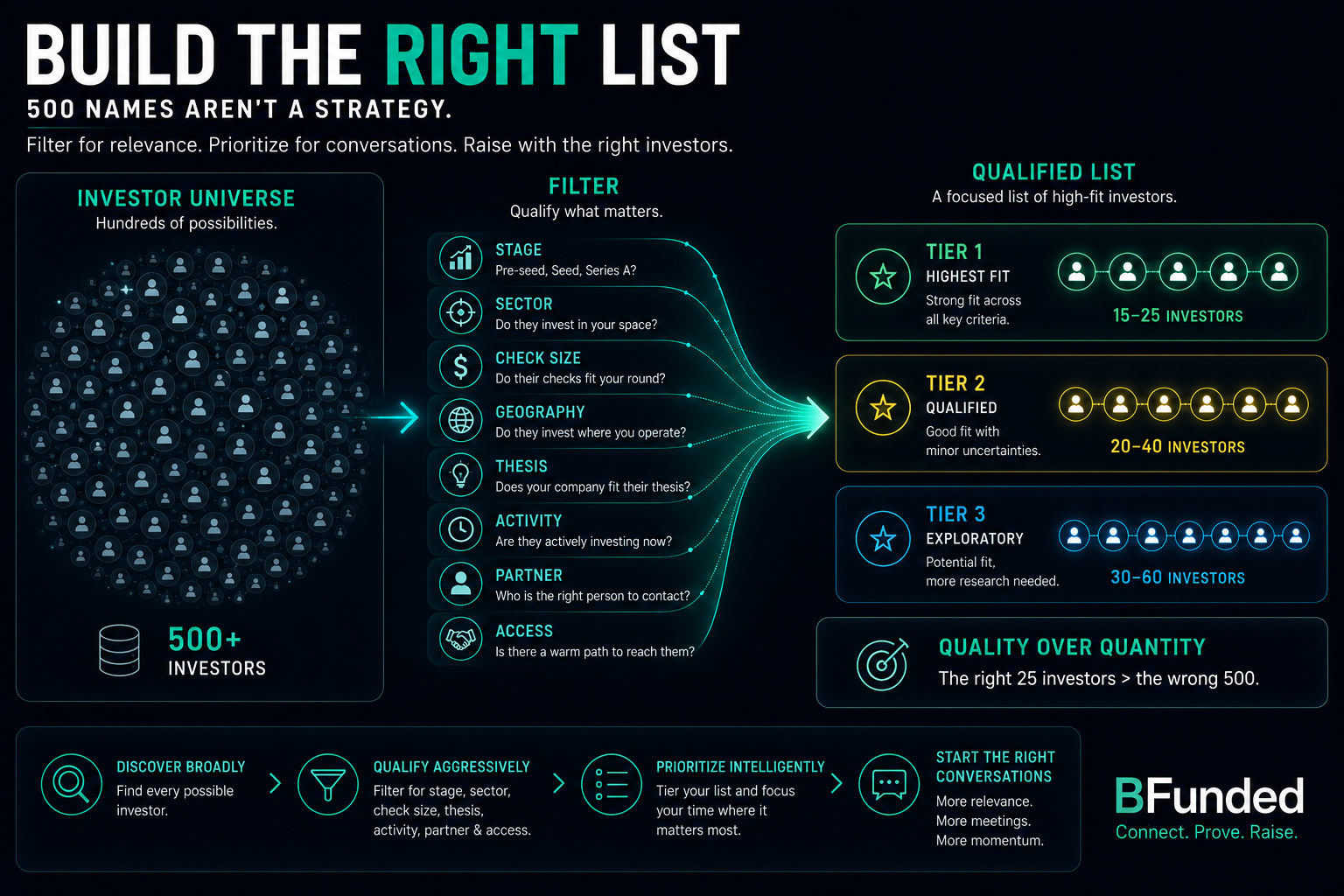
How to Build an Investor List That Actually Matches Your Raise
Learn how to build a startup investor list by filtering investors for stage, sector, check size, geography, thesis, activity, partner fit, and warm access.
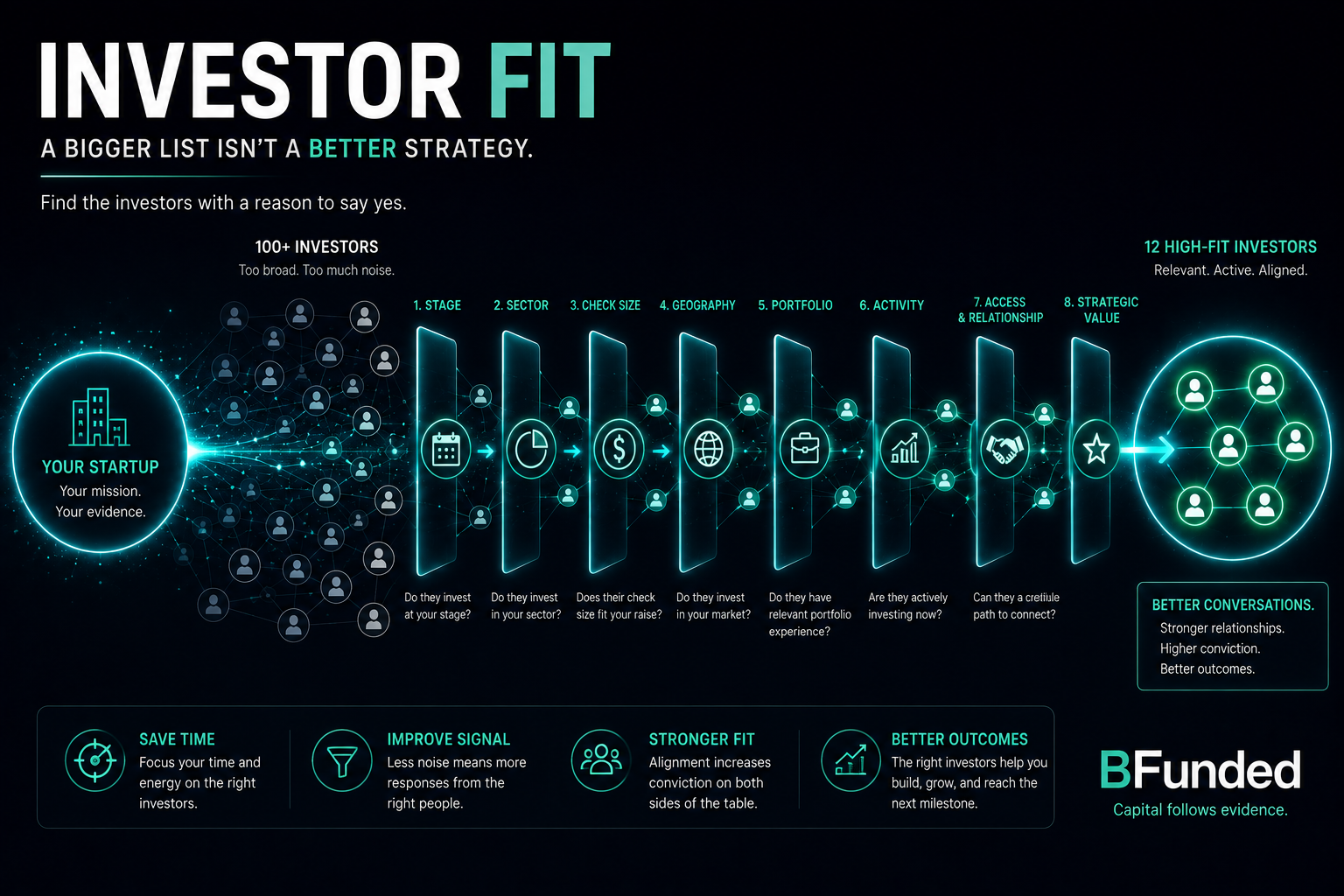
Investor Fit: How to Know Whether an Investor Actually Fits Your Startup
Investor fit goes beyond finding names. Learn how to evaluate startup investors by stage, sector, check size, thesis, portfolio, activity, access and long-term value.
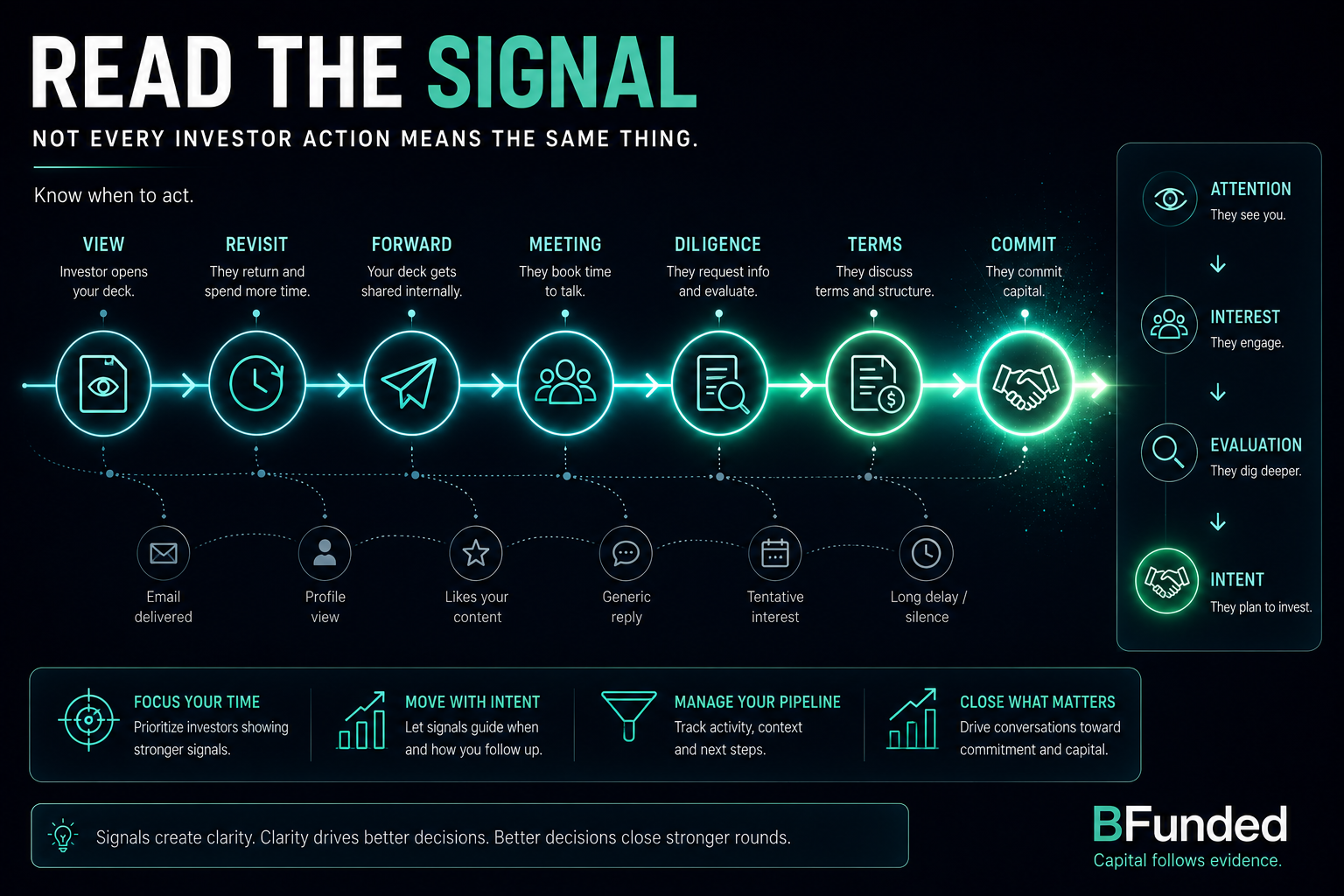
Investor Signals: How to Know When an Investor Is Actually Interested
Learn how to read investor signals during a startup raise, from pitch deck views and repeat engagement to meetings, diligence, terms, and actual commitments.