How to Build an Investor List That Actually Matches Your Raise
Learn how to build a startup investor list by filtering investors for stage, sector, check size, geography, thesis, activity, partner fit, and warm access.
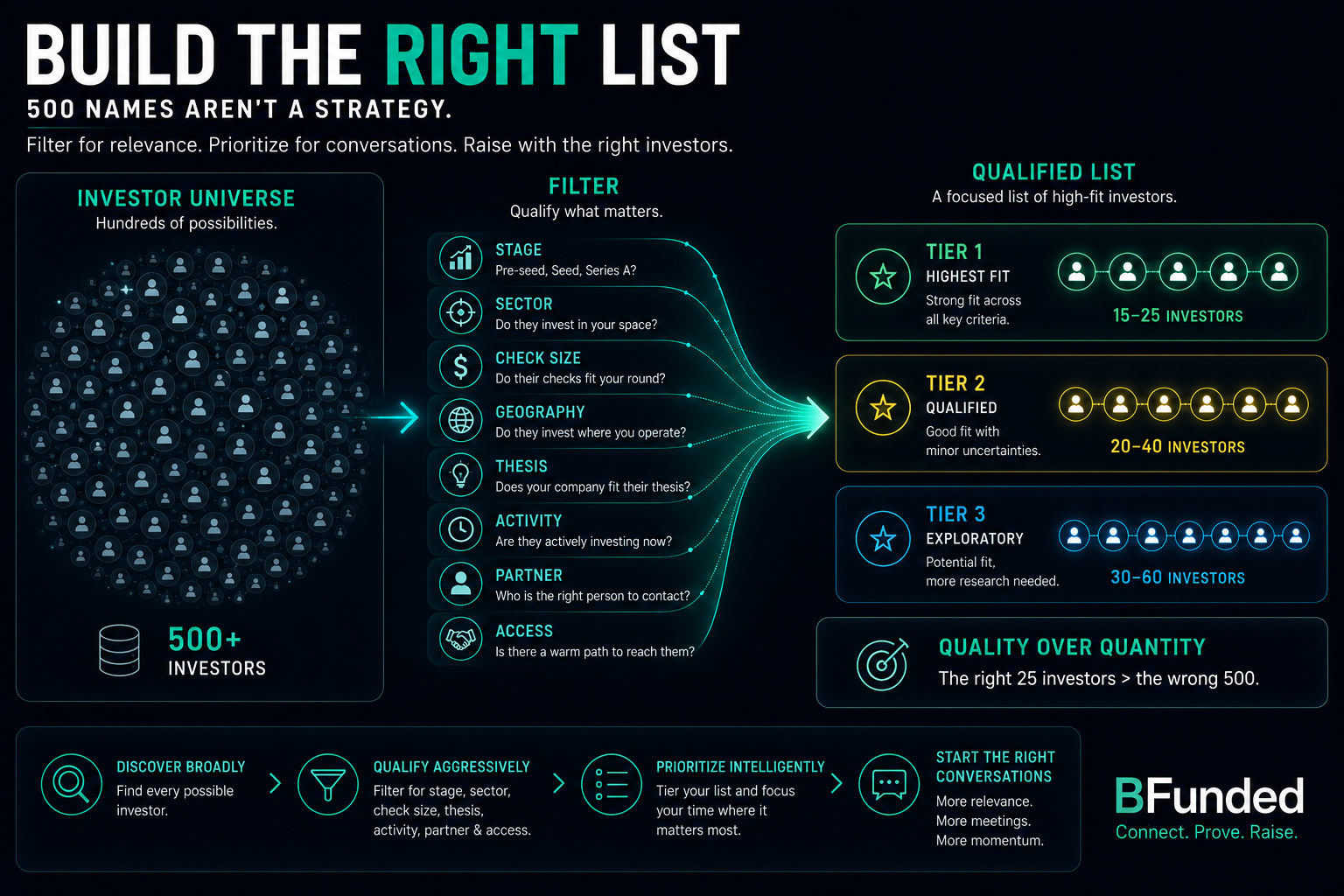
A spreadsheet with 500 investor names is not automatically a fundraising asset.
Sometimes it is just 500 opportunities to waste founder time.
The purpose of a startup investor list is not to collect as many investors as possible.
It is to create a qualified universe of investors who can realistically invest in your company, at your stage, in your round, right now.
That means every serious name on the list should survive a basic question:
Why does this investor belong here?
The answer should be more specific than:
“They invest in startups.”
A strong investor list is built around stage, sector, check size, geography, thesis, portfolio, recent activity, partner fit, and access.
Then it is prioritized.
Because the goal is not more names.
The goal is more relevant conversations.
What Is a Startup Investor List?
A startup investor list is the working database of investors a founder may approach during a fundraising round.
Depending on the company, it can contain:
venture capital firms
individual VC partners
angel investors
angel groups
family offices
corporate venture funds
strategic investors
syndicates
accelerators
other relevant capital providers
But there is an important distinction between a database and a target list.
An investor database answers:
Who exists?
A target investor list answers:
Who should we actually spend time trying to reach?
That difference is the foundation of good investor targeting.
OpenVC currently gives founders access to thousands of investor profiles, but its own guidance explicitly recommends filtering by factors such as stage, sector, geography, and check size because not every investor in the database is relevant to every startup.
Discovery creates possibilities.
Qualification creates strategy.
Step 1: Define the Raise Before Searching for Investors
Do not begin with Crunchbase, LinkedIn, OpenVC, a spreadsheet, or a list someone sent you.
Begin with the raise.
Write down:
company stage
sector
business model
geography
round size
target check size
current traction
instrument or round structure
whether you need a lead
what this capital needs to achieve
Why?
Because investor research becomes far easier when the search criteria are defined before names start appearing.
Consider two startups.
Startup A
Pre-seed B2B AI company
Raising $750K
Looking for $100K–$300K checks
U.S.-focused
Early paid pilots
Needs investors comfortable investing before scaled revenue
Startup B
Series A consumer marketplace
Raising $8M
Looking for a $4M–$5M lead
Operating across Southeast Asia
Strong GMV growth
Needs a fund with marketplace experience and regional follow-on capacity
Both may be called “technology startups.”
Their investor lists should look almost nothing alike.
List-Building Check
Before research begins, you should be able to state:
We are a [stage] company in [sector], raising [amount], looking primarily for investors writing [check range] into companies with [relevant evidence/geography].
If that sentence is difficult to complete, the raise itself may need more definition before investor research begins.
Step 2: Build an Ideal Investor Profile
Before looking at individual names, define what a high-fit investor looks like.
Think of it as an Ideal Investor Profile.
For example:
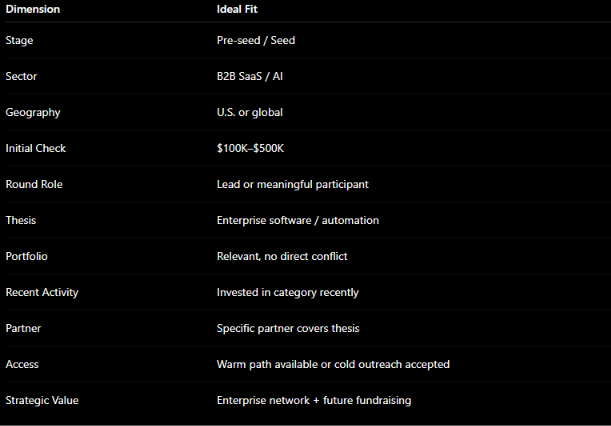
This profile becomes the standard against which names are evaluated.
Without it, list building often becomes emotional.
A founder sees a famous VC firm and adds it.
Then another.
Then a celebrity angel.
Then a fund someone mentioned on a podcast.
Soon the spreadsheet is large, but nobody can explain why half the investors are there.
Your Investor Fit framework should define the qualification criteria before the list begins expanding.
Step 3: Start Broad — But Not Random
Once the raise and Ideal Investor Profile are defined, begin discovery.
Useful sources can include:
investor databases
VC portfolio pages
angel networks
accelerator networks
founder communities
existing investors
industry events
public funding announcements
LinkedIn
startup databases
professional networks
portfolio-founder recommendations
At this stage, the list can be broader than the final target universe.
That is useful.
You are discovering possibilities.
But broad does not mean random.
A seed-stage fintech founder may reasonably discover:
seed-focused fintech funds
generalist seed funds with relevant fintech activity
fintech operators who invest as angels
corporate venture funds with relevant mandates
family offices active in financial technology
They probably should not add every famous venture firm in the world.
Visible's current investor-discovery product similarly centers filters such as check size, stage, sector, and geography so founders can reduce time spent researching irrelevant investors.
The first list is a research universe.
It is not yet the outreach list.
Step 4: Filter by Stage
Stage mismatch is one of the easiest ways to remove irrelevant investors.
Ask:
Do they actually invest at our current stage?
Is that stage part of the current fund?
Have they made recent investments at this stage?
Do they lead, follow, or both?
What evidence do companies normally have when this investor enters?
Do not rely only on labels.
“Early stage” can mean different things to different funds.
One investor may consider pre-revenue startups.
Another may describe itself as early-stage while mainly investing after several million dollars in annual revenue.
Look at actual investments.
The best evidence of investor behavior is often what the investor has recently funded.
Step 5: Filter by Check Size
An investor may love your sector and still be unable to participate meaningfully in your round.
Check size should be evaluated in context.
Ask:
What is their typical initial check?
What is the minimum?
What is the maximum?
Do they target a specific ownership percentage?
Do they reserve capital for follow-on rounds?
Do they lead?
Can they fill the role you need in this round?
Suppose you are raising $1 million.
A fund that typically invests $5 million for 15% ownership may be an obvious mismatch.
A $25K angel could still be relevant, but probably not as the lead investor.
The list should reflect the role each investor could realistically play.
You can add a field such as:
Role: Lead / Core / Participant / Strategic Angel
That makes the list far more operational.
Step 6: Filter by Sector and Investment Thesis
Broad industry labels are rarely enough.
“Software.”
“Healthcare.”
“AI.”
“Climate.”
These categories can hide very different investment theses.
Read:
the investor's website
thesis pages
partner writing
portfolio
recent investments
interviews
public comments about what they are looking for
Then ask:
Does our company actually fit the way this investor thinks about the category?
A fund interested in AI infrastructure may not care about consumer AI applications.
A climate investor focused on grid infrastructure may not invest in sustainable consumer products.
A healthcare investor may invest only in software and avoid therapeutics.
OpenVC's 2026 investor-list guidance similarly recommends qualifying investors by vertical, geography, stage, and other mandate-specific criteria before adding them to a shortlist.
The closer the thesis alignment, the easier it becomes to answer:
Why are we contacting this investor?
Step 7: Check Geography
Capital is more global than it used to be.
It is not geography-free.
Investors may restrict activity based on:
country of incorporation
headquarters
customer geography
target market
regulatory environment
partner location
fund mandate
Some funds invest globally.
Others appear global but concentrate most activity in a small number of markets.
Confirm what recent investments show.
Geography may also create positive fit.
If your next major milestone is U.S. market entry, an investor with strong U.S. customer relationships could be particularly relevant.
The point is not simply to ask:
Will they invest here?
Also ask:
Does their geography make them strategically useful for where we are going?
Step 8: Review the Portfolio
A portfolio page can tell you more than a marketing page.
Look for patterns.
What types of companies do they actually back?
At what stages?
In which markets?
Which business models?
Which partners led those deals?
This can reveal strong fit.
It can also reveal conflict.
If the fund already backs a direct competitor, consider:
how close the businesses are
which partner owns the competing investment
information-sharing policies
whether the investor can realistically engage
An adjacent company can validate thesis fit.
A direct competitor may create a reason for caution.
Do not send confidential competitive information before understanding that relationship.
Step 9: Check Recent Investor Activity
One of the biggest problems with investor lists is staleness.
The fund existed.
The partner worked there.
The thesis was relevant.
The investor wrote that size of check.
Three years ago.
Fundraising decisions need current information.
Look for:
investments in the past 12–24 months
recently announced funds
changes in partners
updated investment theses
current portfolio additions
signs of active deployment
public discussion of the sector
Gatekeep's current 2026 founder guide also recommends verifying recent investments and current partner focus rather than treating an investor's historical profile as proof they are actively deploying capital today.
An investor should not remain Tier 1 because they used to be perfect.
Step 10: Identify the Right Partner
Do not stop at the firm.
Find the person.
At many VC firms, individual partners have specific:
sectors
stages
geographies
investment histories
networks
interests
If a firm invests in fintech but the person receiving your email only covers climate investments, firm-level fit is not enough.
Research:
who led relevant investments
who publishes about your category
who sits on relevant portfolio boards
who owns the thesis internally
who appears to be actively making new investments
Add the actual partner to the list.
Not only:
Example Ventures
but:
Example Ventures — Jane Smith — Partner — Enterprise AI
That small change can make outreach far more precise.
Step 11: Check for a Relationship Path
Now that you know which investors actually fit, examine how you might reach them.
Possible paths include:
existing investors
advisors
customers
portfolio founders
operators
lawyers
accountants
accelerator networks
alumni
founders in your community
mutual professional connections
The order matters.
First:
Does this investor fit?
Then:
Can someone credible connect us?
Not the other way around.
A warm relationship does not repair poor investment fit.
But a warm path to a high-fit investor can be extremely valuable.
Gatekeep's current founder guide recommends mapping introductions through portfolio founders, advisors, customers, operators, existing investors, and professional communities once relevant investors have been identified.
Article 08 will go deeper into how to identify and use those warm paths.
Step 12: Score and Tier the List
A flat spreadsheet encourages founders to treat every investor equally.
Do not do that.
Create tiers.
Tier 1 — Highest Fit
Strong alignment across:
stage
sector
check size
geography
activity
partner
portfolio
access
These deserve the most founder attention.
Tier 2 — Qualified
They meet the major criteria but may have one or two uncertainties.
Examples:
thesis appears relevant, but activity is unclear
good sector fit, no relationship path
stage fits, but check size is near the edge
Tier 3 — Exploratory
Potentially relevant, but weaker evidence of fit.
These should not receive the same time investment as Tier 1.
A useful investor list might therefore look like:
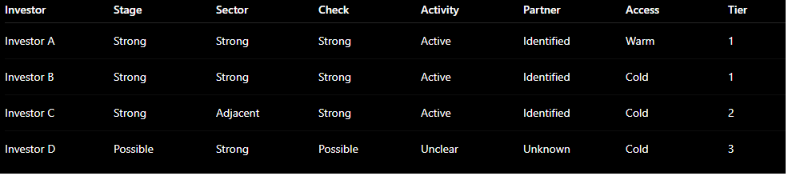
The point is not the exact tier labels.
The point is forcing prioritization.
Step 13: Add the Fields You Will Need During Outreach
An investor list becomes much more useful when it is designed to become a fundraising pipeline later.
Recommended fields include:
Identity
firm
investor name
role
email
profile URL
Fit
stage
sector
check size
geography
thesis
relevant portfolio companies
conflict
recent activity
partner fit
Access
warm connection
introducer
relationship strength
cold submission route
Strategy
priority tier
why this investor fits
personalized angle
likely objection
potential strategic value
Pipeline
outreach status
last activity
meeting stage
next action
follow-up date
commitment status
Now the list can move directly into fundraising operations without being rebuilt from scratch.
How Many Investors Should Be on the List?
There is no universal magic number.
The answer depends on:
round size
stage
target check size
sector
geography
investor concentration
existing network
conversion rates
OpenVC's February 2026 guide proposes sizing the list relative to the amount of capital represented in the pipeline rather than simply counting investor names.
That is a useful principle.
The important question is not:
Do we have 100 investors?
It is:
Does this qualified list represent enough realistic capital and enough relevant investors to run a real process?
A list of 40 investors who regularly write $250K–$1M checks may support one type of raise.
A list of 100 angels writing $10K–$25K checks may represent something completely different.
Think about capital coverage and fit, not vanity list size.
Do Not Send the Same Pitch to Everyone on the List
Qualification should improve outreach.
If you have researched:
the investor's thesis
relevant partner
portfolio
check size
stage
reason for fit
then your message should reflect that knowledge.
That does not mean writing a 500-word personalized essay for every investor.
It means answering:
Why them?
A useful opening can reference:
relevant thesis
specific portfolio pattern
market focus
shared connection
relevant investment history
Bad targeting produces generic outreach.
Good targeting makes specificity possible.
Do Not Use Tier 1 Investors as Practice Calls
There is a nuance here.
Founders often improve their pitch through early investor conversations.
That is normal.
But your highest-value investor relationships should not be the first time you discover that:
your story is confusing
your financial assumptions do not reconcile
your traction slide raises obvious questions
your round size makes no sense
Before starting the highest-priority conversations, make sure the company and fundraising materials are sufficiently prepared.
Our Startup Fundraising Readiness Checklist explains what should be in place before outreach becomes active.
A Better Investor List Is a Living System
Investor research is not complete the moment the spreadsheet is built.
Update it.
Investors change firms.
Funds close.
New funds launch.
Partners change focus.
Companies enter portfolios.
Warm paths appear.
The company itself also changes.
A pre-seed founder may become a seed-stage founder.
The round may grow.
Traction may improve.
A previously irrelevant investor may become highly relevant six months later.
Treat the list as live fundraising infrastructure.
Not a one-time research project.
Common Investor-List Mistakes
Mistake 1: Measuring Quality by Number of Names
A larger spreadsheet can still contain fewer relevant targets.
Mistake 2: Adding Famous Investors Automatically
Brand recognition is not an investment criterion.
Mistake 3: Ignoring Check Size
Good sector fit cannot repair a completely incompatible ownership model.
Mistake 4: Using Old Investor Data
The most relevant information is often recent behavior.
Mistake 5: Targeting Firms Instead of Partners
The firm may fit while the individual investor does not.
Mistake 6: Treating Warm Connections as Qualification
Access and fit are different.
Mistake 7: Skipping Portfolio Conflicts
The most sector-relevant investor may also back your closest competitor.
Mistake 8: Failing to Prioritize
A flat list creates a flat allocation of founder attention.
Mistake 9: Starting Outreach Before Research Is Finished
Once investor conversations begin, rebuilding the targeting strategy becomes expensive.
From Investor List to Investor Strategy
A strong investor list should eventually answer five questions for every priority name:
1. Can they invest?
Stage, geography, check size, mandate.
2. Would they care?
Sector, thesis, portfolio, market.
3. Are they active?
Recent investment behavior.
4. Who should we contact?
Specific partner or investor.
5. How should we reach them?
Warm path, direct submission, or targeted cold outreach.
If you cannot answer those questions, the name probably belongs in research — not yet in outreach.
How BFunded Approaches Investor Lists
BFunded's current positioning makes a clear argument:
A founder does not need a million investors. They need the few hundred who understand what they are building and have written checks in that sector before.
That is why BFunded's model combines founder evidence with investor matching rather than treating access to a large investor database as the final product.
The current BFunded site describes a 1M+ investor network, while its earned-access model progressively opens relevant investor reach as founders pass additional tests.
The logic is:
Evidence first.
Then:
Match.
Then:
Access.
A large network creates discovery potential.
Matching creates relevance.
And relevance is what turns a database into a fundraising strategy.
Frequently Asked Questions
What should be included in a startup investor list?
At minimum, include investor and firm name, stage, sector, check size, geography, thesis, recent activity, relevant portfolio companies, partner, relationship path, priority, and outreach status.
Where can founders find startup investors?
Common sources include investor databases, VC portfolio pages, angel networks, accelerators, founder communities, funding announcements, LinkedIn, professional networks, and introductions from founders or advisors.
How many investors should I put on my list?
There is no universal ideal number. The list should contain enough qualified investors and realistic capital coverage to support the round without reducing fit standards simply to reach a target count.
Should I include famous VC firms on my investor list?
Only when they fit the company and round. Reputation alone does not create stage, thesis, check-size, or sector alignment.
How do I know whether an investor is active?
Review recent portfolio investments, new fund announcements, partner activity, current thesis content, and other recent evidence that the investor is still deploying capital.
Should I find warm introductions before building the investor list?
Usually, qualify the investor first and map the relationship path second. A warm introduction is more valuable when the investor already fits the raise.
Should I target the VC firm or an individual partner?
Research the specific person whose investment history and focus best match the company. Firm-level fit is useful, but investment decisions are ultimately driven by people.
How often should an investor list be updated?
Update it throughout the raise. Investor roles, fund activity, portfolio conflicts, relationship paths, and your own company's stage can all change.
The Bottom Line
The investor list is not the fundraising strategy.
It is the raw material for one.
A strong list tells you:
who can invest
who is likely to care
who is active
who inside the firm matters
and
how you might reach them.
Everything else is noise until proven relevant.
Do not build the biggest investor list.
Build the list that gives your raise the strongest reasons to start the right conversations.
Keep reading
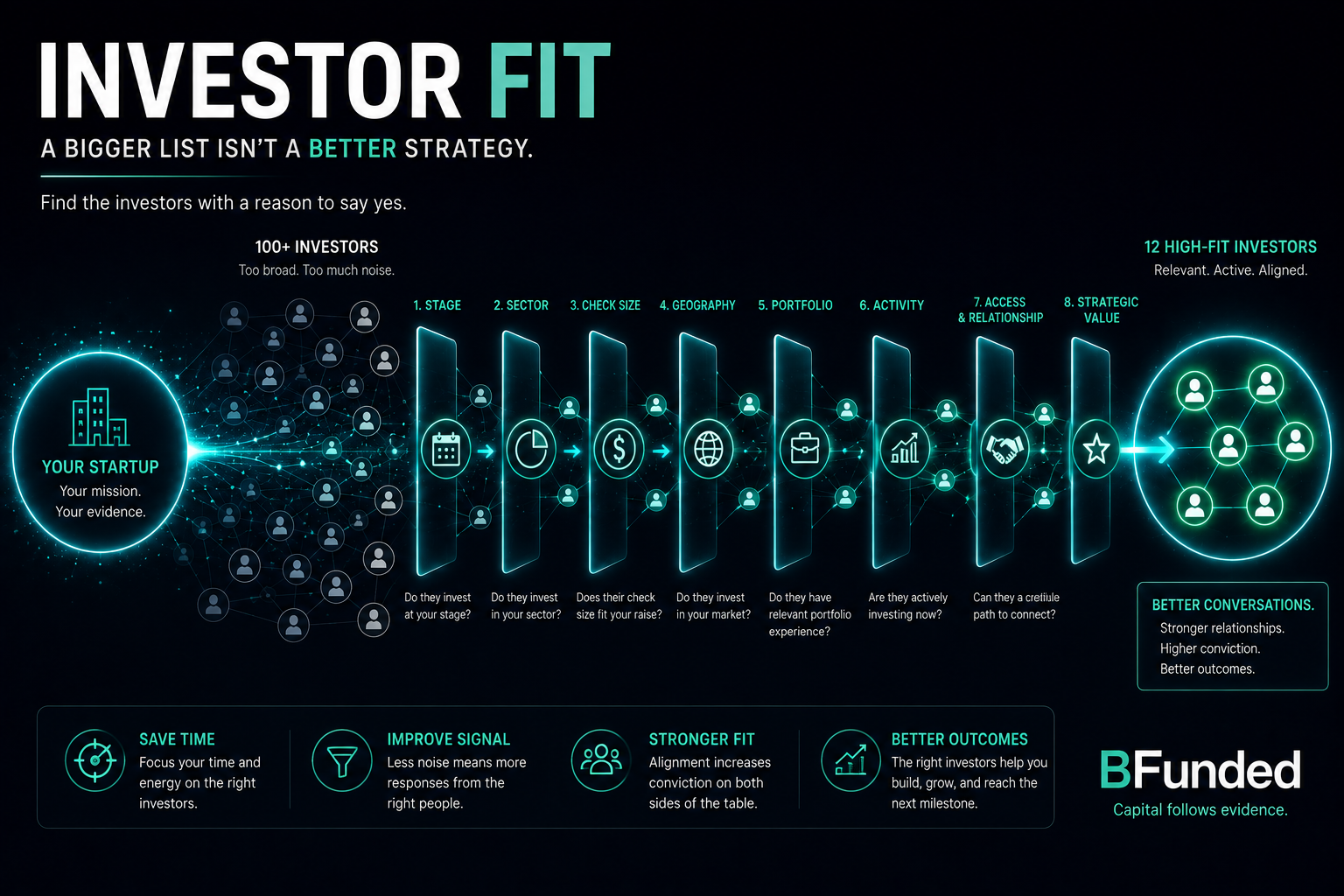
Investor Fit: How to Know Whether an Investor Actually Fits Your Startup
Investor fit goes beyond finding names. Learn how to evaluate startup investors by stage, sector, check size, thesis, portfolio, activity, access and long-term value.
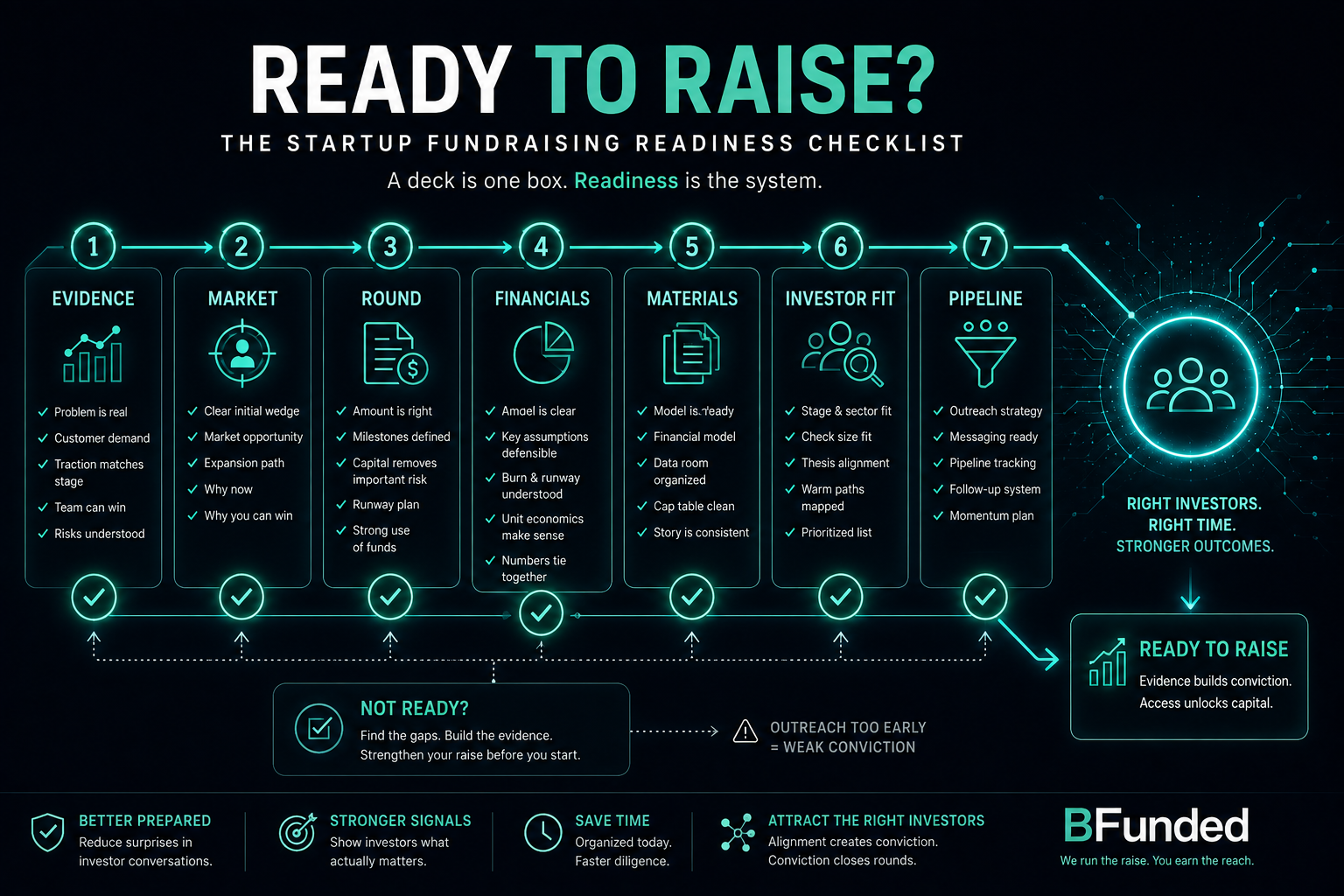
Startup Fundraising Readiness Checklist: Are You Actually Ready to Raise?
Use this startup fundraising readiness checklist to assess your evidence, pitch, financials, data room, investor strategy and fundraising process before outreach begins.
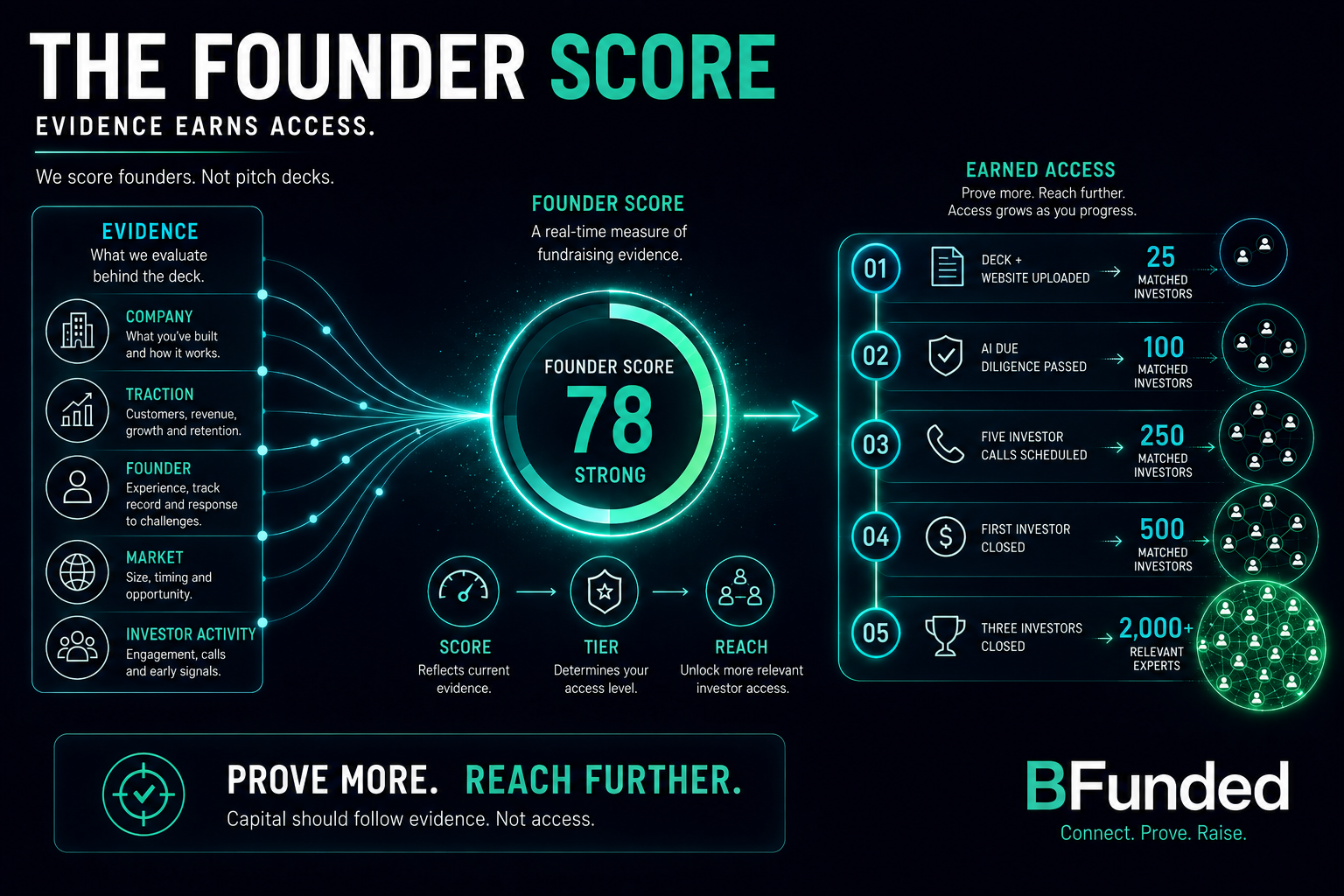
The BFunded Founder Score: What It Measures and Why It Matters
Learn how the BFunded Founder Score turns startup evidence into a fundraising signal, how the Five Tests unlock investor reach, and what the score does — and does not — mean.