How to Find Investors for Your Startup Without Wasting Months on the Wrong Ones
Learn how to find investors for your startup by qualifying stage, sector, check size, activity, investor fit, access paths, and fundraising signals before outreach.
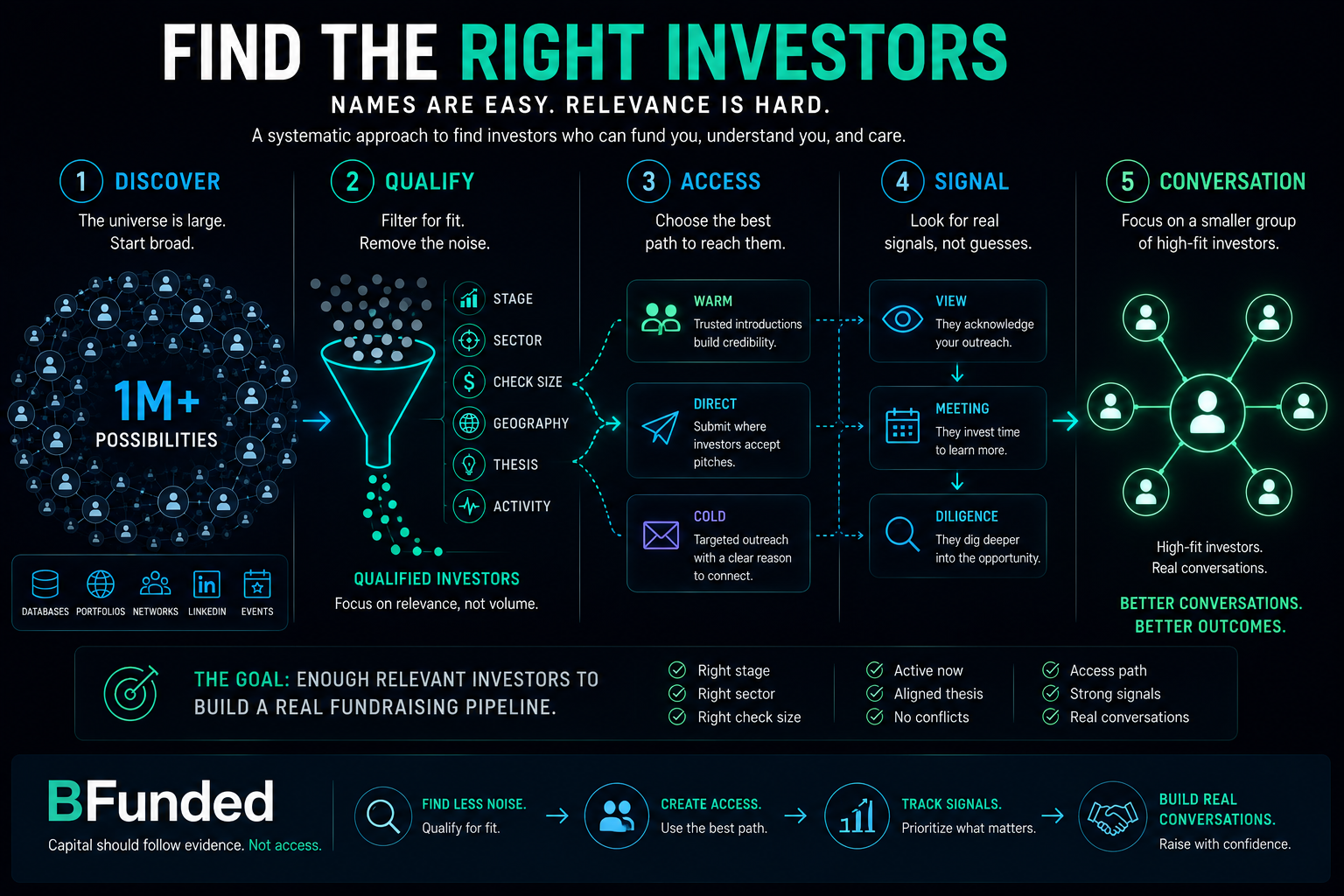
Finding investor names is not the hardest part of fundraising anymore.
There are databases, portfolio pages, LinkedIn, funding announcements, angel networks, accelerator communities, founder groups, and thousands of public investor profiles.
The difficult part is determining:
Which investors can realistically fund your company — and which ones are worth spending founder time on?
That difference matters.
A founder can spend months sending hundreds of emails and still have almost no real fundraising pipeline if the investors:
do not invest at the company's stage
write the wrong check size
do not understand the sector
have stopped deploying capital
operate in the wrong geography
have portfolio conflicts
or were never likely to evaluate the company seriously
The goal is therefore not:
Find as many investors as possible.
It is:
Find enough relevant investors to create a real fundraising process.
That requires four things:
Fundability → Investor Fit → Access → Execution
Get those in the wrong order and fundraising becomes noise.
Get them in the right order and the investor search becomes much easier to operate.
Step 1: Make Sure You Should Be Looking for Investors Yet
The first question is not:
Where do I find investors?
It is:
Are we ready for investors to evaluate us?
A founder can build a perfect investor list and still fail to raise if the underlying company evidence is too weak.
Before spending weeks researching investors, ask:
Is the problem clearly defined?
Is there meaningful evidence customers care?
Does our traction make sense for our stage?
Can we explain why this team should win?
Is the market opportunity credible?
Do we know what the round will achieve?
Are the financials understandable?
Can we survive reasonable investor scrutiny?
Our Startup Fundraising Readiness Checklist covers these questions before active outreach begins.
This does not mean every startup must have revenue.
Early-stage companies are early by definition.
But investors need enough evidence appropriate to the stage to make the remaining uncertainty worth investigating.
Finding more investors cannot permanently solve weak fundability.
Step 2: Define Exactly What You Are Raising
Investor search becomes far more efficient once the round is clear.
Write down:
Stage
Pre-seed? Seed? Series A?
Raise Size
How much capital are you actually seeking?
Target Check Size
Do you need:
$25K angels?
$250K seed investors?
a $2M lead?
several core participants?
Sector
What category does the company actually belong in from an investor's perspective?
Geography
Where is the company incorporated, operating, and planning to expand?
Evidence
What traction or proof already exists?
Round Objective
What milestone does this capital unlock?
Now investor research has constraints.
Instead of:
Find startup investors.
you are really asking:
Find investors who back seed-stage B2B healthcare software companies in the United States, typically write $250K–$750K checks, and are actively investing now.
That is a much better search problem.
Step 3: Understand the Main Types of Startup Investors
Not every startup should target the same source of capital.
Common categories include:
Angel Investors
Individuals investing personal capital.
They can be particularly relevant at:
pre-seed
seed
smaller rounds
early validation stages
Some angels are primarily financial investors.
Others are experienced founders, operators, or industry experts who can add significant strategic value.
Angel Groups
Organized groups of individual investors who review opportunities collectively or through structured screening.
These can provide:
larger combined checks
multiple investor relationships
sector expertise
but may involve more structured evaluation.
Micro VCs
Smaller venture funds often focused on early-stage companies.
They may specialize by:
sector
geography
founder type
business model
Micro VCs can be particularly relevant for pre-seed and seed rounds.
Venture Capital Funds
Institutional funds investing across one or more stages.
VC funds normally operate within defined mandates involving:
stage
check size
ownership
geography
sector
return expectations
Do not assume every VC is relevant simply because they invest in startups.
Family Offices
Investment organizations managing capital for wealthy families.
Their mandates can vary dramatically.
Some operate similarly to venture funds.
Others focus on:
later-stage companies
specific sectors
impact
real assets
long-duration opportunities
Corporate Venture Capital
Investment arms of established companies.
They may invest where there is strategic alignment involving:
technology
distribution
market access
product ecosystem
future partnerships
Strategic alignment can be valuable, but founders should understand whether corporate objectives align with their own long-term goals.
Strategic Investors
Companies or individuals investing because the startup creates a commercial or strategic advantage.
The strongest source of capital depends on:
what you are building, your stage, the round, and what the company needs next.
Step 4: Build a Qualified Investor List
Now begin investor discovery.
A founder may use:
investor databases
VC websites
angel databases
accelerator networks
LinkedIn
funding announcements
startup communities
industry events
existing investors
founders
professional advisors
portfolio research
But the first list should not immediately become the outreach list.
Think of it as:
Investor Universe
↓
Qualification
↓
Target List
Our guide on building a startup investor list explains how to filter investors before outreach begins.
Current OpenVC guidance recommends narrowing investors using factors such as vertical, geography, stage, and check size rather than treating every database profile as a realistic target.
The same principle applies regardless of which database or research method you use.
Step 5: Filter by Stage
This is one of the simplest qualification filters.
If your company is pre-seed, an investor primarily entering at Series B is probably not worth founder outreach time.
Review:
stated investment stage
actual recent investments
company maturity when the investor first invested
whether the investor leads or follows
current fund strategy
Do not rely only on broad labels like:
Early-stage investor
because “early stage” can mean very different things across funds.
Look at behavior.
What have they actually funded recently?
Step 6: Filter by Sector and Thesis
An investor who backs “technology” may still be completely irrelevant.
A technology fund might focus specifically on:
AI infrastructure
cybersecurity
developer tools
while your company is consumer fintech.
Both are technology.
The investment logic is different.
Research:
investment thesis
portfolio
partner writing
recent investments
interviews
sector pages
public investment announcements
Ask:
Why would this investor care about this company specifically?
If the answer is difficult to articulate, the investor probably should not be a high-priority target.
Step 7: Filter by Check Size
Check size determines whether an investor can meaningfully participate in the round.
Suppose you are raising $750K.
An investor whose minimum check is $3M is probably not relevant.
Likewise, an angel investing $10K may be useful but cannot solve a $500K lead requirement.
For each target, understand:
typical initial check
check range
ownership expectations
whether they lead
follow-on reserves
maximum allocation
Classify investors by likely role:
Lead
Core Participant
Participant
Strategic Angel
This makes the eventual fundraising pipeline much easier to understand.
Step 8: Check Geography
Investor geography still matters.
A fund may invest only in:
U.S. corporations
European startups
Southeast Asian companies
specific local ecosystems
Others invest globally.
Do not infer global appetite only because one portfolio company operates internationally.
Look at:
company incorporation
headquarters
recent portfolio geography
partner location
fund mandate
regulatory restrictions
Also consider positive strategic value.
An investor in your target expansion market might help with:
customers
partnerships
hiring
future investors
market entry
Geography can therefore be both a constraint and an advantage.
Step 9: Check Whether the Investor Is Actually Active
Old investor lists are dangerous.
A partner may have changed firms.
A fund may have stopped deploying.
A thesis may have shifted.
The investor may be reserving remaining capital for existing portfolio companies.
Verify:
recent investments
new fund announcements
portfolio additions
partner activity
current sector focus
active public presence
Gatekeep's current 2026 founder guide emphasizes recent investment activity, partner focus, check-size fit, sector fit, and portfolio conflicts when founders qualify investor targets.
The question is not:
Has this investor ever invested in a company like ours?
It is:
Are they likely to invest in a company like ours now?
Step 10: Identify the Right Partner
A VC firm is not one investor.
Different partners may focus on completely different:
sectors
stages
geographies
networks
investment themes
Do not stop at:
Example Ventures
Find:
Example Ventures → Jane Smith → Seed Fintech Partner
Research:
relevant portfolio investments
board seats
published thesis
areas of expertise
recent deal activity
This improves both:
fit
and:
outreach personalization.
A generic firm inbox may still be appropriate when the fund explicitly requests submissions there.
But when the right partner is identifiable, know who they are.
Step 11: Review Portfolio Fit and Conflicts
An investor portfolio provides two kinds of useful information.
Evidence of Fit
Relevant investments suggest the investor:
understands the sector
has conviction in the category
knows the customer
can evaluate the market
Evidence of Conflict
A direct competitor can create complications.
Before sharing sensitive information, understand:
portfolio overlap
partner involvement
conflict policies
how similar the businesses actually are
The right investor should understand the opportunity.
They should not create unnecessary information risk.
Step 12: Prioritize Investors Instead of Treating Everyone Equally
Once investors have been qualified, assign priorities.
For example:
Tier 1 — Highest Fit
Strong alignment across:
stage
sector
check size
geography
activity
thesis
partner
Tier 2 — Good Fit
Most major criteria align, but one or two uncertainties remain.
Tier 3 — Exploratory
Possible relevance, but more research or weaker alignment.
Now founder time has structure.
A Tier 1 investor deserves:
deeper research
stronger personalization
relationship-path analysis
careful timing
A Tier 3 investor should not consume the same amount of attention.
Prioritization is how research becomes strategy.
Step 13: Find the Best Access Path
Only after investor fit is established should you ask:
How do we reach them?
Potential paths include:
Existing Relationship
You already know the investor.
Warm Introduction
A trusted third party connects you.
Inbound Interest
The investor discovers the company.
Direct Submission
The investor accepts pitches through a form or platform.
Targeted Cold Outreach
You contact the investor directly with a relevant, specific message.
Our guide to warm introductions to investors explains how to map trusted paths after investor fit has already been established.
HubSpot's current startup-investor guide similarly recommends building a qualified target list and using founder networks and existing relationships when relevant rather than treating investor discovery as a mass-outreach exercise.
Warm access can improve context.
It does not create investment fit.
Step 14: Do Not Wait for a Warm Introduction That Does Not Exist
Founders sometimes waste weeks trying to manufacture a connection to an investor they could have contacted directly.
That can be just as inefficient as mass cold outreach.
If:
investor fit is strong
there is no credible warm path
the investor accepts direct outreach
then send the message.
Cold outreach is not inherently bad.
Irrelevant outreach is bad.
A strong cold message can explain:
why this investor
what the company does
strongest evidence
round
clear next step
OpenVC's current angel-investor guide similarly treats warm introductions, direct outreach, investor databases, and pipeline management as parts of the same systematic fundraising process rather than mutually exclusive strategies.
Use the best realistic access path available.
Step 15: Personalize the Reason, Not the Entire Email
Personalization does not mean writing a biography of the investor.
The useful question is:
Why are we contacting this person?
Possible reasons:
You invested in two companies serving the same customer group.
Your thesis explicitly covers our category.
You recently wrote about the market problem we're solving.
Your typical seed check matches our round.
A portfolio founder suggested we speak.
That is useful personalization.
This is not:
I saw you went to Stanford and enjoy skiing.
Investor targeting should create investment relevance, not superficial familiarity.
Step 16: Turn the Investor List Into a Pipeline
Finding investors is only the acquisition stage.
Once outreach starts, the process needs to track:
investor
fit
access path
outreach date
response
meeting
follow-up
requests
diligence
terms
commitment
pass reason
Without a pipeline, founders begin relying on memory.
Someone seemed excited.
Someone asked for the deck.
Someone wanted a follow-up.
Someone needed metrics next month.
Eventually context disappears.
OpenVC's current investor-pipeline guide frames fundraising as a progression from investor prospecting toward active conversations and eventual commitments rather than a collection of disconnected meetings.
The investor search is not complete when the name enters the spreadsheet.
It is complete when the relationship has an outcome.
Step 17: Read Investor Signals Instead of Guessing
Not every investor action means the same thing.
Consider:
Deck open
versus:
Second meeting
versus:
Diligence request
versus:
Terms discussion
Those are different levels of engagement.
A founder should prioritize investors partly based on what they are actually doing.
This creates a useful operating framework:
Fit × Access × Signal
Investor A:
High fit + warm path + diligence
Investor B:
High fit + cold outreach + first meeting
Investor C:
Low fit + warm intro + vague interest
Investor D:
Low fit + cold outreach + silence
Which deserves the most founder time?
Probably not C simply because the introduction was warm.
Our guide to investor signals explains how to distinguish attention, evaluation, intent, and commitment during a raise.
Where Startup Founders Actually Find Investors
There is no single perfect source.
Strong fundraising processes combine several.
Investor Databases
Useful for broad discovery and filtering.
Examples include platforms that organize investors by:
stage
sector
geography
check size
Databases make investor names easier to find.
They do not eliminate the need for qualification.
Portfolio Research
Start with companies similar or adjacent to yours.
Then ask:
Who funded them?
This can surface investors with proven category interest.
Funding Announcements
Recent startup funding news can reveal:
actively investing funds
relevant partners
current check sizes
category momentum
Recent deals are often more useful than an investor profile written three years ago.
Useful for:
partner research
mutual connections
career history
current firm
sector content
relationship mapping
But visible connections should not automatically be treated as strong relationships.
Existing Investors
One of the most useful sources.
Current investors may know:
co-investors
later-stage funds
angels
sector specialists
portfolio investors
Their incentive to help may also be stronger because they already own part of the company.
Other Founders
Founders who recently raised can provide unusually current information.
They may know:
who is actively taking meetings
who moves quickly
who actually invests
which partners matter
which funds quietly changed thesis
This information can be more current than public databases.
Customers and Partners
Do not overlook the commercial network.
A respected customer may know sector investors extremely well.
In some industries, customers can provide stronger credibility than traditional startup-network connections.
Accelerators and Communities
Useful for:
investor events
introductions
founder referrals
demo days
sector networks
Quality varies.
Do not confuse access to an event with actual investor fit.
Professional Advisors
Attorneys, accountants, advisors, and bankers can have extensive investor relationships.
Again:
qualify the investor before asking for the introduction.
How Many Investors Do You Need?
There is no universal number.
A round should have enough qualified investor coverage to survive:
passes
non-responses
timing mismatches
portfolio conflicts
changing priorities
But list size alone is misleading.
Consider:
List A
150 investors.
Typical relevant check: $25K.
List B
50 investors.
Typical relevant check: $250K–$750K.
Those lists represent completely different capital capacity.
OpenVC's current investor-list framework recommends thinking about the amount of potential capital represented by a shortlist, not just the number of names.
The useful question is:
Does this list contain enough realistic capital, from enough high-fit investors, to support the round?
Why Founders Waste Months on the Wrong Investors
Most wasted fundraising time can be traced to a few patterns.
Searching Before the Raise Is Defined
Without constraints, every investor looks potentially relevant.
Optimizing for List Size
More names feel like more opportunity.
Often they mean more administration.
Targeting Brand Instead of Fit
A famous fund is not automatically a useful investor.
Using Stale Investor Data
Past behavior is not current mandate.
Ignoring the Partner
Firm-level fit can hide partner-level mismatch.
Chasing Warm Introductions to Poor-Fit Investors
Warm does not mean relevant.
Waiting Forever for Warm Intros
Strong cold outreach can be better than a nonexistent connection.
Treating Every Investor Equally
Founder time should follow probability and signal.
Failing to Track the Pipeline
Good conversations disappear because follow-up becomes inconsistent.
Confusing Positive Feedback With Investment Intent
“Great company” is not a commitment.
The BFunded Approach: Find Relevance Before Reach
BFunded's current philosophy is built around a different problem than simple investor discovery.
The network already contains more than a million investors.
But BFunded's About page makes the point explicitly: a founder does not need a million investors; they need the smaller group who actually understand what they are building and have relevant investment experience.
That changes the fundraising sequence.
Not:
Database → Everyone → Outreach
But:
Founder Evidence
↓
Fundability
↓
Investor Fit
↓
Relevant Reach
↓
Access Path
↓
Investor Signals
↓
Conversation
↓
Commitment
BFunded's stated mission is that capital should follow evidence rather than access, with founders matched to investors suited to back them.
Finding investors is therefore not fundamentally a search problem.
Investor names are abundant.
Relevance is scarce.
Frequently Asked Questions
How do I find investors for my startup?
Start by defining your stage, round size, sector, geography, traction, and target check size. Then use investor databases, portfolio research, funding announcements, founder networks, LinkedIn, angel networks, accelerators, and professional relationships to build a qualified target list.
Where can I find angel investors?
Angel investors can be found through dedicated investor databases, angel groups, founder networks, startup communities, accelerators, professional networks, LinkedIn, and recommendations from other founders or existing investors.
Should I contact angel investors or venture capital firms?
That depends on your stage, round size, business, and capital needs. Angels and micro VCs can be especially relevant for smaller early-stage rounds, while larger institutional funds may become more appropriate as capital requirements and company maturity increase.
How many investors should I contact?
There is no universal number. Build enough qualified investor coverage to support the size of your round without lowering your fit standards simply to increase the number of names.
Is cold emailing investors worth it?
Yes, when investor fit is strong and the outreach is targeted. Cold outreach becomes inefficient when founders send generic pitches to poorly qualified investors.
Do I need warm introductions to raise venture capital?
No. Warm introductions can provide context and trust, but they are one access path among several. Strong investor fit and founder evidence remain more important than forcing every conversation through a connection.
How do I know whether an investor fits my startup?
Evaluate stage, sector, check size, geography, thesis, portfolio, current activity, specific partner focus, and strategic value.
What should I send an investor first?
Usually a concise message explaining the company, strongest evidence, round, and why the investor is relevant. Follow the investor's preferred submission process where one exists.
How long should finding investors take?
Investor research is an ongoing part of the fundraising process, but founders should build and qualify a meaningful target universe before high-priority outreach begins rather than discovering every investor one at a time while raising.
What is the biggest mistake founders make when finding investors?
Treating investor discovery as a volume problem. Finding more names does not help if stage, sector, check size, activity, or thesis are wrong.
The Bottom Line
You do not need investor names.
Those are everywhere.
You need investors who:
can invest
understand the opportunity
fit the round
are active now
and
have a credible reason to keep evaluating the company.
Then you need a path to reach them.
Then you need a process for moving the strongest conversations forward.
That is the difference between:
looking for investors
and
running a raise.
Keep reading
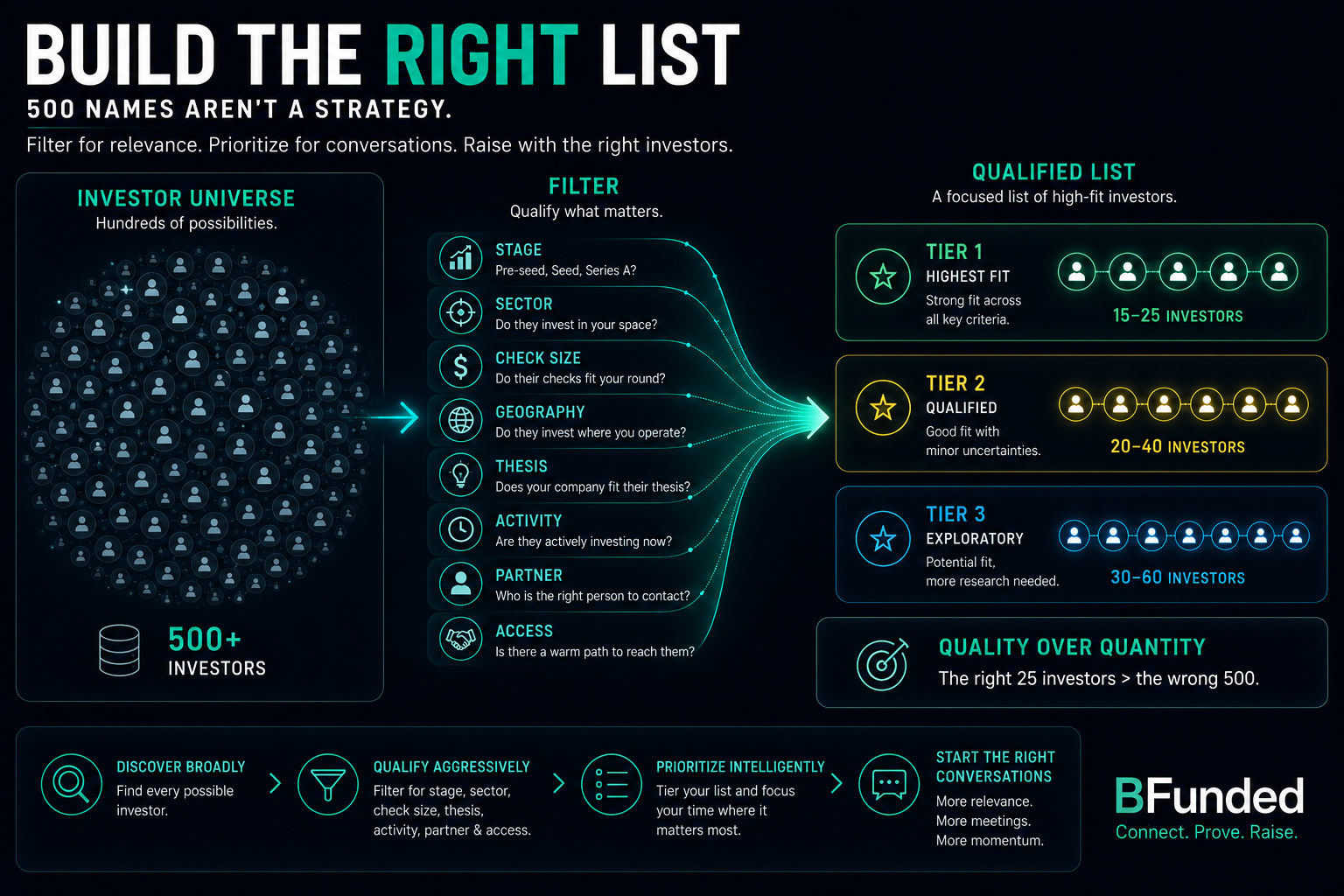
How to Build an Investor List That Actually Matches Your Raise
Learn how to build a startup investor list by filtering investors for stage, sector, check size, geography, thesis, activity, partner fit, and warm access.
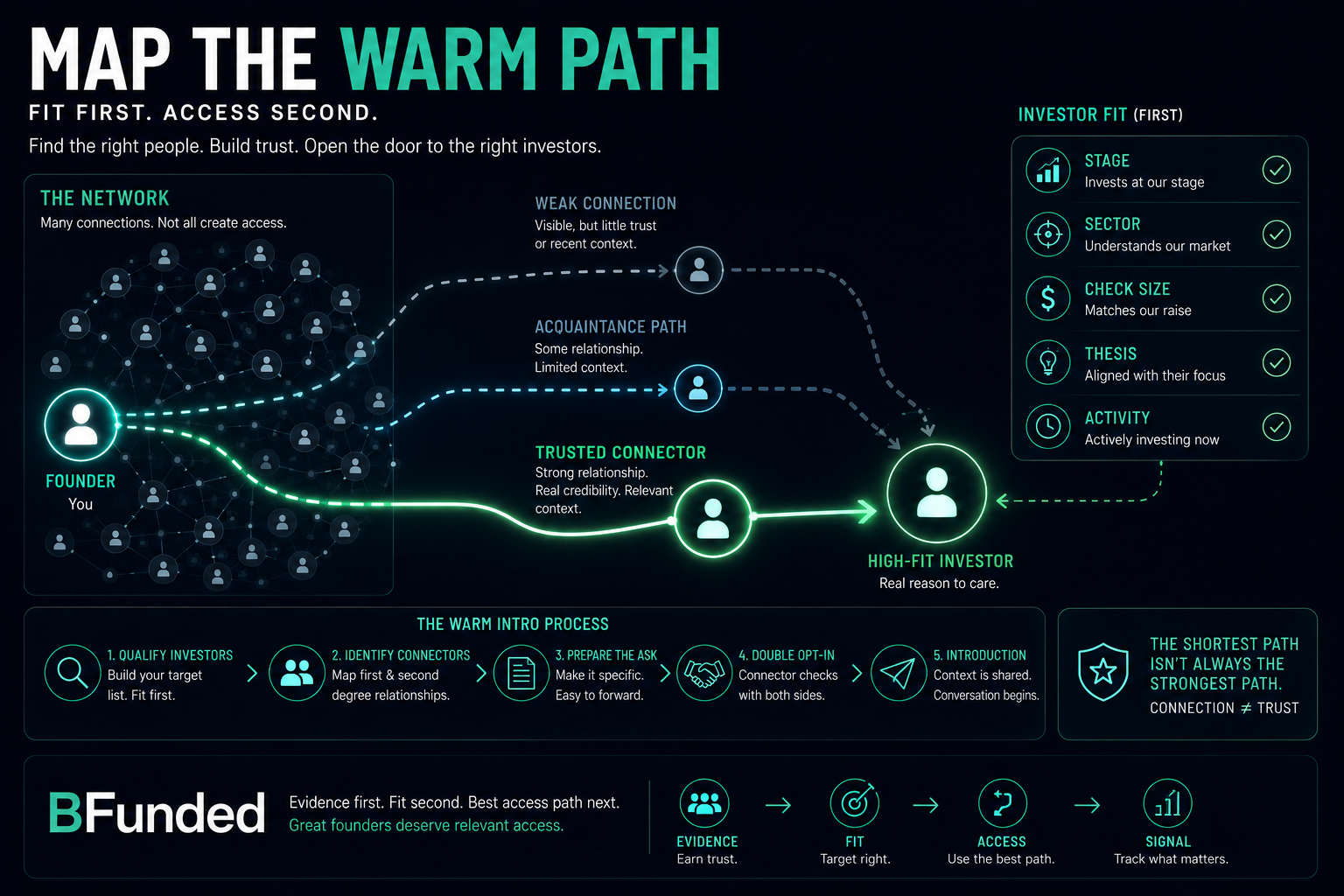
How to Find Warm Paths to the Right Startup Investors
Learn how to find warm paths to startup investors by qualifying investor fit first, mapping trusted connectors, creating forwardable intro requests, and tracking introductions through the raise.
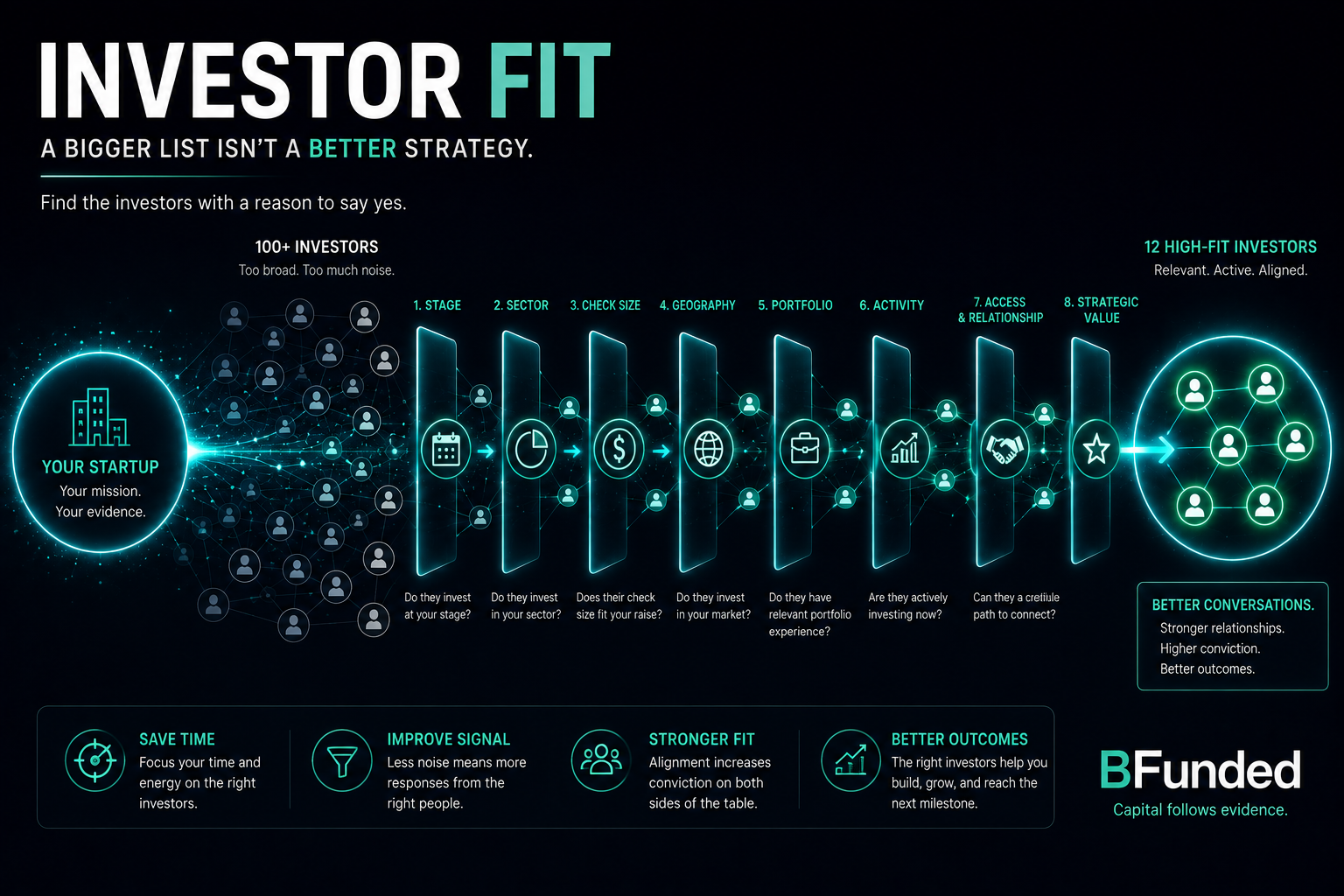
Investor Fit: How to Know Whether an Investor Actually Fits Your Startup
Investor fit goes beyond finding names. Learn how to evaluate startup investors by stage, sector, check size, thesis, portfolio, activity, access and long-term value.