Investor Fit: How to Know Whether an Investor Actually Fits Your Startup
Investor fit goes beyond finding names. Learn how to evaluate startup investors by stage, sector, check size, thesis, portfolio, activity, access and long-term value.
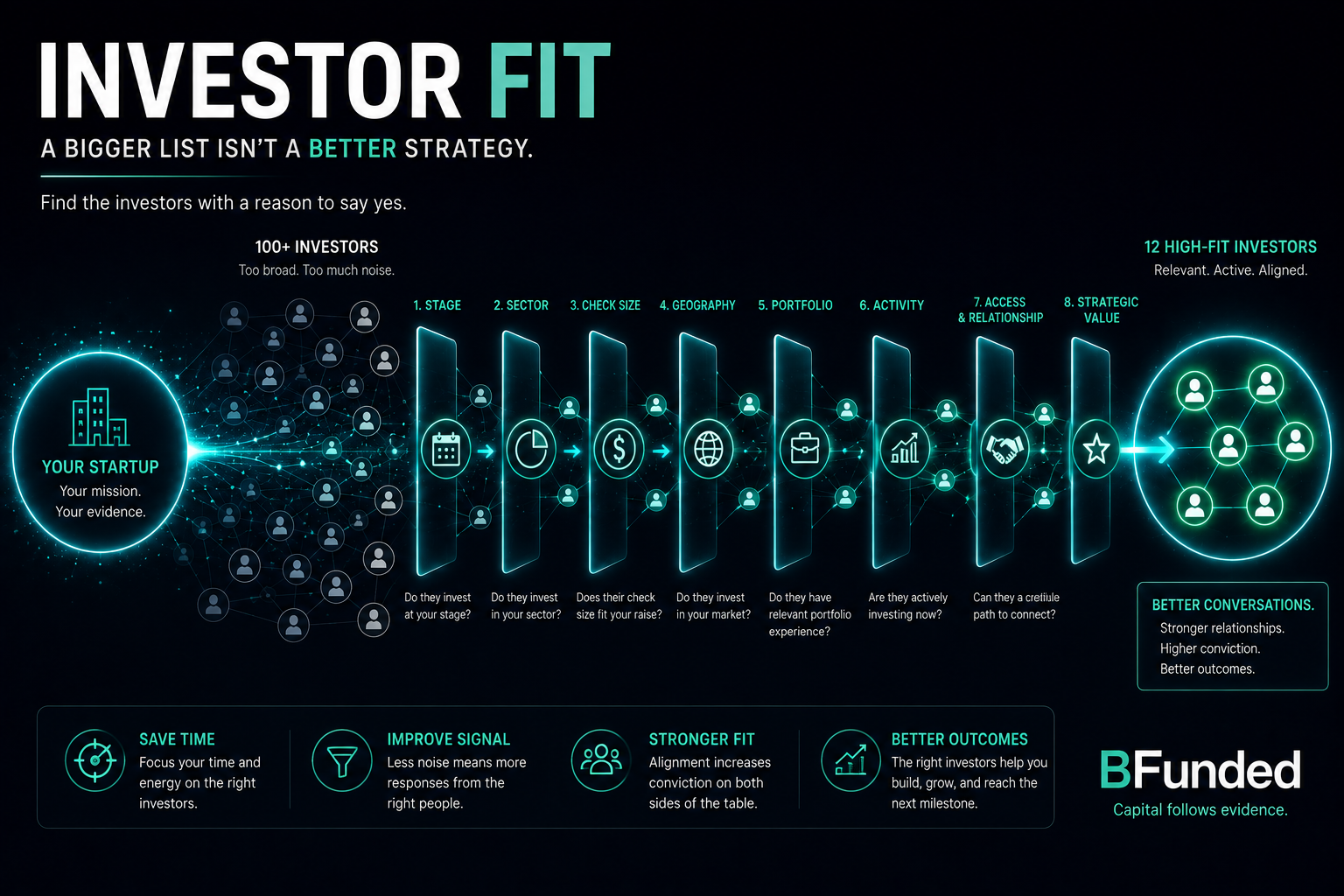
Finding investors is easy compared with finding investors who actually fit your startup.
There are thousands of venture funds, angel investors, family offices, syndicates and other capital sources. A founder can build a spreadsheet with hundreds of names in a few hours.
That does not make it an investor strategy.
Investor fit is the alignment between what your startup is raising and what an investor is realistically positioned, willing and useful enough to fund.
That alignment can include stage, sector, check size, geography, investment thesis, portfolio history, current activity and relationship path.
And there is another dimension founders sometimes overlook:
Would you actually want this investor involved in the company after the money arrives?
The goal is not to find the largest possible investor list.
It is to identify the investors where there is a credible reason for both sides to say yes.
What Is Investor Fit?
Investor fit answers two different questions.
The first is:
Does this investor fit the raise?
That includes objective factors such as:
stage
sector
check size
geography
investment model
portfolio
fund mandate
The second is:
Does this investor fit the company?
That can include:
relevant experience
network
reputation
decision-making style
expectations
follow-on capacity
board behavior
values
long-term usefulness
A founder should consider both.
An investor who loves your sector but never invests at your stage is probably not a realistic target.
An investor whose check size fits perfectly but whose behavior creates long-term friction may not be the right partner either.
Current founder guidance increasingly emphasizes this distinction. Investors should not be evaluated only on reputation, valuation or check size; long-term behavior, judgment and usefulness can matter for years after the round closes.
Why Investor Fit Matters
Poor investor fit wastes more than outreach.
It wastes founder attention.
Every irrelevant investor added to the pipeline can create:
research time
personalization work
introduction requests
emails
follow-ups
meetings
internal preparation
CRM administration
The cost compounds quickly.
Imagine two investor lists.
List A contains 500 investors.
Many invest in the wrong stage, write checks outside your range, have no relevant sector history or are no longer actively deploying capital.
List B contains 75 investors.
Each has a credible reason to consider the company.
The second list is smaller.
It may also represent a much stronger fundraising strategy.
This is why investor targeting should happen before outreach, not after months of poor response rates.
1. Does the Investor Match Your Stage?
Stage is one of the fastest filters available.
A pre-seed company should not spend significant time pitching a fund that normally enters at Series B.
Even when a firm describes itself as “multi-stage,” that does not mean every partner or fund vehicle actively invests at every stage.
Look at what the investor has actually done recently.
Ask:
Do they invest at pre-seed, seed, Series A or later?
Do they lead rounds or mainly follow?
Do they invest before meaningful revenue?
What maturity were recent portfolio companies when the investor entered?
Does the current fund still support this stage?
This matters because the evidence expected changes by stage.
A pre-seed investor may be willing to underwrite founder quality, customer insight and early product evidence.
A later-stage investor may expect meaningful revenue, retention, efficiency and a much more developed operating history.
The right startup can still be wrong for the investor's stage.
2. Does Your Sector Fit Their Investment Thesis?
“Technology investor” is not specific enough.
Two technology investors can have completely different mandates.
One may focus on:
enterprise SaaS
fintech
AI infrastructure
Another may focus on:
climate
healthcare
industrial technology
Even within the same category, the thesis can become more specific.
A healthcare investor may avoid therapeutics but actively fund healthcare software.
A climate fund may concentrate on energy infrastructure rather than consumer sustainability products.
Read the investment thesis.
Then compare it with actual portfolio activity.
Ask:
Has the investor backed companies in or adjacent to our sector?
Does their published thesis explicitly cover our category?
Which partner inside the firm understands this space?
Have they recently invested in this area?
Is there a portfolio conflict?
A good sector fit does not mean the investor has backed a company identical to yours.
It means there is evidence that they understand the category and have a mandate that can include the opportunity.
3. Does the Check Size Fit the Round?
Check-size mismatch eliminates many investors immediately.
If you are raising $1 million and an investor typically writes $5 million initial checks, the fit is weak.
If a fund normally invests $100,000 but you need a $3 million lead, it may still participate — but it probably cannot solve the main capital requirement.
Founders should distinguish between:
Lead investors
Investors capable of anchoring or pricing a meaningful portion of the round.
Core participants
Investors whose checks contribute significantly but may not lead.
Strategic angels or smaller checks
Investors who may add expertise, credibility or network value alongside capital.
For each investor, understand:
typical initial check
minimum check
maximum check
ownership targets
whether they lead
whether they follow
reserves for follow-on rounds
A check that fits mathematically is not automatically strategic.
But if the check does not fit at all, the rest of the analysis often becomes irrelevant.
4. Does Geography Matter?
Capital is increasingly global, but geography still influences investor fit.
Some funds invest only in companies:
incorporated in specific countries
headquartered in defined regions
serving particular markets
operating within certain regulatory environments
Others have broad international mandates.
Do not assume a fund will invest globally because its website has portfolio companies in multiple countries.
Confirm:
geographic mandate
incorporation requirements
local office or partner coverage
whether cross-border deals are common
whether the investor can support your target market
Geographic fit can also be strategic rather than restrictive.
If entering the United States is central to the company's next phase, an investor with deep U.S. commercial relationships may provide value beyond the check itself.
5. Does Their Portfolio Support or Conflict With You?
An investor's portfolio is one of the most useful sources of information available to founders.
It shows what the investor has actually funded — not merely what the website says they are interested in.
Look at:
sectors
business models
stages
geography
outcomes
follow-on activity
relevant partners
Portfolio companies can reveal genuine thesis fit.
They can also reveal conflicts.
An investor may be highly interested in your market precisely because they already back a direct competitor.
That does not automatically mean you should avoid the conversation.
But it means you should understand:
information barriers
conflict policies
partner overlap
how close the competing business really is
Do not reveal sensitive competitive information before understanding the situation.
6. Is the Investor Actually Active?
Investor databases can become stale quickly.
A fund may exist while no longer making new investments.
A partner may have moved firms.
An angel may have changed focus.
A fund may be reserving remaining capital for existing portfolio companies.
This makes recent activity an important fit signal.
Look for:
recent investments
newly announced funds
partner activity
recent portfolio additions
current thesis content
public statements about deployment
The question is not only:
Could this investor theoretically invest?
It is:
Are they realistically deploying capital now?
A technically perfect investor who is not writing checks is not a useful priority.
7. Is There a Credible Relationship Path?
Investor fit and investor access are related, but they are not the same thing.
An investor can fit perfectly without knowing the founder.
A founder can also have a warm relationship with an investor who has little reason to invest.
The strongest targets combine both:
high investment fit + credible access path.
Possible paths include:
existing investor
portfolio founder
advisor
customer
lawyer
accountant
accelerator
angel
operator
mutual professional connection
A warm introduction can improve context and trust.
But warmth should not replace fit.
A warm introduction to the wrong investor is still an introduction to the wrong investor.
That is why network mapping works best after the target investor universe has been filtered.
8. Does the Specific Partner Fit?
Founders often target firms.
But firms do not take meetings.
People do.
Within one venture firm, different partners can have completely different:
sectors
networks
investment histories
board styles
seniority
decision authority
interests
Research who actually sponsored the firm's relevant investments.
If a fund has five partners but only one consistently invests in your category, targeting the generic firm inbox may be much less effective than understanding the right person.
Ask:
Who owns this thesis internally?
Which partner made the relevant portfolio investments?
Is that partner currently taking new deals?
What types of founders or businesses do they publicly discuss?
Will this person be involved after investment?
Firm fit gets you into the right building. Partner fit gets you into the right room.
9. What Can the Investor Add Beyond Capital?
Not every investor needs to be highly operational.
Sometimes capital itself is the primary value.
But when choosing among multiple investors, founders should understand what each one can realistically contribute.
Potential value can include:
customer introductions
hiring
future fundraising
strategic partnerships
regulatory experience
market entry
technical expertise
pricing or go-to-market support
credibility with later-stage investors
Be skeptical of vague claims.
“Access to our global network” sounds good.
Ask what that means in practice.
Which customers?
Which markets?
Which follow-on investors?
What happened for previous portfolio companies?
The goal is not to demand that investors operate the business.
It is to understand whether the promised value is real.
10. How Does the Investor Behave When Things Go Wrong?
Investor fit becomes most important when the company is not following the plan.
Almost every investor will be supportive when:
growth is accelerating
the next round is oversubscribed
hiring is easy
customers are happy
A better diligence question is:
What happens when the company misses?
That might include:
a missed quarter
a difficult bridge round
an executive departure
a product delay
a failed expansion
a down round
disagreement with the founder
Founders should conduct their own diligence on investors.
Speak with portfolio founders.
Ideally, speak with more than only the founders the investor chooses as references.
Ask:
How do they behave under pressure?
Do they help or create noise?
Do they follow through on commitments?
How involved are they?
How do they handle disagreement?
Did their behavior change when the company struggled?
CRV's current founder guide makes this point directly: evaluating investors matters because the wrong long-term partner can create friction for years, especially when the company faces difficult decisions.
Build an Ideal Investor Profile Before Building the List
One of the fastest ways to improve investor targeting is to define the target before opening a database.
Create an Ideal Investor Profile.
It might look like this:
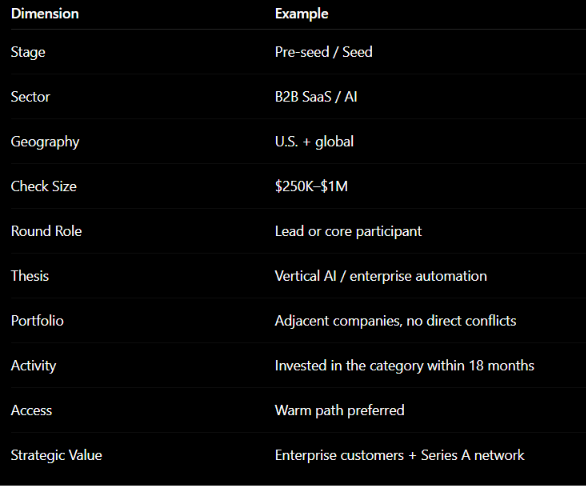
Now every investor can be measured against the same starting criteria.
This reduces one of the most common fundraising problems:
adding investors because they exist rather than because they fit.
A Simple Investor Fit Score
Investor selection does not need to become complicated.
A basic framework can help founders prioritize.
Score each factor from 0 to 2:
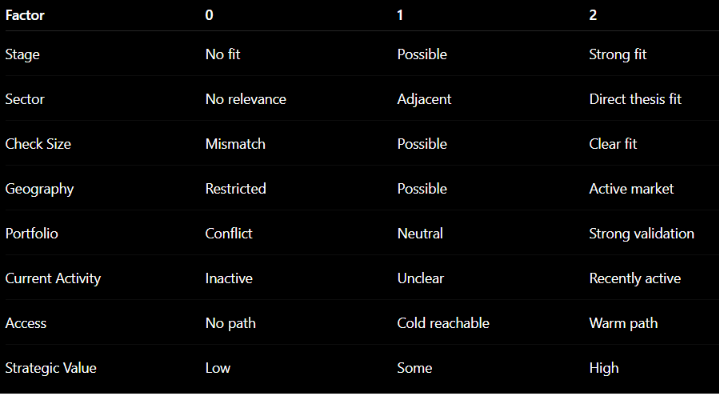
Maximum score: 16
This is not a scientific prediction of whether an investor will fund the company.
It is a prioritization tool.
An investor scoring 14 should probably receive more founder attention than one scoring 5.
The important part is not the exact number.
It is forcing the founder to answer:
Why is this investor actually on the list?
Investor Fit Is Two-Way
Founders spend most of a raise trying to convince investors to choose them.
When serious interest appears, the direction of diligence should change.
The founder should also ask:
Should we choose this investor?
Bulletpitch's current founder guide recommends evaluating investor fit beyond valuation or brand, including long-term usefulness and how the investor behaves during difficult periods.
That means evaluating:
Working Style
Do they expect weekly involvement?
Monthly updates?
Board control?
Minimal interaction?
Time Horizon
How long does the fund expect to hold investments?
Does that align with the company's likely path?
Follow-On Behavior
Does the fund normally reserve capital?
Under what conditions?
Decision-Making
Who makes the final investment decision?
How many partners need conviction?
Expectations
What outcome does the investor need for the investment to matter?
Alignment here can prevent significant conflict later.
What Investor Fit Does Not Mean
Investor fit does not mean finding investors who agree with everything the founder says.
A good investor may challenge assumptions.
It does not mean finding the most famous firm.
Brand can be useful, but prestige does not guarantee relevance.
It does not mean choosing only investors with existing companies in the exact category.
Adjacent knowledge can be valuable, and direct overlap may create conflicts.
It does not mean rejecting every cold path.
A perfectly targeted cold email can be more useful than a warm introduction to an irrelevant investor.
And it does not mean waiting for the mythical perfect investor.
The objective is not perfection.
It is higher-probability alignment.
Common Investor-Fit Mistakes
Starting With the Biggest Possible List
Volume feels productive because it creates activity.
But it can hide poor targeting.
Targeting the Firm Instead of the Partner
The firm's thesis may fit while the person receiving the pitch does not.
Ignoring Check Size
A famous investor who cannot realistically participate in the round is not automatically a priority.
Treating Warmth as Fit
A mutual connection creates access.
It does not create investment mandate.
Ignoring Portfolio Conflicts
Sector expertise can be useful until sensitive information crosses into a direct competitive relationship.
Assuming Old Investments Prove Current Activity
Funds, people and theses change.
Recency matters.
Failing to Diligence the Investor
The founder-investor relationship can last longer than many jobs.
Do not evaluate it using a logo alone.
How Investor Fit Connects to Startup Fundability
Fundability and investor fit solve different problems.
Startup fundability asks:
Has the founder and company produced enough evidence to justify investor attention?
Investor fit asks:
Which investors are actually positioned to evaluate that evidence?
A stronger company does not automatically make every investor relevant.
And perfect targeting cannot compensate indefinitely for weak evidence.
This is why fundraising works better when the sequence is:
Evidence → Fundability → Investor Fit → Access → Conversation
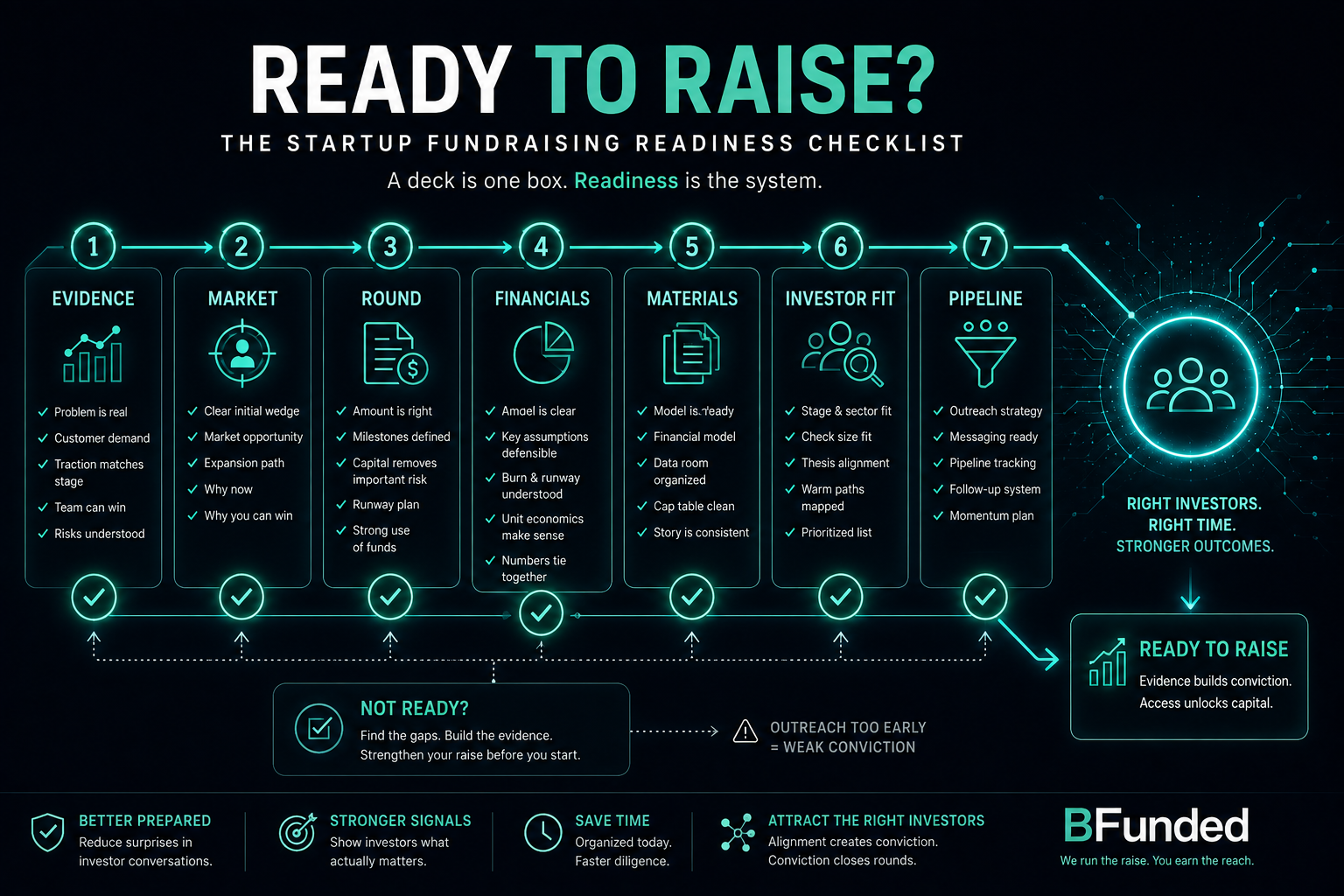
BFunded's fundraising readiness guide explains how founders can evaluate the company, materials and process before beginning active investor outreach.
How BFunded Approaches Investor Fit
BFunded's current Raise Engine is designed around the idea that investors should be matched rather than simply collected.
The platform extracts information about the startup's sector, stage, raise and traction, then uses that information to rank potential investors and firms for fit.
The current BFunded Raise Engine describes scoring thousands of investors and firms against an individual raise before network access and outreach begin.
The objective is not maximum exposure.
It is better alignment between:
what the startup has proved
and
who should see it next.
That is also why investor fit becomes more useful when combined with network mapping.
First determine who belongs on the target list.
Then determine the strongest path to reach them.
Frequently Asked Questions
What is investor fit?
Investor fit is the alignment between a startup and an investor across factors such as stage, sector, check size, geography, thesis, portfolio, current activity and long-term partnership expectations.
How do I know if a VC invests at my stage?
Review the firm's stated mandate and recent portfolio investments. Pay particular attention to the stage at which the investor first entered each company rather than the company's current stage.
How important is check size when choosing investors?
Very important. An investor whose typical check is significantly outside your round requirements may be unable to participate meaningfully even if other aspects of the fit are strong.
Should I only contact investors who already invest in my industry?
No. Adjacent investors may still have relevant expertise and thesis alignment. The objective is credible relevance, not necessarily an identical portfolio company.
Is a warm introduction more important than investor fit?
No. A warm introduction can improve access and context, but it does not change an investor's mandate. High fit with a cold path can be more valuable than low fit with a warm introduction.
Should founders research investors before accepting money?
Yes. Founder diligence can include speaking with portfolio founders, understanding the investor's working style, behavior during difficult periods, follow-on strategy and expectations after investment.
How many investors should be on my target list?
There is no universal ideal number. The quality and relevance of the list matter more than maximizing its size. Build enough qualified targets to create a real pipeline without lowering the fit criteria simply to increase volume.
Can an investor fit change over time?
Yes. Funds raise new vehicles, partners change firms, theses evolve and check sizes can shift. Investor research should therefore include recent activity rather than relying only on historical profiles.
The Bottom Line
An investor database tells you who exists.
Investor fit tells you who matters.
Before adding another name to the fundraising pipeline, be able to answer:
Why this investor?
Why this company?
Why this round?
Why now?
If those answers are weak, another investor name creates more work.
If those answers are strong, you have the beginning of an investor strategy.
Keep reading
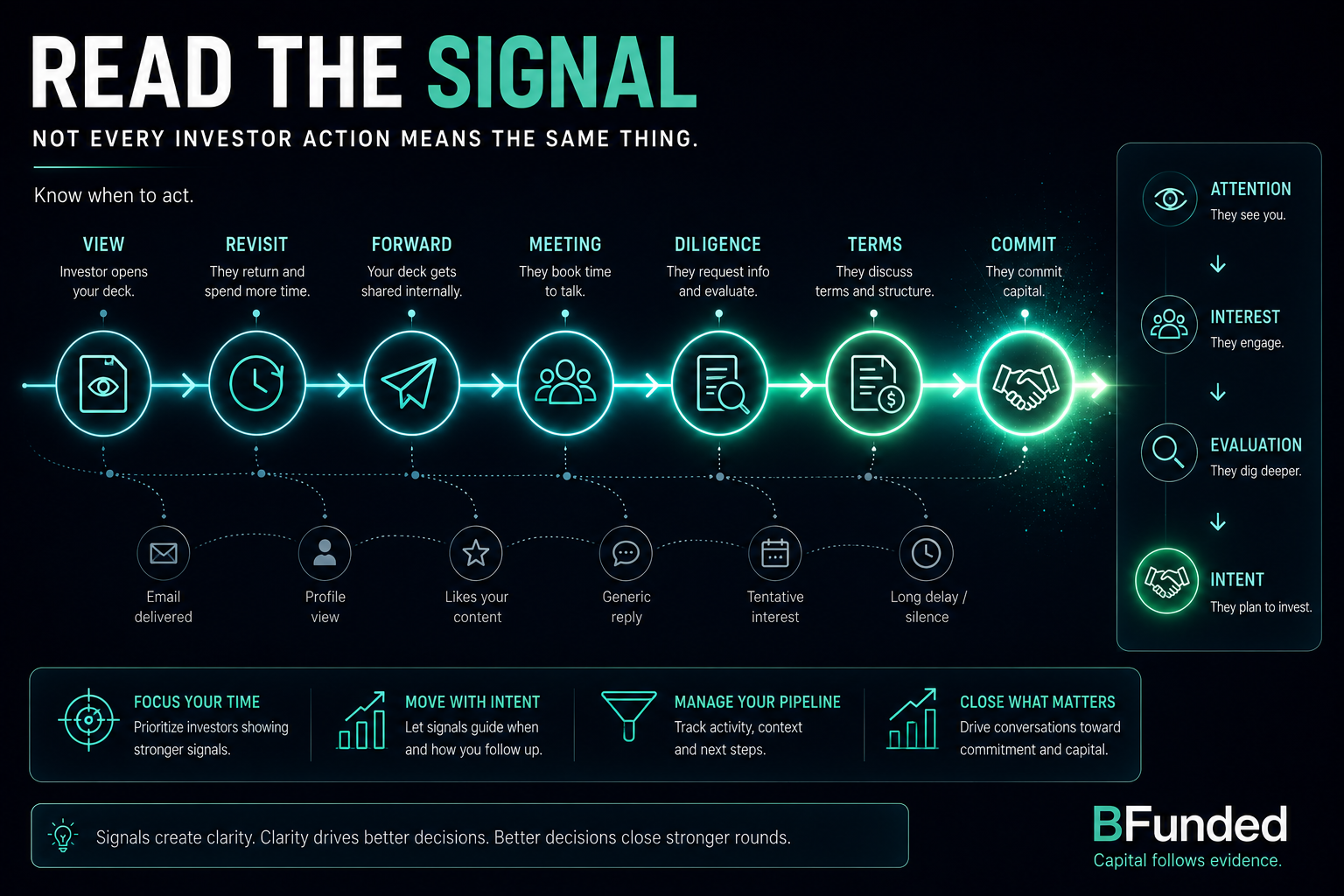
Investor Signals: How to Know When an Investor Is Actually Interested
Learn how to read investor signals during a startup raise, from pitch deck views and repeat engagement to meetings, diligence, terms, and actual commitments.
Startup Fundraising Readiness Checklist: Are You Actually Ready to Raise?
Use this startup fundraising readiness checklist to assess your evidence, pitch, financials, data room, investor strategy and fundraising process before outreach begins.
What Do Investors Look for in a Startup Before They Invest?
Investors don't expect startups to be risk-free. Learn the founder, market, traction, distribution and financial signals they evaluate before deciding to invest.