Investor Signals: How to Know When an Investor Is Actually Interested
Learn how to read investor signals during a startup raise, from pitch deck views and repeat engagement to meetings, diligence, terms, and actual commitments.
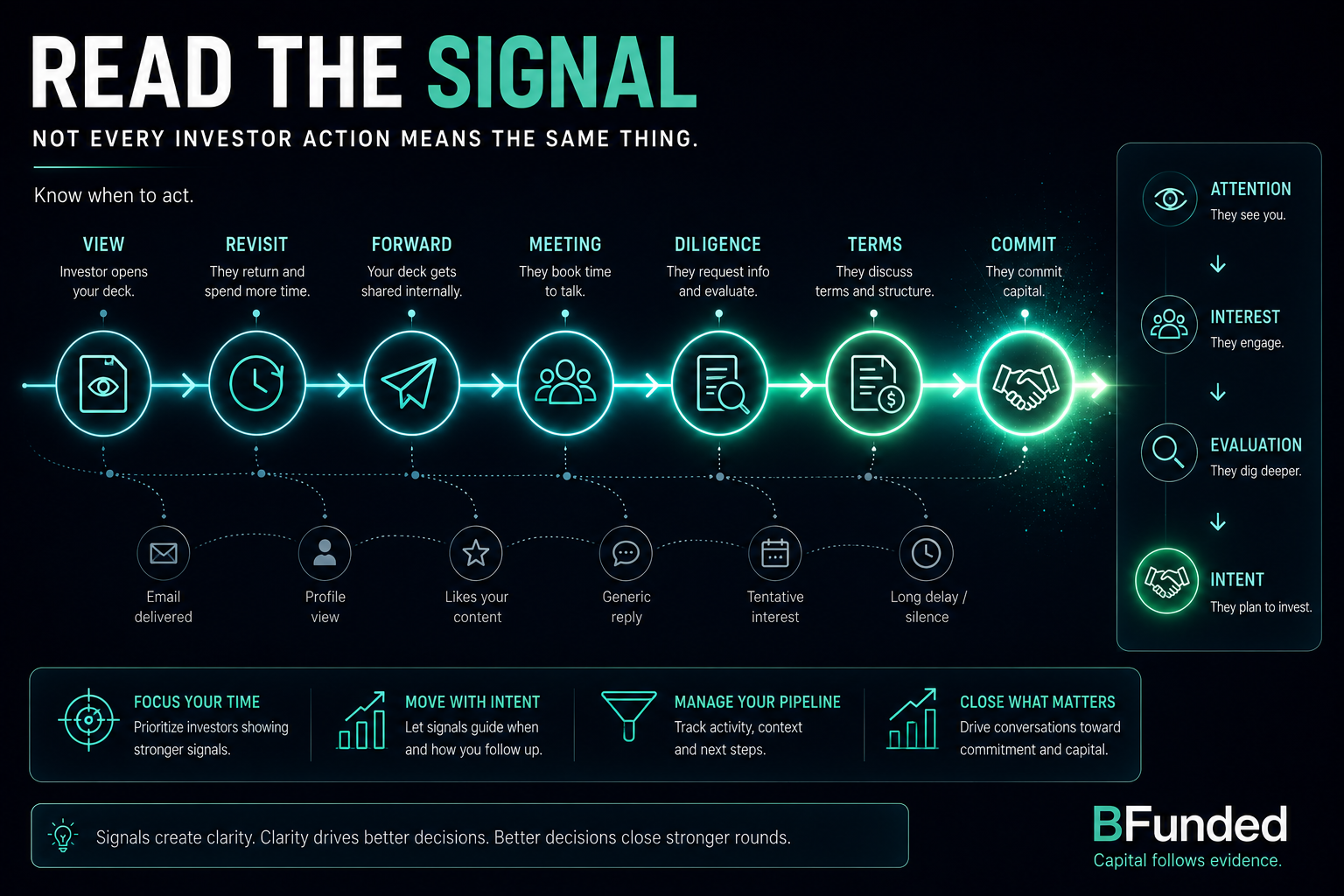
An investor opening your pitch deck is not the same as an investor wanting to invest.
Neither is a positive email, a first meeting, or a compliment about the company.
During a raise, founders receive dozens of signals that can look like progress.
Some matter.
Some barely matter at all.
Investor signals are observable actions that help founders understand where an investor may sit between awareness, curiosity, evaluation, commitment, and investment.
The important word is may.
No individual signal guarantees a check.
A deck can be opened and ignored.
A meeting can go well and lead nowhere.
An investor can begin due diligence and still pass.
The purpose of investor signals is not to predict the future with certainty.
It is to help founders make better decisions about where to spend time, when to follow up, and which conversations are actually moving forward.
Investor Interest Is a Spectrum
Founders often classify investors too simply:
Interested or not interested.
Real fundraising is messier.
An investor may be:
aware of the company
curious enough to open the deck
interested enough to revisit it
discussing it internally
willing to meet
actively evaluating
conducting diligence
negotiating terms
ready to commit
Those are not equivalent states.
Treating them as equivalent creates bad decisions.
A founder might spend hours chasing someone who opened the deck once while ignoring another investor who has returned three times, forwarded it internally, requested a financial model, and booked a second meeting.
Good fundraising operations require a better question:
What has this investor actually done?
Signal 1: The Investor Opens the Deck
A deck open is one of the earliest measurable investor signals.
It tells you something useful:
The material reached the investor and they chose to look at it.
That is better than silence.
But it is still a weak signal.
An investor may open hundreds of decks.
They may spend a few seconds scanning yours.
They may realize immediately that the company does not fit their mandate.
So the correct interpretation is not:
They are interested.
It is:
They have moved from potential exposure to actual awareness.
OpenVC's August 2026 investor-pipeline guide uses a pitch-deck open as a practical gate for moving an investor from outreach into an active pipeline, while also warning that interest before commitment remains uncertain.
Signal 2: They Spend Meaningful Time With the Material
A deck open becomes more interesting when the investor actually engages with the content.
Trackable fundraising documents can reveal:
session duration
pages viewed
time spent per page
repeat visits
document forwarding
DocSend specifically recommends using this engagement information to understand which investors are spending meaningful time with shared materials and to prioritize communication accordingly.
Still, founders should not overinterpret individual analytics.
An investor spending sixty seconds on your financial slide does not necessarily mean they love the economics.
They might be confused.
They might be checking one number.
They might have left the browser tab open.
Engagement data provides context, not mind reading.
Use it to improve your next action, not to invent certainty that does not exist.
Signal 3: They Return to the Deck
A return visit is usually more meaningful than a first visit.
Why?
Because something caused the investor to come back.
They may be:
reconsidering the opportunity
checking a detail
preparing for a meeting
comparing the company with another investment
discussing the deal internally
reviewing a question raised by a partner
DocSend's June 2026 guidance describes multiple document views as a stronger indicator of serious engagement than a single view, and recommends timing follow-up around re-engagement where appropriate.
Again, this is not a commitment.
But it is evidence that the opportunity has remained relevant enough to revisit.
That should influence prioritization.
Signal 4: The Deck Gets Forwarded
Forwarding can be one of the more useful early digital signals.
An investor may forward a deck to:
another partner
an associate
an investment committee member
a sector expert
a portfolio founder
someone performing technical diligence
That matters because venture investment decisions are often organizational rather than individual.
An investor liking the company is useful.
The opportunity beginning to move through the investor's internal network is more meaningful.
DocSend's current 2026 document-sharing guidance specifically highlights forwarding as a way to identify when materials may be moving further through a decision process.
But founders should still avoid jumping to:
“The partnership is discussing us, therefore we are getting funded.”
The better interpretation is:
The deal appears to have earned enough relevance to be shared.
That is a stronger signal than a single passive view.
Signal 5: The Investor Replies With Specific Questions
A generic response such as:
Interesting. Keep us updated.
is different from:
What does retention look like by cohort?
or:
Can you send the breakdown of the current $700K pipeline?
Specific questions indicate that the investor is trying to resolve uncertainty.
The quality of the question matters.
Questions about:
customer retention
unit economics
founder ownership
technical risk
competitive differentiation
pipeline quality
pricing
round structure
often suggest deeper evaluation than surface-level praise.
This does not automatically mean the investor likes the answer.
But they are spending effort to understand the opportunity.
Effort is itself a signal.
Signal 6: They Book a First Meeting
A meeting is a meaningful transition.
The investor is now willing to spend scarce time directly with the founder.
That is progress.
But the first meeting should still be interpreted carefully.
A VC may take a meeting because:
the company is genuinely interesting
someone credible introduced the founder
they are exploring a new sector
they want market intelligence
the company is adjacent to an existing thesis
an associate is conducting initial screening
The meeting moves the conversation forward.
It does not mean conviction already exists.
The founder's job is to leave that conversation with clarity about:
What happens next?
Signal 7: They Introduce More People Into the Conversation
One of the clearest signs that an investment process is becoming more serious is when additional stakeholders appear.
For example:
First meeting:
Founder → Associate
Later:
Founder → Associate + Partner
Then:
Founder → Partner + Sector Specialist
Then:
Founder → Investment Committee
Each firm operates differently, so this sequence is not universal.
But generally, more decision-makers spending time on the company means the opportunity is receiving greater organizational attention.
Founders should learn the investor's decision process.
Ask:
Who else needs to evaluate this?
Who can sponsor the investment internally?
What is the next decision point?
What information will they need?
Fundraising becomes easier to manage when the founder understands not only who is interested, but also how that investor makes decisions.
Signal 8: They Request Additional Materials
A request for more information can indicate that the investor is moving from a pitch-level evaluation into deeper analysis.
Common requests include:
financial model
cap table
customer references
cohort data
sales pipeline
product roadmap
technical documentation
legal documents
market research
historical financials
The important thing is not merely that a file was requested.
Look at what the investor is trying to understand.
A request for customer retention data suggests a different concern from a request for IP documentation.
That information can help the founder prepare the next conversation more effectively.
It can also reveal where the investment case still feels uncertain.
Signal 9: A Second Meeting Gets Booked
Second meetings usually carry more signal than first meetings.
The investor has already spent time with the founder.
They know the basic story.
They had an opportunity to pass.
And they chose to continue.
A second meeting may involve:
deeper product questions
partner participation
customer economics
market strategy
fundraising terms
diligence preparation
That is why pipeline management should distinguish between:
meeting happened
and
investor voluntarily advanced the process.
The second one matters more.
Signal 10: Due Diligence Begins
Due diligence is a significant progression.
The investor is no longer asking only:
Is this interesting?
They are increasingly asking:
Is what we have been told accurate, and are the remaining risks acceptable?
Diligence may cover:
financials
ownership
corporate structure
customers
product
intellectual property
legal issues
team
market claims
references
At this point, founders should treat the process seriously.
But they should not count the money yet.
Investors can and do pass during diligence.
New information can emerge.
Internal priorities can change.
Another investment can take precedence.
A diligence process is a strong signal of evaluation.
It is not a closed round.
Signal 11: The Investor Starts Discussing Terms
Term discussions represent another major increase in signal strength.
Topics may include:
valuation
valuation cap
check size
ownership
SAFE terms
board rights
pro rata
round structure
lead participation
allocation
The conversation has moved beyond:
Should we look at this company?
toward:
What would an investment actually look like?
That is a major shift.
Still, founders should distinguish verbal interest from documented commitment.
“I think we can do $250K” is useful.
A signed investment document is stronger.
Funds received are stronger still.
Signal 12: There Is a Signed Commitment
At some point, behavioral signals stop being the most important evidence.
A signed SAFE, subscription agreement, term sheet, or other applicable investment document is a much stronger indicator of commitment than engagement analytics.
OpenVC's current investor-pipeline framework similarly separates active conversations from committed investors and uses signed financing documents or wired funds as the transition into commitment.
This is a useful discipline for founders.
Do not mentally close the round based on positive conversations.
Track what is actually committed.
A Practical Investor Signal Hierarchy
Not every fundraising process follows the same order.
But this framework is useful for understanding relative signal strength:
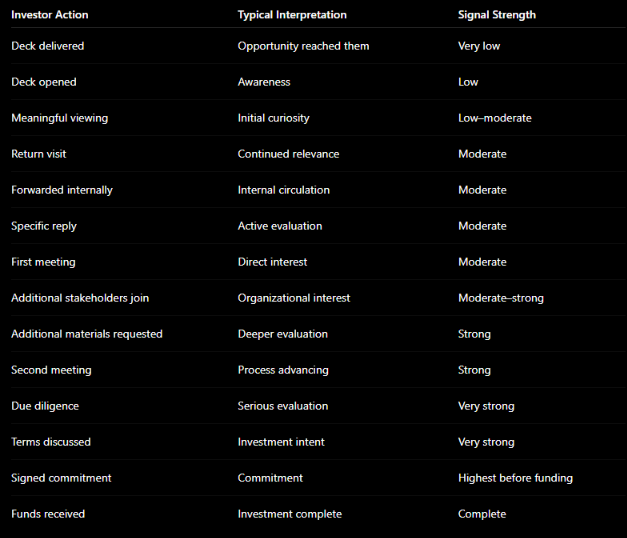
This table is not a probability model.
Do not turn:
return visit = 30% chance of funding
into a rule unless you have reliable data supporting that conclusion.
The purpose is prioritization.
Signals Should Change What You Do Next
Tracking signals is useful only if the information changes behavior.
Weak Signal
Example:
Investor opened the deck once.
Action: Do not overreact. Follow the normal process.
Moderate Signal
Example:
Investor revisited the deck and forwarded it.
Action: Prioritize a thoughtful follow-up while the opportunity is active.
Strong Signal
Example:
Investor asks for financials and schedules another meeting.
Action: Prepare the requested materials, identify likely objections, and understand the next decision gate.
Very Strong Signal
Example:
Investor begins diligence and discusses potential check size.
Action: Treat the process as active, respond quickly, and clarify what is required to reach a formal decision.
The principle is simple:
Better signal should produce better timing.
Do Not Confuse Signal With Investor Fit
Investor signals matter only after investor fit.
A highly engaged investor who cannot realistically participate in the round may still be a poor fundraising target.
For example:
They may love the company but:
invest at a later stage
write checks too large for the round
have a portfolio conflict
lack a mandate in the geography
have no remaining capital to deploy
This is why BFunded's Investor Fit framework should come before signal interpretation.
A strong fundraising process asks two separate questions:
Should this investor be in the pipeline?
Then:
What is this investor doing inside the pipeline?
Mixing those questions creates noise.
Silence Is Also Information — But Handle It Carefully
Founders frequently struggle with investor silence.
A deck is opened.
No reply arrives.
What does that mean?
Sometimes:
the investor is not interested
the opportunity is low priority
they are busy
the email was forgotten
another deal consumed attention
they are waiting for more traction
the timing is wrong
One useful rule is not to build complicated stories around silence.
OpenVC's June 2026 investor-outreach guide recommends using deck tracking as context for follow-up and warns against overanalyzing tiny differences in engagement data.
Follow up professionally.
Then keep the pipeline moving.
The goal is not to extract a response from every investor.
It is to avoid allowing low-signal conversations to consume the founder's entire raise.
The Biggest Mistake: Treating Every Investor Equally
Imagine a founder has twenty investors in the pipeline.
Five have never opened the deck.
Six opened it once.
Four returned multiple times.
Three held first meetings.
One requested diligence materials.
One is discussing terms.
Those twenty investors should not receive equal attention.
Yet founders often manage them that way.
Everyone gets the same follow-up cadence.
Everyone receives the same amount of founder energy.
Everyone looks like one line in a spreadsheet.
That is inefficient.
A better operating model considers:
Fit × Signal × Stage
Investor A:
High fit + strong signal + advanced stage.
Investor B:
High fit + weak signal + early stage.
Investor C:
Low fit + strong signal.
Investor D:
Low fit + weak signal.
The founder's time should not be distributed equally across all four.
Investor Signals Need a Pipeline
A signal without context is just an event.
The investor pipeline gives it meaning.
A clean signal system starts before outreach, with clear stages, ownership, materials, and follow-up rules.
At minimum, founders should know:
investor
fit
outreach status
last activity
meetings
requests
next step
follow-up date
commitment status
This is one of the reasons Article 03's fundraising readiness checklist treats pipeline preparation as part of being ready to raise.
A founder should not wait until thirty conversations are active to decide how fundraising will be tracked.
How BFunded Approaches Investor Signals
BFunded's current fundraising model is built around more than introducing founders to investor names.
The objective is to connect fundable founders with relevant investors and then run the raise around those relationships.
The current BFunded platform emphasizes matched investors rather than unrestricted reach, with access expanding as founders demonstrate stronger evidence through the raise.
Investor signals fit naturally into that philosophy.
First:
Is the founder fundable?
Then:
Does the investor fit?
Then:
What is the investor actually doing?
The stronger the evidence across all three, the clearer the founder's next action becomes.
Fundraising should not depend on remembering which investor “seemed excited” on a call two weeks ago.
It should be operated from visible evidence.
Frequently Asked Questions
What are investor signals in startup fundraising?
Investor signals are observable actions that may indicate where an investor sits in the fundraising process, such as opening a pitch deck, revisiting it, forwarding it, asking questions, scheduling meetings, requesting diligence materials, discussing terms, or committing capital.
Does opening my pitch deck mean an investor is interested?
It shows awareness, not necessarily serious interest. A single open is relatively weak compared with repeat engagement, internal forwarding, meetings, diligence, or term discussions.
Is a forwarded pitch deck a good sign?
It can be. Forwarding may indicate that the investor is sharing the opportunity with colleagues or other stakeholders. DocSend's current document analytics specifically track forwarding as a useful engagement signal.
Should I follow up when an investor views my deck?
Potentially, but context matters. A deck open can help inform timing, while repeat engagement may provide a stronger reason to prioritize the follow-up. Do not treat every open as an invitation to immediately send another email.
What is the strongest investor signal before investment?
A signed financing commitment is substantially stronger than behavioral engagement. Due diligence and term discussions are strong signals, but investors can still pass before formal commitment.
Does investor silence mean no?
Not always. Investors can be busy or timing can change. Follow up professionally, but do not let repeated silence consume disproportionate founder attention.
How should founders track investor interest?
Use a fundraising pipeline that records investor fit, current stage, meetings, document activity where available, requests, next actions, follow-up dates, and actual commitments.
Can investor engagement analytics predict who will invest?
They can help prioritize and interpret activity, but they should not be treated as guaranteed predictions. Engagement provides context; final investment decisions depend on many other factors.
The Bottom Line
Fundraising creates a lot of activity.
Activity is not the same as progress.
A deck open is a signal.
A return visit is a stronger signal.
A meeting is another.
Diligence is stronger again.
Terms are stronger still.
And money in the company is what ultimately matters.
The job is not to become obsessed with every click.
It is to understand which investor actions deserve a different response.
Because good fundraising is not only about getting investor attention.
It is about knowing when that attention is turning into intent.
Keep reading
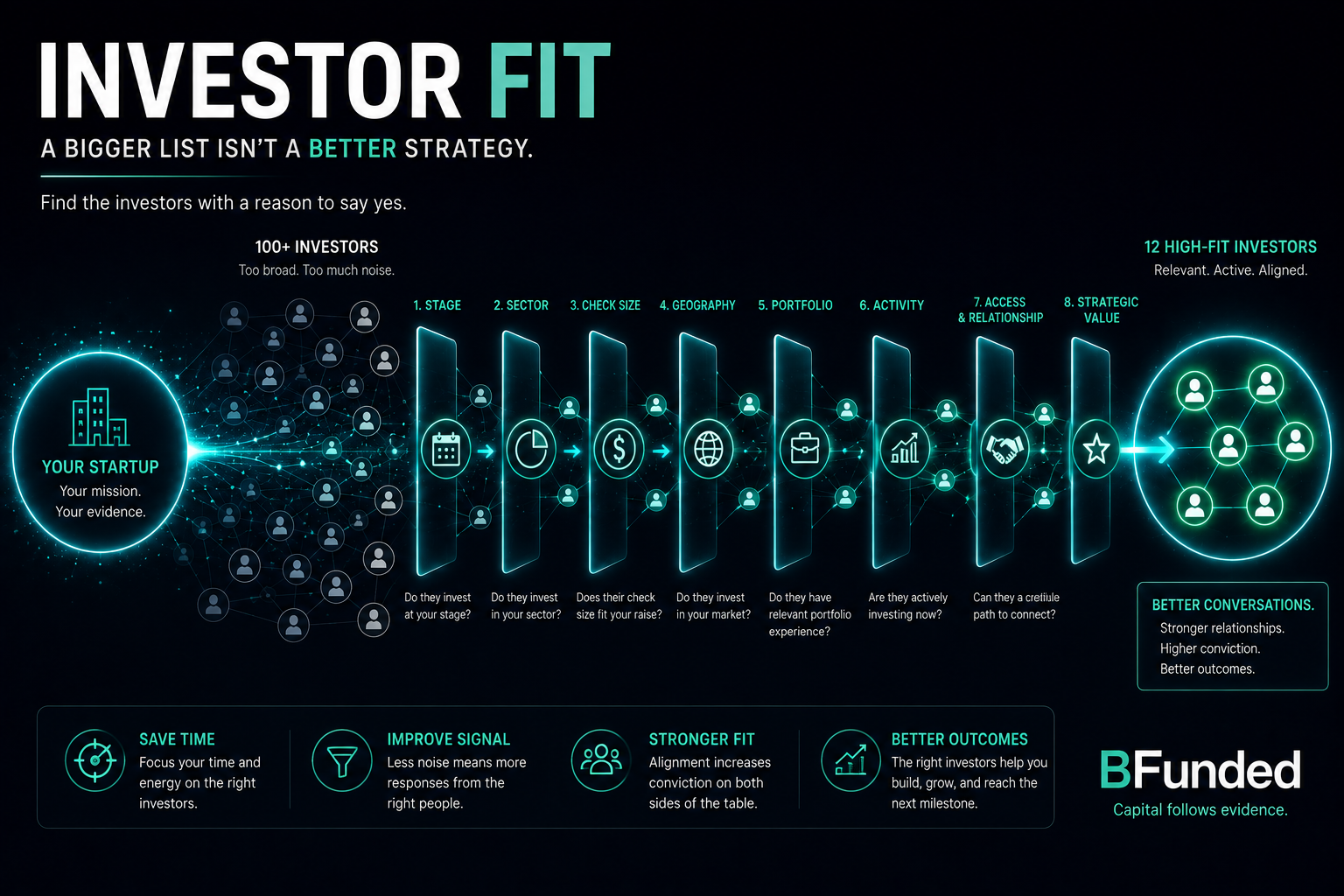
Investor Fit: How to Know Whether an Investor Actually Fits Your Startup
Investor fit goes beyond finding names. Learn how to evaluate startup investors by stage, sector, check size, thesis, portfolio, activity, access and long-term value.
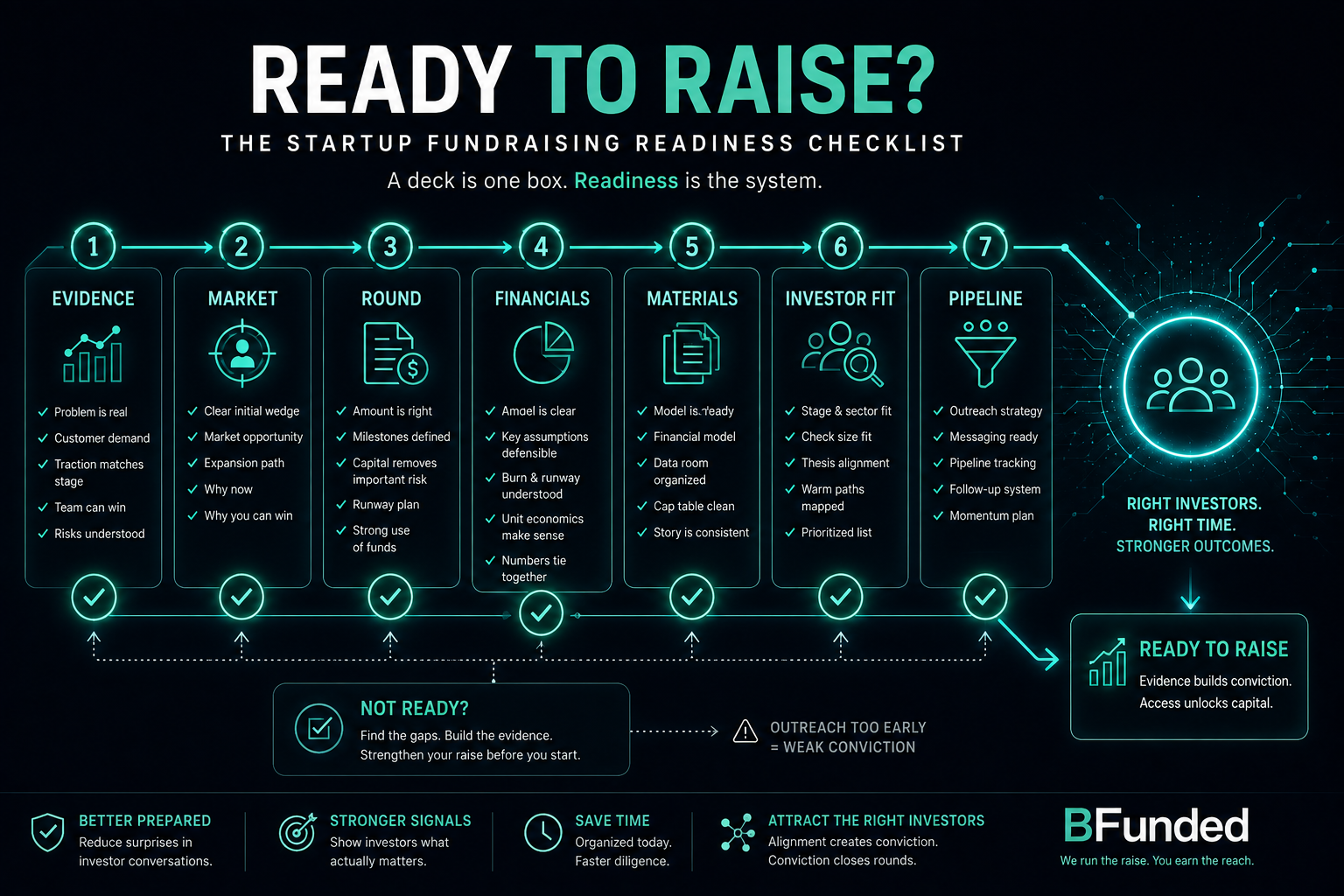
Startup Fundraising Readiness Checklist: Are You Actually Ready to Raise?
Use this startup fundraising readiness checklist to assess your evidence, pitch, financials, data room, investor strategy and fundraising process before outreach begins.
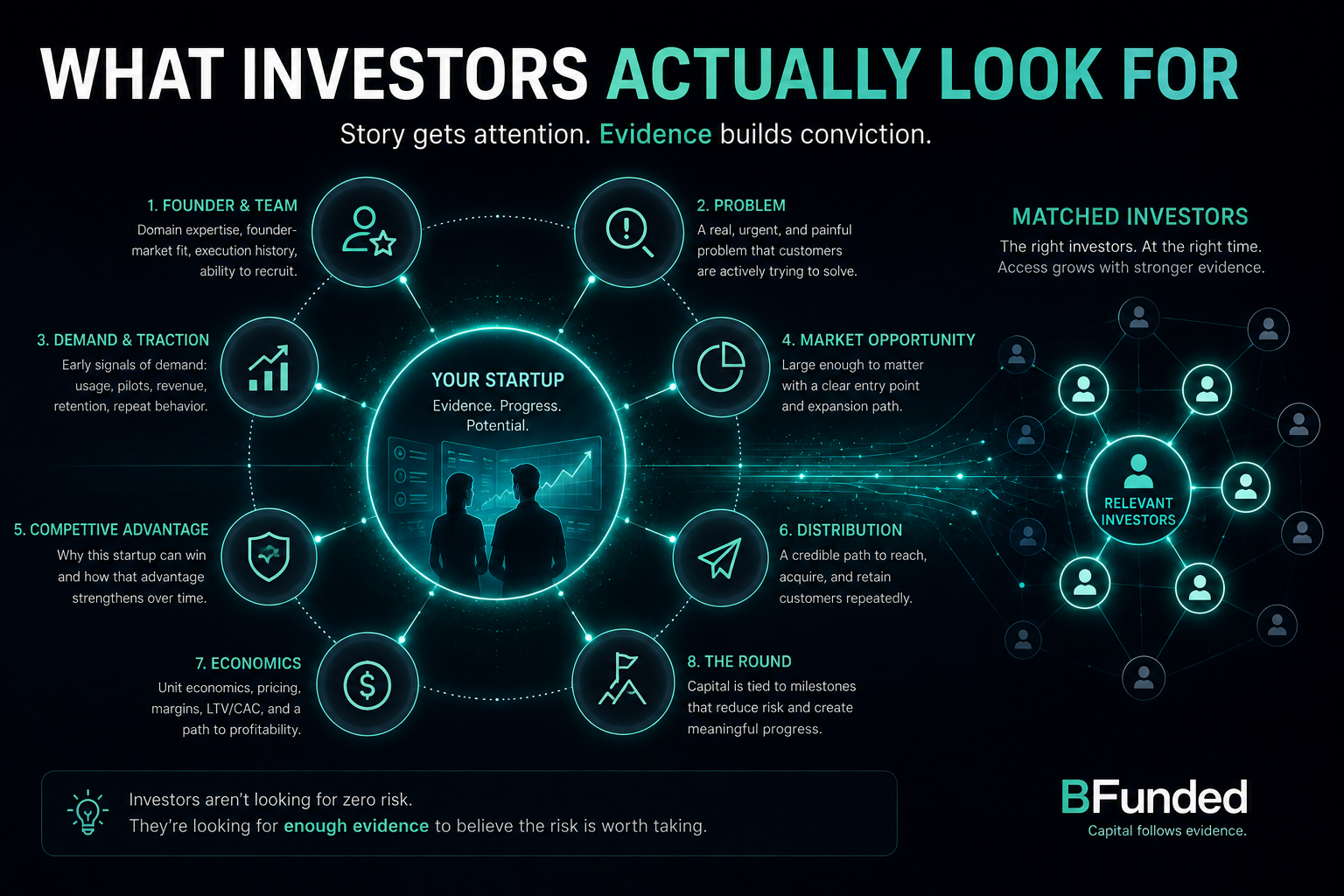
What Do Investors Look for in a Startup Before They Invest?
Investors don't expect startups to be risk-free. Learn the founder, market, traction, distribution and financial signals they evaluate before deciding to invest.