What Is an Accredited Investor? What Startup Founders Need to Know
Learn who qualifies as an accredited investor, including income, net worth, professional credentials, entity rules, and verification requirements under Regulation D.
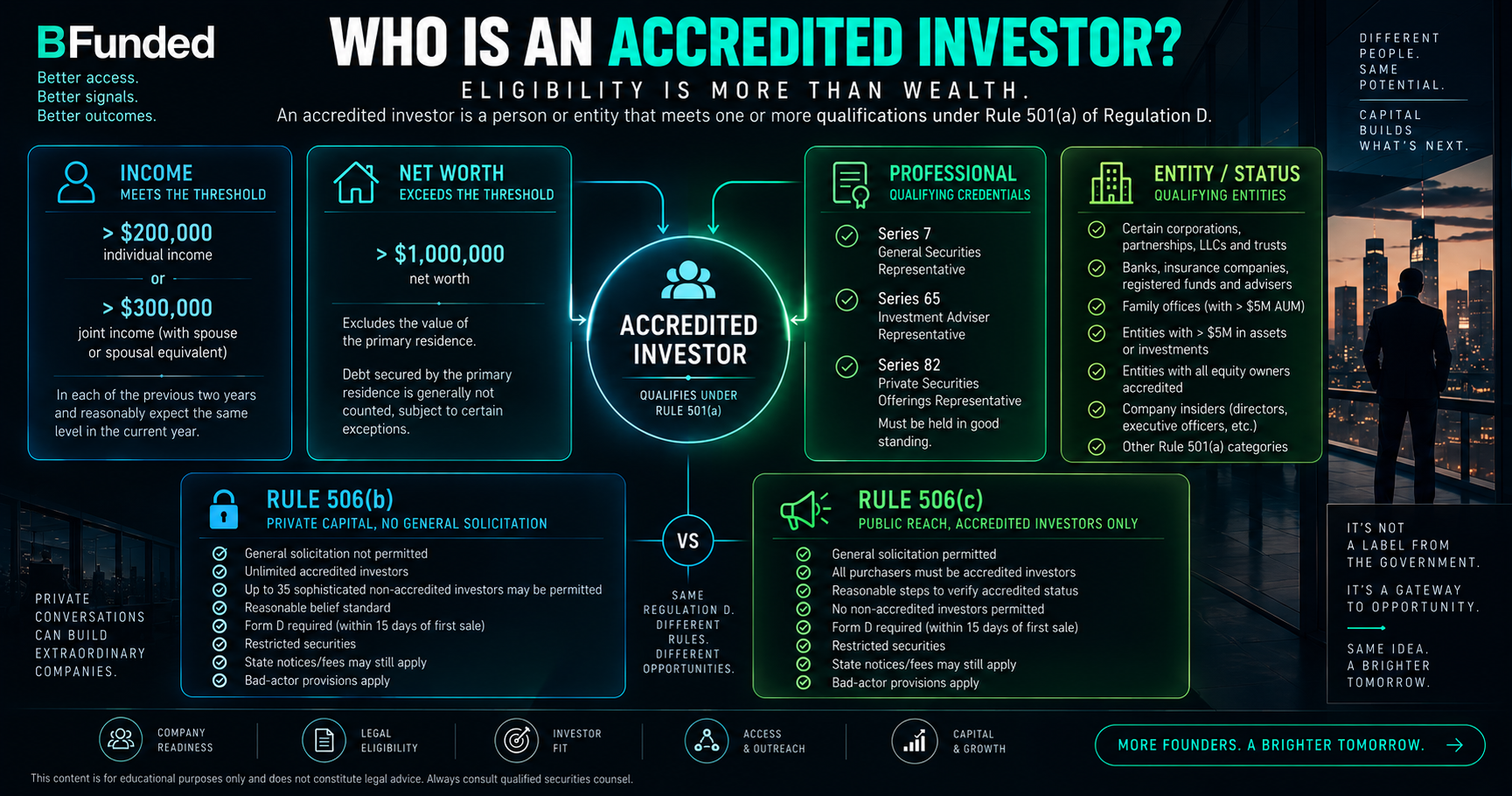
If you are raising startup capital under Regulation D, the term accredited investor can determine who is eligible to participate in the offering and what the company needs to do before accepting their investment.
But accredited does not mean:
approved by the SEC
guaranteed to be sophisticated
or
protected from losing money.
It is a legal classification defined under Rule 501(a) of Regulation D.
For startup founders, that classification matters because Rule 506(b) and Rule 506(c) treat accredited investors differently.
Under Rule 506(b), accredited-investor status generally involves a reasonable-belief standard.
Under Rule 506(c), every purchaser must be accredited and the issuer must take reasonable steps to verify that status.
So the practical question is not only:
Who counts as an accredited investor?
It is also:
How does our chosen fundraising exemption require us to establish that status?
This article is educational information only and is not legal advice. Founders should work with qualified U.S. securities counsel for their specific offering.
What Is an Accredited Investor?
An accredited investor is a person or entity that meets one or more qualifications under Rule 501(a) of Regulation D.
The definition matters because certain private securities offerings either:
limit participation to accredited investors, or
impose additional requirements when non-accredited investors participate.
The SEC explains that individuals can qualify through financial thresholds, certain professional credentials, or other qualifying status, while entities can qualify based on their structure, assets, investments, ownership, or regulatory status.
Accreditation is therefore broader than:
“wealthy individual.”
A person may qualify because of income.
Another because of net worth.
Another because they hold an approved professional license.
Certain company insiders can qualify based on their role.
And several types of entities can qualify without using an individual's wealth test.
How Can an Individual Qualify as an Accredited Investor?
For most startup raises, founders will encounter three common individual qualification routes.
1. The Income Test
An individual can qualify if they earned more than:
$200,000 individually
or
$300,000 together with a spouse or spousal equivalent
in each of the previous two years and reasonably expect to reach the same income level in the current year.
The important parts are:
It Is Not a One-Year Test
Someone earning $250,000 last year after earning $150,000 the year before does not satisfy the standard individual income test based only on those figures.
The threshold needs to have been exceeded in each of the prior two years.
Current-Year Expectation Matters
The investor must also reasonably expect to reach the applicable income level in the current year.
Joint Income Can Qualify
The $300,000 threshold can be measured together with a spouse or spousal equivalent.
The SEC defines a spousal equivalent as a cohabitant occupying a relationship generally equivalent to that of a spouse.
2. The Net Worth Test
An individual may also qualify if their net worth exceeds:
$1 million
either individually or jointly with a spouse or spousal equivalent.
But there is an important exclusion:
the value of the investor's primary residence is generally not counted as an asset for this test.
The SEC’s current guidance continues to state the $1 million threshold excluding the primary residence.
How Is Net Worth Calculated?
At a simple level:
Assets − Liabilities = Net Worth
But the primary residence requires special treatment.
Primary Residence Value
Generally exclude it as an asset.
Suppose an investor owns:
$600K in investments
$250K in cash
$250K in other qualifying assets
a $900K primary home
The home's $900K value is not simply added to the accredited-investor net worth calculation.
Mortgage on the Primary Residence
Debt secured by the primary residence generally is not counted as a liability up to the home's estimated fair market value.
But there are exceptions.
If the mortgage or other secured debt exceeds the home's value, the excess generally counts as a liability.
The SEC also notes special treatment when secured debt increases during the 60 days before the securities purchase for reasons other than acquiring the residence.
That is one reason founders should not try to manually interpret complicated investor balance sheets without an appropriate verification process.
Example: Net Worth Test
Imagine an investor has:
Investment portfolio: $800K
Cash: $300K
Other qualifying assets: $150K
Non-mortgage liabilities: $100K
Primary residence: $700K
Mortgage: $300K
Ignoring additional complications:
$800K + $300K + $150K − $100K
=
$1.15 million
The value of the primary residence is excluded.
The investor may therefore satisfy the net-worth threshold based on the remaining assets and liabilities.
This simplified example is educational only. Actual qualification can involve details that should be reviewed appropriately.
3. Certain Professional Credentials
Wealth is not the only route.
The SEC currently recognizes certain financial professional licenses as qualifying credentials.
They are:
Series 7 — General Securities Representative
Series 65 — Investment Adviser Representative
Series 82 — Private Securities Offerings Representative
The person needs to hold the qualifying credential in good standing.
This expansion matters because the accredited-investor concept is not based solely on the ability to absorb financial loss.
It can also recognize particular forms of financial sophistication.
Are Those the Only Ways an Individual Can Qualify?
No.
Other qualifying categories can apply in particular circumstances.
For example, the SEC lists:
directors, executive officers, or general partners of the issuer selling the securities
certain family clients of qualifying family offices
knowledgeable employees of certain private funds for investments in those funds
These categories are more situational than the standard income, net-worth, and professional-license tests.
Founders should therefore avoid designing one investor questionnaire that assumes every accredited investor qualifies through wealth.
Company Directors and Executive Officers
Certain insiders of the issuer can qualify as accredited investors because of their relationship to the company.
The SEC includes directors, executive officers, and general partners of the company selling the securities, as well as certain comparable persons associated with a general partner.
That is a status-based qualification.
It does not mean every employee of the startup automatically qualifies.
The exact role matters.
Knowledgeable Employees
Another specialized category applies to certain knowledgeable employees of private funds.
This rule is particularly relevant to private-fund offerings rather than the typical operating startup selling its own equity.
The SEC’s compliance guidance makes clear that knowledgeable-employee status applies in the context of investments in the relevant private fund and related private funds managed by the employer; it does not create unlimited accredited status for unrelated investments.
For a normal operating startup raise, this category is usually less central than the income, net-worth, professional-license, or entity standards.
Can a Company or Other Entity Be an Accredited Investor?
Yes.
Accredited investors are not limited to natural persons.
Entities can qualify through several different categories.
Common examples include certain:
corporations
partnerships
limited liability companies
trusts
nonprofit organizations
employee benefit plans
banks
insurance companies
registered investment companies
investment advisers
registered broker-dealers
family offices
other investment entities
The qualification test depends on the type and structure of the entity.
The SEC’s current summary identifies several entity routes, including asset or investment thresholds, regulated financial status, and ownership by accredited investors.
The $5 Million Entity Tests
Several entity categories use a threshold above:
$5 million
But founders should be careful because not every entity uses the exact same legal test.
Some categories look to:
total assets
while a broader catch-all category can look to:
investments in excess of $5 million.
Additional conditions can apply, including whether the entity was formed specifically to purchase the offered securities.
Do not reduce every entity analysis to:
Company has $5M, therefore accredited.
The actual Rule 501 category matters.
What If Every Owner of an Entity Is Accredited?
Another category can apply when:
all equity owners of the entity are themselves accredited investors.
The SEC expressly lists entities whose equity owners are all accredited as a qualifying category.
That can allow an investment entity to qualify through ownership even when another entity-level test is not the relevant route.
Again, the ownership analysis should be documented properly.
What About Family Offices?
Certain family offices can qualify as accredited investors.
The SEC describes qualifying family offices as generally involving:
more than $5 million in assets under management
not being formed specifically to purchase the securities being offered
investment decisions directed by someone capable of evaluating the merits and risks
Qualifying family clients can also fall within the accredited-investor definition where the applicable requirements are met.
This matters for startups because family offices are increasingly visible in private capital markets, but founders should not assume every organization calling itself a family office automatically meets the legal definition.
Accredited Investor Does Not Mean “Sophisticated Investor”
These terms are related in conversation.
Legally, they are not interchangeable.
This becomes particularly important under Rule 506(b).
Rule 506(b) can permit up to 35 non-accredited purchasers who satisfy the applicable sophistication requirement.
So someone may be:
non-accredited but sufficiently sophisticated for a particular 506(b) offering
while another person may be:
accredited under one of the Rule 501 categories.
Different legal concepts.
Do not use:
accredited
and
sophisticated
as synonyms in offering documentation.
Why Accredited-Investor Status Matters Under Rule 506(b)
Rule 506(b) can include:
an unlimited number of accredited investors
potentially up to 35 qualifying non-accredited purchasers
subject to the rule’s requirements.
For accredited investors under a 506(b) offering, the issuer operates under a reasonable-belief standard when determining whether they qualify.
The SEC describes reasonable belief as a facts-and-circumstances analysis that can depend on:
the issuer's relationship with the investor
information the issuer has about the investor
Our Rule 506(b) vs. Rule 506(c) guide explains the broader differences between these two Regulation D pathways.
Why Accredited-Investor Status Matters Even More Under Rule 506(c)
Rule 506(c) permits general solicitation.
But the tradeoff is strict:
all purchasers must be accredited investors.
Not most.
Not almost all.
Every purchaser.
And the company must take reasonable steps to verify their accredited status.
This creates a very different operating requirement from simply collecting investor representations.
The marketing channel becomes broader.
The purchaser eligibility process becomes stricter.
Reasonable Belief vs. Reasonable Steps to Verify
This distinction deserves to be explicit.
506(b)
Reasonable belief
The company must have a reasonable basis to believe the investor qualifies.
506(c)
Reasonable steps to verify
The company must actively perform an appropriate verification process.
The SEC’s April 2026 guidance emphasizes this distinction between the two rules.
A fundraising team should know which standard applies before investor onboarding begins.
Is Checking an “I Am Accredited” Box Enough?
No—not by itself.
This is an important compliance point.
The SEC says that investor self-certification alone, without additional knowledge concerning the investor's financial circumstances or sophistication, is not sufficient by itself to satisfy either the Rule 506(b) reasonable-belief standard or Rule 506(c)’s reasonable-steps-to-verify requirement.
That does not mean investor questionnaires are useless.
They can be part of a process.
They should not be mistaken for the entire process.
How Can a Company Verify Accredited Status Under 506(c)?
The exact approach depends on the investor and facts.
The SEC describes a principles-based verification framework and also provides non-exclusive verification methods for natural persons.
Potential methods can involve:
Income Verification
Review of specified income documentation together with the applicable representation concerning expected income.
Net Worth Verification
Reviewing qualifying documentation concerning assets and liabilities together with investor representations.
Relevant documents may include:
bank statements
brokerage statements
certificates of deposit
tax assessments
credit-report information
subject to the rule's requirements.
Qualified Third-Party Confirmation
The issuer may be able to rely on written confirmation from certain professionals who have taken reasonable steps to verify the investor.
Those can include:
registered broker-dealer
SEC-registered investment adviser
licensed attorney
certified public accountant
Certain Previously Verified Investors
SEC guidance also provides a route involving written representations from certain investors previously verified by the issuer, subject to conditions and a five-year period from the earlier verification.
Founders should design this workflow with counsel instead of inventing it after an investor tries to wire funds.
Verification Is Not the Same as Collecting Every Investor's Private Financial Data Yourself
A founder does not necessarily need to personally inspect every bank statement.
Qualified verification providers and eligible third-party professionals can play roles in the process where the legal requirements are satisfied.
That can be particularly useful because founders should think carefully about:
financial-data privacy
document retention
security
internal access controls
Investor verification needs to be compliant.
It should also be handled professionally.
Does Being Accredited Mean the Investment Is Safe?
No.
Accredited-investor status says something about eligibility under certain securities-law exemptions.
It does not mean:
the SEC approved the investment
the startup has passed government due diligence
the investment is low risk
or
the investor cannot lose everything.
Investor.gov specifically warns that investors in exempt private offerings may receive fewer prescribed disclosures than investors in registered offerings and can lose their entire investment.
That distinction should be clear in founder communication.
Do not market accreditation as a seal of approval.
Why Does the Accredited-Investor Definition Exist?
Certain private offerings operate without the full registration and disclosure framework of public securities offerings.
The accredited-investor rules help determine which investors can participate in some of those exempt offerings.
Historically, financial thresholds have played a major role.
The modern definition also includes certain measures of professional sophistication and status.
For founders, however, the strategic lesson is simple:
Accreditation is an eligibility framework.
It is not an investment recommendation.
Does Accredited Status Guarantee an Investor Fits the Startup?
No.
This is another common fundraising mistake.
An accredited investor may legally be eligible to invest.
That says nothing about whether they:
invest at your stage
understand your sector
write the right check size
invest in your geography
have relevant experience
want to evaluate your company
Legal eligibility and investor fit solve different problems.
A founder still needs to ask:
Can they invest legally?
and separately:
Should they be in our fundraising pipeline?
Our seed funding guide explains why fundraising works better when legal structure, company evidence, investor targeting, and raise execution are treated as separate but connected systems.
Accredited Status Does Not Create Investor Intent
An accredited investor who opens your deck is not automatically interested.
An accredited investor who takes a meeting is not committed.
An accredited investor who says:
This is exciting.
has still not invested.
Qualification answers:
Are they eligible under the applicable framework?
Investor behavior answers:
Are they moving toward a decision?
Founders should not mix the two.
What Should Founders Collect From Investors?
The answer depends on:
exemption
qualification route
investor type
verification method
legal process
platform
jurisdiction
Potential information may include:
investor identity
entity type
qualification category
applicable investor representations
verification evidence or third-party confirmation
subscription documents
investment amount
required tax or compliance information
Do not collect sensitive financial documents simply because:
more paperwork feels safer.
Collect what the applicable legal process requires and protect it properly.
When Should Accredited-Investor Status Be Addressed?
Not at the end.
A startup should determine early:
Which securities exemption is being used?
Who is eligible to purchase?
What standard applies for establishing accreditation?
Who owns verification?
What documentation will be retained?
What happens if an investor does not qualify?
This should be part of fundraising infrastructure before serious investment commitments arrive.
Otherwise, the company may discover late in the process that an enthusiastic investor cannot participate under the selected offering structure.
Can Non-Accredited Investors Invest in Startups?
Sometimes.
Accredited status is not a universal requirement for every startup securities offering.
For example:
Rule 506(b) can permit a limited number of qualifying non-accredited purchasers under specified conditions.
Regulation Crowdfunding has its own rules that can permit participation by non-accredited investors subject to applicable requirements.
The correct answer depends on the offering exemption.
That is another reason founders should not start with:
Is this investor accredited?
Start with:
What exemption are we using?
Then determine who can participate under that framework.
Does Nationality Determine Accredited-Investor Status?
The Rule 501 definition itself is based on the applicable qualification categories rather than simply labeling investors by nationality.
But cross-border securities offerings can introduce additional U.S. and foreign-law issues.
A non-U.S. investor should therefore not be treated as:
automatically exempt from analysis
or:
automatically accredited
merely because they live outside the United States.
Cross-border fundraising should receive appropriate legal review.
What Founders Should Not Do
Assume Wealth Means Accreditation
Use the actual qualification tests.
Assume Accreditation Means Investor Fit
Eligibility does not create relevance.
Use a Checkbox as the Entire Verification Process
The SEC explicitly warns against that approach.
Treat 506(b) and 506(c) the Same
Their accreditation-assessment standards differ.
Wait Until Closing to Think About Verification
Build it into the workflow.
Collect Sensitive Information Without Proper Controls
Compliance and data security need to work together.
Advertise an Investor as “SEC Approved”
Accreditation is not government endorsement.
Give Investors Legal or Tax Conclusions You Are Not Qualified to Give
Use appropriate professionals.
A Founder Checklist for Accredited Investors
Before accepting private investment:
Offering
✅We know which exemption we are relying on.
✅Securities counsel has reviewed the structure.
✅Investor-eligibility rules are documented.
Investor
✅Qualification category is identified.
✅Individual vs. entity status is clear.
✅Any required supporting process is complete.
506(b)
✅Reasonable-belief process is documented.
✅Non-accredited participation, if any, has been specifically addressed.
506(c)
✅Every purchaser is accredited.
✅Reasonable verification steps are complete.
✅Verification evidence or permitted confirmation is retained appropriately.
Operations
✅Sensitive investor information is protected.
✅Subscription documentation is complete.
✅Form D and state-notice responsibilities have owners.
✅Commitment status is separated from funding status.
The goal is not more paperwork.
It is a fundraising process where eligibility does not become an emergency at closing.
How BFunded Approaches Accredited Investors
The BFunded Raise Engine sits inside a fundraising workflow where the selected Regulation D pathway affects how investor outreach and eligibility need to operate.
For a 506(b) raise, accreditation and investor relationships need to be handled within the restrictions of the private offering.
For a 506(c) raise, broad solicitation is possible, but every purchaser needs to be accredited and appropriately verified.
BFunded's role is fundraising infrastructure.
It does not turn investor matching into legal accreditation.
An investor can be:
high-fit but not eligible
or:
legally eligible but low-fit.
Those are different dimensions.
A strong fundraising system keeps them separate:
Company Evidence
↓
Legal Eligibility
↓
Investor Fit
↓
Access
↓
Investor Signals
↓
Commitment
↓
Funded
That protects a simple principle:
Reach should expand intelligently, but the offering still has to operate inside the rules.
Frequently Asked Questions
What is an accredited investor?
An accredited investor is an individual or entity that meets one or more qualification categories under Rule 501(a) of Regulation D.
What income makes someone an accredited investor?
An individual can generally qualify by earning more than $200,000 individually, or more than $300,000 with a spouse or spousal equivalent, in each of the prior two years and reasonably expecting to reach the same threshold in the current year.
What net worth qualifies as an accredited investor?
An individual can generally qualify with net worth above $1 million individually or jointly with a spouse or spousal equivalent, excluding the value of the primary residence.
Does a Series 65 license make someone accredited?
A Series 65 license held in good standing is one of the professional credentials currently recognized by the SEC, alongside Series 7 and Series 82.
Does my house count toward the $1 million net-worth test?
The value of the investor's primary residence is generally excluded from the calculation. Debt associated with the residence has specific treatment under the rule.
Can a company be an accredited investor?
Yes. Several entity categories can qualify based on assets, investments, regulatory status, ownership, or other applicable Rule 501 criteria.
Is an accredited investor the same as a sophisticated investor?
No. They are different legal concepts. Rule 506(b), for example, can permit certain sophisticated non-accredited purchasers under specified conditions.
Does an accredited investor need verification?
It depends on the offering. Rule 506(b) uses a reasonable-belief standard. Rule 506(c) requires reasonable steps to verify every purchaser's accredited status.
Can an investor simply check a box saying they are accredited?
A self-certification checkbox alone, without other supporting knowledge or verification, is not sufficient by itself under the SEC's current guidance.
Can non-accredited investors participate in a startup raise?
Potentially, depending on the exemption. Rule 506(b) can permit a limited number under specified conditions, while other exemptions such as Regulation Crowdfunding have different participation rules.
Does accredited status mean the SEC approved the investor or investment?
No. Accreditation does not represent SEC approval of the investment, and private securities can involve substantial risk.
The Bottom Line
An accredited investor is not simply:
someone wealthy enough to invest in startups.
It is a defined securities-law category with multiple qualification paths.
For founders, three questions matter:
Does the investor qualify?
What standard does our exemption require us to use to establish that qualification?
and:
Does this investor actually fit the raise?
The first is legal eligibility.
The second is compliance.
The third is fundraising strategy.
Do not confuse them.
Because a good private-capital process needs all three.
Keep reading
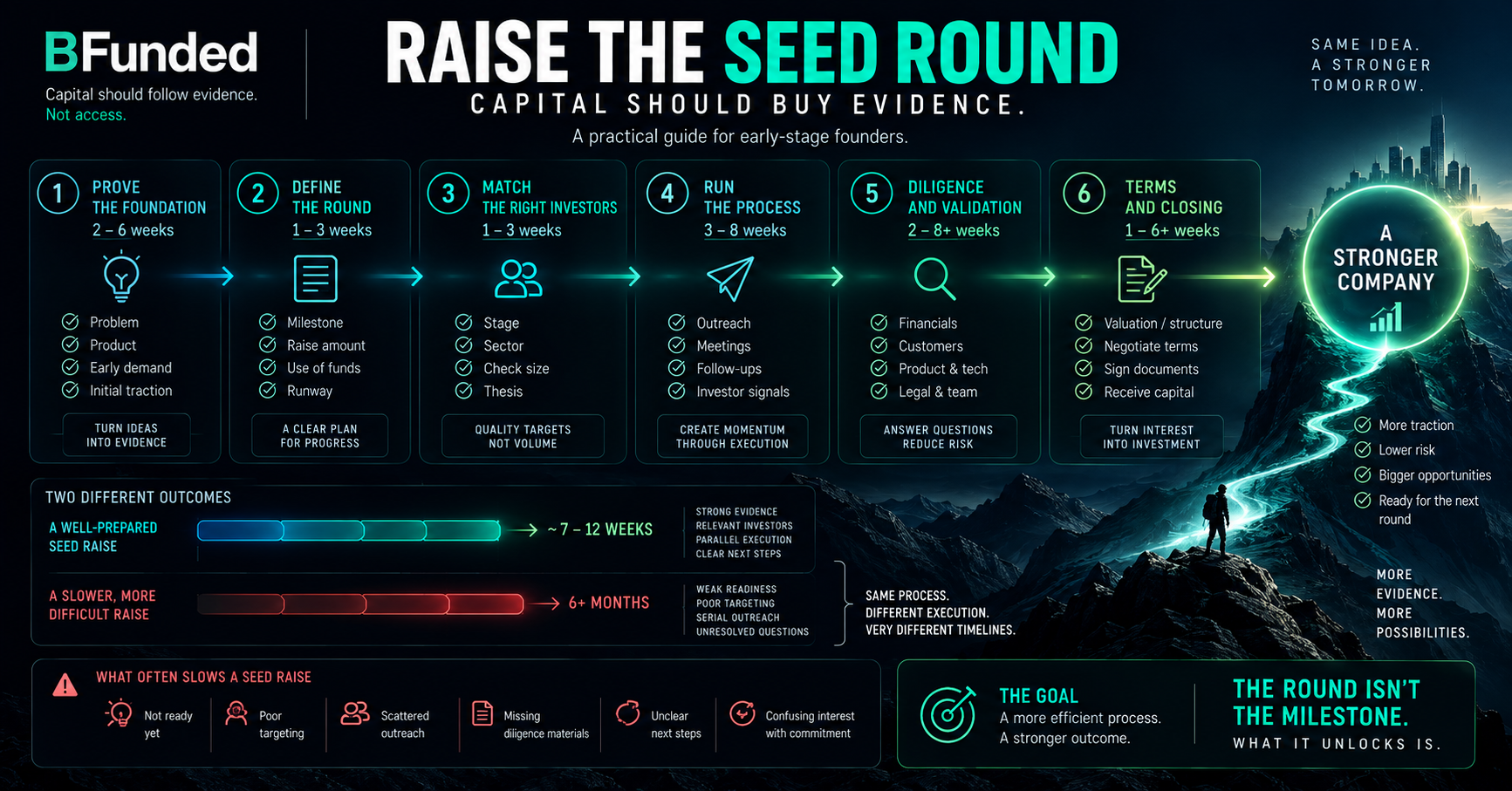
How to Raise Seed Funding: A Practical Guide for Early-Stage Founders
Learn how to raise seed funding by defining the milestone, proving readiness, targeting the right investors, running a fundraising pipeline, and closing the round.
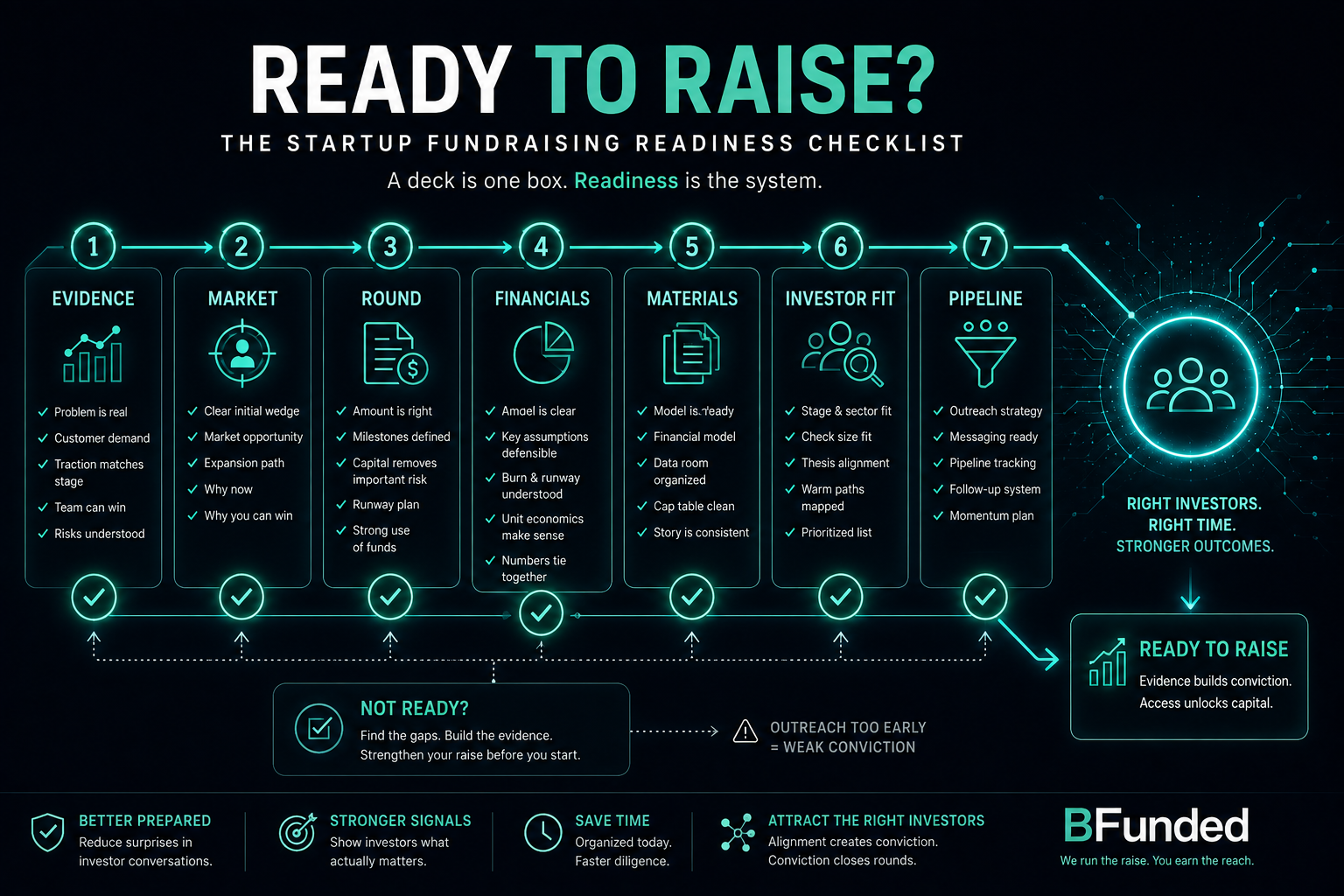
Startup Fundraising Readiness Checklist: Are You Actually Ready to Raise?
Use this startup fundraising readiness checklist to assess your evidence, pitch, financials, data room, investor strategy and fundraising process before outreach begins.
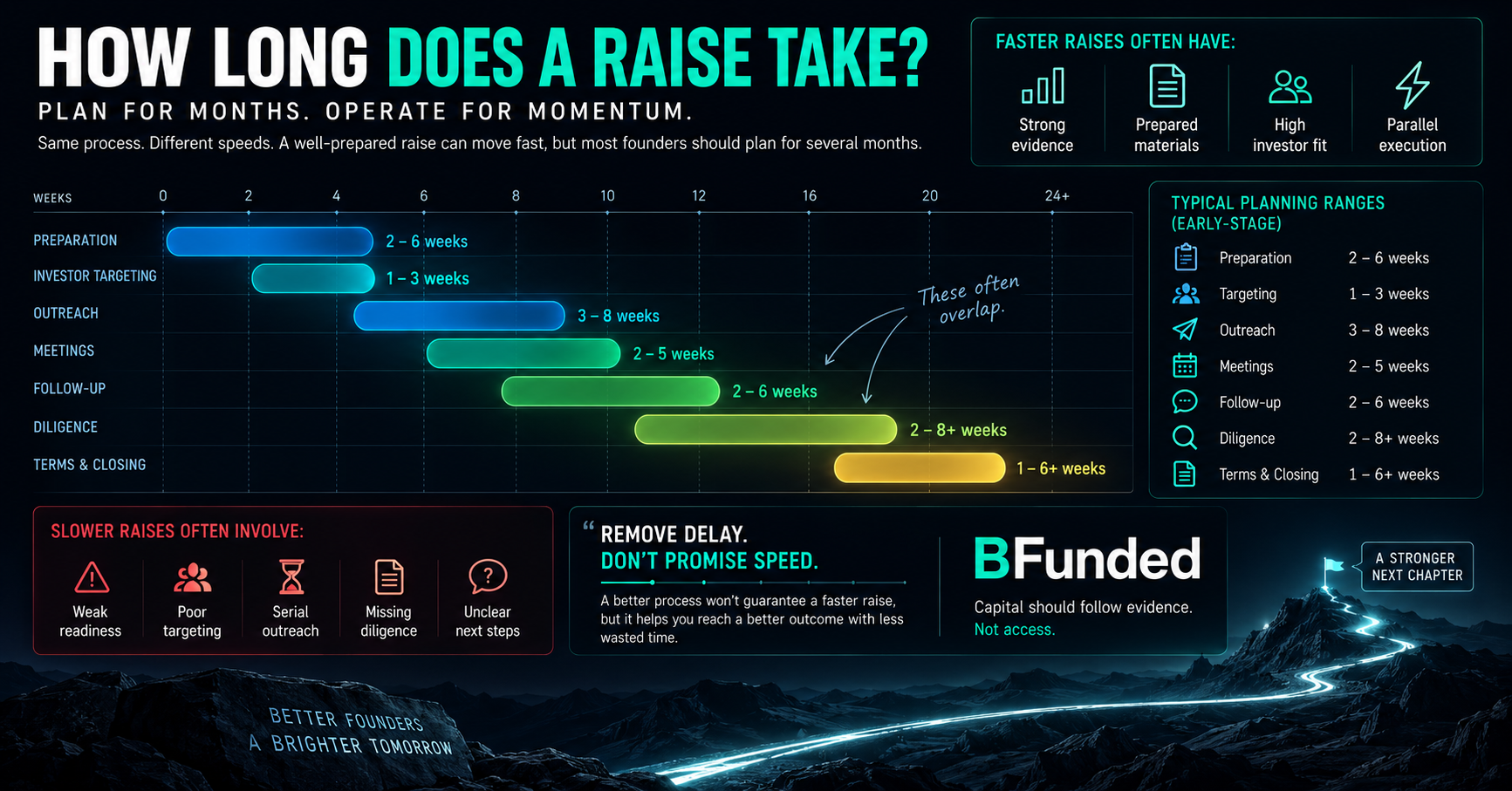
How Long Does Startup Fundraising Take? A Realistic Raise Timeline
How long does startup fundraising take? Learn what happens from preparation and investor outreach through meetings, diligence, terms, and closing — and what usually causes delays.