Rule 506(b) vs. 506(c): What Startup Founders Need to Know Before Raising
Learn the difference between Rule 506(b) and 506(c), including general solicitation, accredited investors, verification, Form D, and what founders should consider before raising.
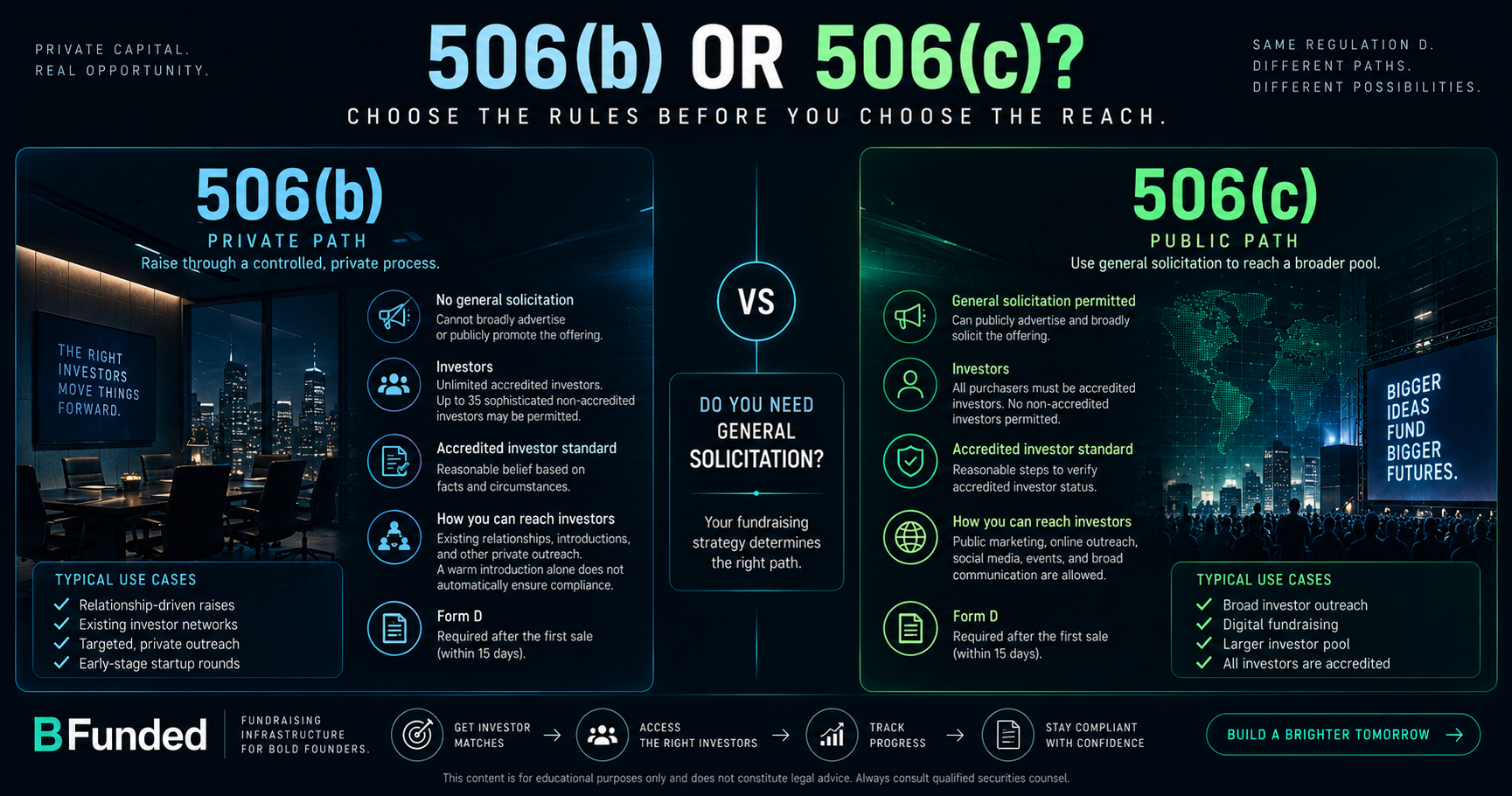
Choosing between Rule 506(b) and Rule 506(c) is not a marketing decision.
It changes who you can sell securities to, how you can communicate about the offering, and what you must do to establish investor eligibility.
Both rules sit inside Regulation D of the U.S. Securities Act framework and can allow companies to raise capital without registering the offering with the SEC.
But they operate differently.
At a high level:
Rule 506(b) generally prohibits general solicitation.
Rule 506(c) permits general solicitation, but every purchaser must be an accredited investor and the issuer must take reasonable steps to verify that status.
That difference affects everything from investor outreach to public fundraising communications.
Founders should choose the exemption with qualified U.S. securities counsel before beginning the offering — not after marketing has already started.
This article is educational information only and is not legal advice.
What Is Regulation D?
Under U.S. federal securities law, every offer and sale of securities generally needs either:
registration
or
an available exemption from registration.
Regulation D contains several exemptions companies can use for private capital raising.
Two of the most important for startup founders are:
Rule 506(b)
and
Rule 506(c).
Unlike Rule 504, Rule 506 offerings are not subject to a federal dollar cap on the amount that can be raised.
That does not mean the offering is unregulated.
Companies still need to comply with the conditions of the exemption they rely on.
That can include:
restrictions on solicitation
investor eligibility requirements
disclosure obligations
accredited-investor assessment
Form D filing
state notice requirements
bad-actor rules
anti-fraud requirements
An exemption from SEC registration is not an exemption from securities law.
506(b) vs. 506(c) at a Glance
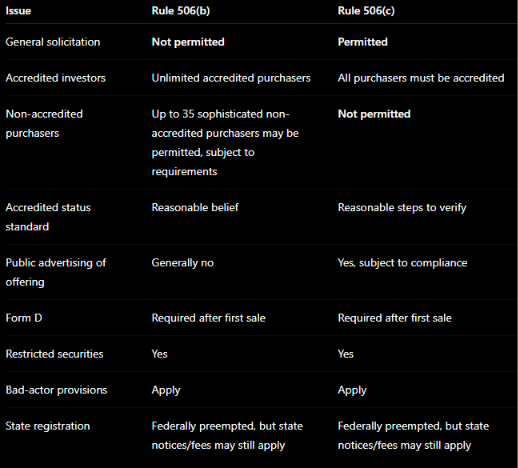
The simplest distinction is:
506(b) limits how the offering is marketed.
506(c) opens the marketing channel but raises the accredited-investor verification requirement.
What Is Rule 506(b)?
Rule 506(b) is commonly used for private placements where the company is not using general solicitation or general advertising to market the securities.
The SEC states that companies relying on Rule 506(b) may raise an unlimited amount of capital and sell to an unlimited number of accredited investors.
The rule can also permit sales to up to 35 non-accredited investors who meet the applicable sophistication standard.
Those non-accredited investors create additional obligations.
If they participate, the issuer generally must provide specified disclosure information and financial statement information before the sale and make itself available to answer their questions.
Many startup raises using 506(b) therefore choose to accept accredited investors only even though the exemption itself can permit certain non-accredited purchasers.
What Does “No General Solicitation” Mean?
This is one of the most important Rule 506(b) concepts.
General solicitation can include broadly advertising or promoting the securities offering to the public.
Depending on the circumstances, examples can include:
unrestricted public websites advertising the offering
public advertisements
broad media promotion
mass communications about the securities offering
public seminars or events that do not fall within an applicable exception
That does not mean founders using Rule 506(b) must disappear from the internet.
Companies can still communicate ordinary factual business information.
The legal question is whether the communication becomes an offer or effectively conditions the market for the securities offering.
That determination can be highly fact-specific.
Founders should therefore be careful about publicly posting:
“We're raising $2 million. Invest here.”
when relying on an exemption that prohibits general solicitation.
A normal product announcement and a public securities solicitation are not the same thing.
Does Rule 506(b) Require a Warm Introduction?
Not exactly.
This distinction matters.
A pre-existing, substantive relationship with a prospective investor is one recognized way to help demonstrate that an offering did not involve general solicitation.
But the SEC does not say:
warm introduction = automatic Rule 506(b) compliance.
The SEC describes a pre-existing relationship as one formed before the relevant offering or established through certain intermediaries before their participation in the offering.
A substantive relationship involves having sufficient information to evaluate — and actually evaluating — the prospective investor's financial circumstances and sophistication.
The SEC also makes clear that the existence of general solicitation depends on the facts and circumstances.
There are situations involving experienced investor networks and referrals that may not constitute general solicitation.
But a founder should not assume that receiving someone's email address through a mutual connection automatically establishes the legal relationship required for every 506(b) situation.
Warm access is a fundraising concept.
Compliance is a legal determination.
The two can overlap.
They should not be treated as identical.
Why This Matters for Investor Networking
Suppose a founder has identified a highly relevant seed investor.
A portfolio founder makes an introduction.
From a fundraising perspective, that may be an excellent warm path.
From a securities-law perspective, the company still needs to understand whether its overall offering practices comply with the chosen exemption.
Our guide to warm introductions to investors explains how founders can identify the best relationship path from an investor-access perspective.
Securities counsel should determine how that outreach fits into the actual offering structure.
That separation keeps two different questions clear:
How do we reach the investor?
and
How are we legally permitted to offer the security?
What Is Rule 506(c)?
Rule 506(c) takes a different approach.
It allows companies to broadly solicit and generally advertise the securities offering.
That can make 506(c) attractive when the fundraising strategy involves:
public promotion
broad digital distribution
online investor acquisition
public social-media communication about the offering
a larger investor discovery universe
But the broader marketing flexibility comes with a stricter purchaser rule:
every purchaser must be an accredited investor.
The issuer must also take reasonable steps to verify that purchasers are accredited.
That is different from simply asking someone:
Are you accredited?
and accepting a checked box with no additional basis.
Reasonable Belief vs. Reasonable Verification
This is another core difference.
Rule 506(b)
When treating an investor as accredited under 506(b), the issuer generally needs a reasonable belief that the investor qualifies.
The SEC says this is a facts-and-circumstances assessment that can depend on factors such as:
the company's relationship with the investor
information the company has about the investor
Rule 506(c)
The standard is different.
The issuer must take reasonable steps to verify accredited investor status.
The SEC describes this as an objective, facts-and-circumstances determination.
Possible factors include:
the type of accredited investor claimed
the information available about that purchaser
how the investor was solicited
the terms of the offering
potentially the minimum investment amount
The practical distinction is important.
506(b): have a reasonable basis for believing applicable investors are accredited.
506(c): actively take reasonable steps to verify every purchaser is accredited.
How Can Accredited Status Be Verified Under 506(c)?
Rule 506(c) provides flexibility.
The SEC describes both a principles-based approach and a non-exclusive list of verification methods.
Depending on the investor and circumstances, verification can involve methods such as:
Income Documentation
Reviewing relevant IRS income forms and obtaining required representations.
Net Worth Documentation
Reviewing specified documentation showing assets and liabilities, together with applicable representations.
Professional Confirmation
Receiving written confirmation from certain qualified third parties, such as:
registered broker-dealer
SEC-registered investment adviser
licensed attorney
certified public accountant
where the requirements are satisfied.
Previously Verified Investors
Certain previously verified investors can potentially qualify through updated representations under the applicable conditions.
The important point is that the statutory framework does not force one identical method on every investor.
The SEC confirmed in updated 2026 guidance that different verification methods may be used for different investors in the same 506(c) offering when appropriate to the facts and circumstances.
Self-Certification Alone Is Not Enough Under 506(c)
This deserves its own section because it is an easy mistake.
A form that says:
I certify that I am an accredited investor.
followed by:
☑ Yes
does not by itself satisfy the reasonable-steps-to-verify requirement for Rule 506(c).
The SEC specifically cautions that self-certification alone, without other supporting knowledge or verification, is insufficient.
If a founder intends to publicly solicit under 506(c), accredited-investor verification should therefore be designed into the fundraising process before investors are allowed to purchase.
What Changed in Recent SEC Guidance?
The underlying 506(b) and 506(c) distinction has not disappeared.
But SEC staff guidance continues to evolve around practical implementation.
In January 2026, SEC staff confirmed that an issuer can use different appropriate verification methods for different purchasers within the same Rule 506(c) offering.
In July 2026, staff also addressed digital attestations in a tokenized-security context and emphasized the importance of keeping sufficient records of the accredited-investor verification process.
The lesson for a normal startup founder is not:
Use tokenized securities.
It is:
verification is a process that needs evidence and records.
A compliant fundraising workflow should be able to show what was actually done.
Can Rule 506(b) Include Non-Accredited Investors?
Yes, potentially.
Rule 506(b) can permit sales to up to 35 non-accredited investors who satisfy the applicable sophistication requirements.
But this introduces additional complexity.
If non-accredited purchasers participate, the SEC requires specified disclosures and financial statement information to be provided to them within the applicable timeframe.
The founder also needs to consider the investor's ability to understand the merits and risks of the investment.
For that reason, many startup issuers and platforms choose operationally to limit their 506(b) investor universe to accredited investors.
That is a business or platform restriction, however.
It should not be confused with the text of Rule 506(b) itself.
Can Rule 506(c) Include Non-Accredited Investors?
No.
All purchasers in a Rule 506(c) offering must be accredited investors.
That is one of the clearest differences between the two exemptions.
If public solicitation is central to the fundraising strategy, the founder accepts a narrower purchaser universe in exchange for greater flexibility in how the offering is marketed.
Public Reach Does Not Mean Anyone Can Invest
This distinction is easy to miss.
Under 506(c):
anyone may potentially see the offering.
That does not mean:
anyone may purchase the securities.
A person can discover the raise publicly and still be unable to invest because they do not satisfy the accredited-investor requirement.
That is why public reach and investor eligibility need to be treated separately.
Rule 506(c) Is Not Regulation Crowdfunding
This is another common source of confusion.
Rule 506(c) allows general solicitation.
That does not make it the same exemption as Regulation Crowdfunding, commonly called Reg CF.
They are separate regulatory pathways.
Regulation Crowdfunding has its own:
offering limits
intermediary requirements
investor limits
disclosure framework
filing requirements
Rule 506(c) remains a Regulation D private-placement exemption where all purchasers must be accredited and verification is required.
Public marketing does not automatically mean “crowdfunding” under federal securities law.
Both 506(b) and 506(c) Require Form D
Using Regulation D does not mean there is no SEC filing.
Companies relying on Rule 506(b) or Rule 506(c) generally must file a Form D notice with the SEC.
The SEC states that Form D must be filed within 15 days after the first sale of securities in the offering.
For this purpose, the first sale occurs when the first investor becomes irrevocably contractually committed to invest.
Form D is filed electronically through EDGAR.
It is a notice filing rather than registration of the offering.
That distinction matters:
Reg D exempts the offering from registration.
It does not eliminate the Form D notice requirement.
Do State Securities Laws Still Matter?
Yes.
Securities issued through Rule 506 offerings are generally “covered securities,” which provides federal preemption from state securities registration and qualification requirements.
But states can still:
enforce anti-fraud laws
require notice filings
require consent to service of process
charge applicable filing fees
So a startup cannot assume:
We filed Form D, therefore every state requirement is finished.
Counsel should determine which state notices or fees apply based on where the securities are offered and sold.
Both Exemptions Produce Restricted Securities
Purchasers under both Rule 506(b) and Rule 506(c) receive restricted securities.
That generally means they cannot simply resell the securities freely into the public market without registration or another available exemption.
This matters more for some companies than others, but founders should understand that private-placement securities are not the equivalent of freely tradable public stock.
Bad-Actor Disqualification Applies to Both
Rule 506 also contains “bad actor” disqualification provisions.
Certain criminal convictions, regulatory orders, court orders, and other disqualifying events involving the issuer or other covered persons can prevent the offering from relying on Rule 506.
Companies therefore need appropriate diligence around people covered by the rule.
Do not treat this as an administrative detail to discover after the raise begins.
Anti-Fraud Rules Still Apply
A private placement is not permission to mislead investors.
The anti-fraud provisions of federal securities law continue to matter even when the offering qualifies for an exemption from registration.
Founders should therefore be careful with claims involving:
revenue
traction
projections
market size
customer relationships
investment commitments
valuation
use of funds
risks
Fundraising evidence should be accurate.
That principle matters legally.
It also matches good fundraising practice.
Which Is Better: 506(b) or 506(c)?
Neither is universally better.
The appropriate exemption depends on how the company intends to raise.
A simplified decision framework looks like this:
506(b) May Fit When:
the offering will not use general solicitation
fundraising happens through a controlled private process
existing investor relationships and targeted access are central
counsel confirms the outreach structure fits the exemption
the company does not need public advertising of the securities offering
506(c) May Fit When:
public solicitation is strategically important
the company wants to promote the offering broadly
every purchaser will be accredited
the company has a robust accredited-investor verification process
the additional verification burden is acceptable
But this table is not a substitute for counsel.
A company should not select an exemption simply because one sounds easier.
The communication strategy, purchaser universe, verification process, and actual facts surrounding the raise all matter.
A Simple Decision Tree
Start with:
Do we need to publicly market the securities offering?
No
Discuss Rule 506(b) with securities counsel.
Then evaluate:
investor relationships
outreach methods
solicitation practices
purchaser eligibility
whether any non-accredited investors will participate
Yes
Discuss Rule 506(c).
Then confirm:
all purchasers will be accredited
verification is built into the investment process
verification records are retained
public communications are accurate
all other Regulation D requirements are addressed
The decision needs to happen before the outreach strategy creates a compliance problem.
Social Media Can Change the Analysis
Founders live online.
That makes the distinction between normal company marketing and securities solicitation especially important.
A founder may publicly post:
product launches
customer wins
hiring
industry commentary
company milestones
Those activities do not automatically become securities solicitation.
But publicly promoting the availability or terms of an investment can create a very different analysis.
For a founder using 506(b), careless fundraising posts can create significant problems.
For a founder using 506(c), public promotion may be permissible, but the rest of the exemption still needs to be satisfied.
Publicly allowed does not mean compliance-free.
Do Not Choose the Exemption After You Start Marketing
This is one of the most practical lessons.
Do not publicly promote the offering for two months and then ask:
Can we call this a 506(b) raise?
The exemption should inform the communications strategy from the beginning.
Switching between offering exemptions can create additional integration and compliance questions.
That is a legal analysis for counsel, not something founders should improvise from a blog post.
Define the fundraising pathway first.
Then build outreach inside it.
How This Connects to Seed Fundraising
Compliance sits underneath the fundraising strategy.
The founder still needs:
fundability
a defined round
relevant investors
outreach
meetings
diligence
terms
closing
Our guide to raising seed funding explains that wider operating process.
Regulation D answers a different question:
Under what securities-law framework are we offering and selling this investment?
Strong investor targeting does not replace legal compliance.
Legal compliance does not create investor fit.
The raise needs both.
How BFunded Approaches 506(b) and 506(c)
The current BFunded Raise Engine is designed specifically around Regulation D fundraising and asks founders to choose between 506(b) and 506(c) before outreach begins.
For 506(b), the product currently emphasizes:
no public solicitation
accredited-investor targeting
warm-path introductions
For 506(c), it permits general solicitation while requiring accredited-investor verification before investment.
That product-level distinction is useful operationally.
But founders should keep one legal nuance in mind:
a BFunded warm path should not automatically be treated as proof that a particular relationship satisfies every legal requirement for a 506(b) offering.
SEC guidance says the existence of a pre-existing substantive relationship and the absence of general solicitation depend on the actual facts and circumstances.
That means founders should have securities counsel review the selected exemption and outreach process for the specific raise.
BFunded itself states that it is software and data only, is not a broker-dealer, does not custody funds, and does not take transaction-based compensation.
The software can help structure the workflow.
The issuer still needs to run the offering under an appropriate legal framework.
A Pre-Raise Regulation D Checklist
Before investor outreach begins:
Offering Structure
✅Securities counsel has reviewed the raise.
✅The applicable exemption has been selected.
✅The fundraising team understands what communications are permitted.
If Using 506(b)
✅No general solicitation strategy is planned.
✅Investor outreach process has been reviewed.
✅Relationship and referral assumptions have been reviewed.
✅Any non-accredited participation has been specifically addressed.
If Using 506(c)
✅Every purchaser will be accredited.
✅A verification procedure exists.
✅Required evidence and records can be retained.
✅Public fundraising communications have review controls.
For Either Exemption
✅Form D filing process is planned.
✅State notice requirements are identified.
✅Bad-actor diligence is addressed.
✅Investor materials are accurate and consistent.
✅Restricted-security implications are understood.
✅Legal responsibilities have clear ownership.
This is one checklist where founders should not improvise.
Frequently Asked Questions
What is the main difference between Rule 506(b) and Rule 506(c)?
Rule 506(b) generally prohibits general solicitation, while Rule 506(c) permits general solicitation if every purchaser is accredited and the issuer takes reasonable steps to verify accredited-investor status.
Can I advertise a Rule 506(b) offering publicly?
Generally, Rule 506(b) prohibits general solicitation and general advertising of the securities offering. Public company communications require careful analysis because ordinary factual business information and securities solicitation are not always the same thing.
Does Rule 506(b) require every investor to be accredited?
No. Rule 506(b) can permit up to 35 non-accredited but sufficiently sophisticated purchasers, subject to additional requirements. Many startup offerings nevertheless choose to limit participation to accredited investors.
Does Rule 506(c) allow non-accredited investors?
No. Every purchaser in a Rule 506(c) offering must be an accredited investor.
Can investors self-certify under Rule 506(c)?
Self-certification alone is not sufficient to satisfy the Rule 506(c) reasonable-steps-to-verify requirement. The issuer needs an appropriate verification process based on the applicable facts and circumstances.
Do I need to file Form D for a 506(b) or 506(c) raise?
Yes. The SEC requires a Form D notice for Regulation D offerings under Rules 506(b) and 506(c), generally within 15 days after the first sale.
Is a warm introduction enough for 506(b)?
Not automatically. The SEC treats the absence of general solicitation and the existence of a pre-existing substantive relationship as fact-specific questions. A fundraising introduction and legal compliance are not synonymous.
Is 506(c) the same as Regulation Crowdfunding?
No. Rule 506(c) is part of Regulation D. Regulation Crowdfunding is a separate securities exemption with different offering limits, investor rules, intermediary requirements, and disclosures.
How much can a startup raise under Rule 506?
Rule 506 is not subject to a federal offering-size cap. The company must still satisfy all applicable conditions of the chosen exemption.
Do state securities rules apply to Rule 506 offerings?
Rule 506 securities receive federal preemption from state registration and qualification, but states can still require notices, fees, consent to service, and enforce anti-fraud laws.
Can BFunded tell me which exemption I should use?
BFunded can structure its software workflow around the selected Reg D exemption, but the legal choice should be made with qualified securities counsel based on the specific offering and outreach strategy.
The Bottom Line
The difference between 506(b) and 506(c) is not simply:
private vs. public.
It is a tradeoff between:
how you reach investors
and
who can actually purchase and how eligibility must be established.
Rule 506(b) protects a private fundraising structure by restricting general solicitation.
Rule 506(c) opens public solicitation but requires every purchaser to be accredited and reasonably verified.
Neither exemption removes:
Form D
securities-law liability
state notices
bad-actor considerations
restricted securities
the need for accurate investor communications
Choose the legal pathway before designing the outreach campaign.
Because the fastest fundraising workflow in the world is not useful if the offering itself is structured incorrectly.
Keep reading
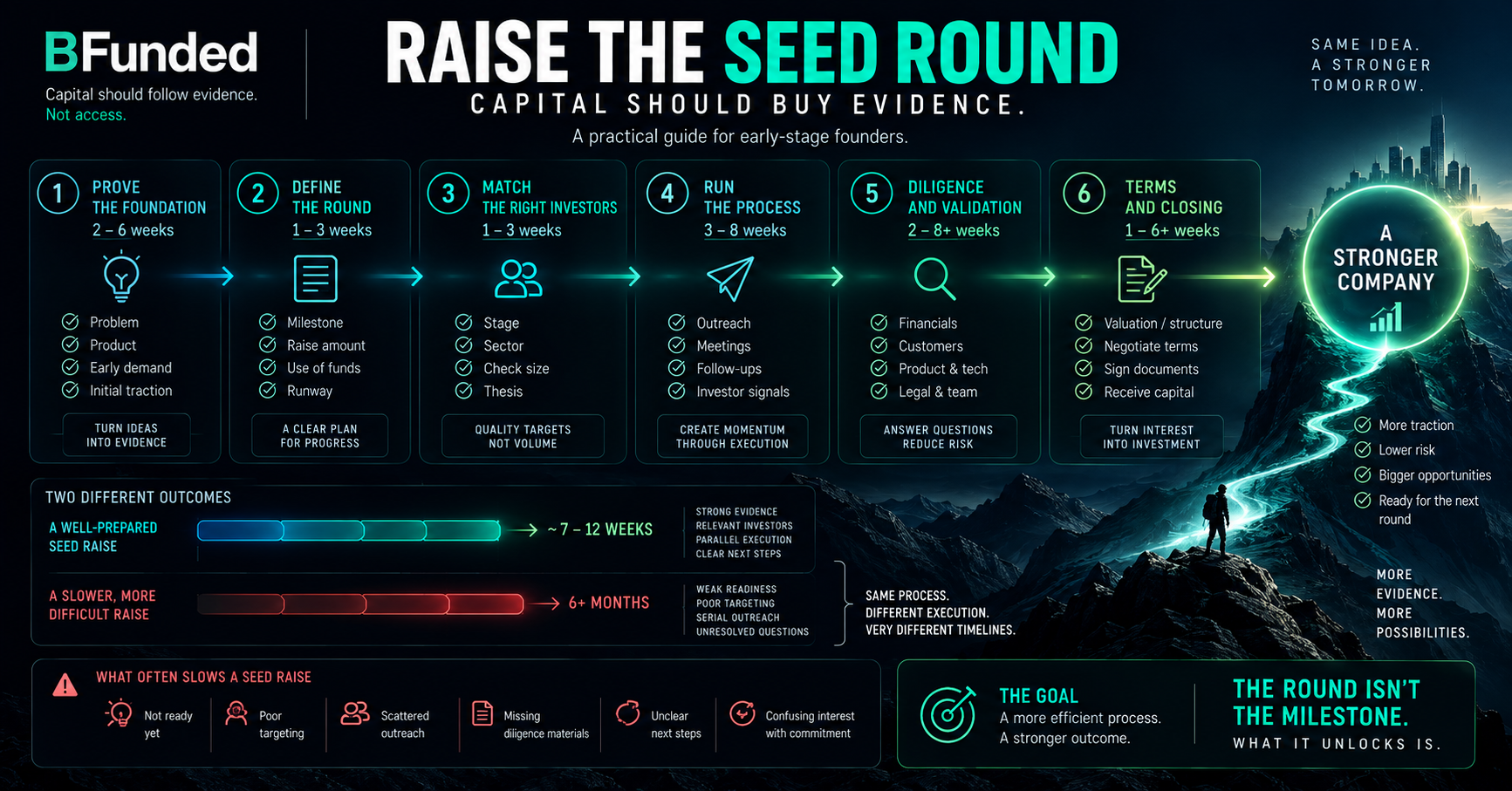
How to Raise Seed Funding: A Practical Guide for Early-Stage Founders
Learn how to raise seed funding by defining the milestone, proving readiness, targeting the right investors, running a fundraising pipeline, and closing the round.
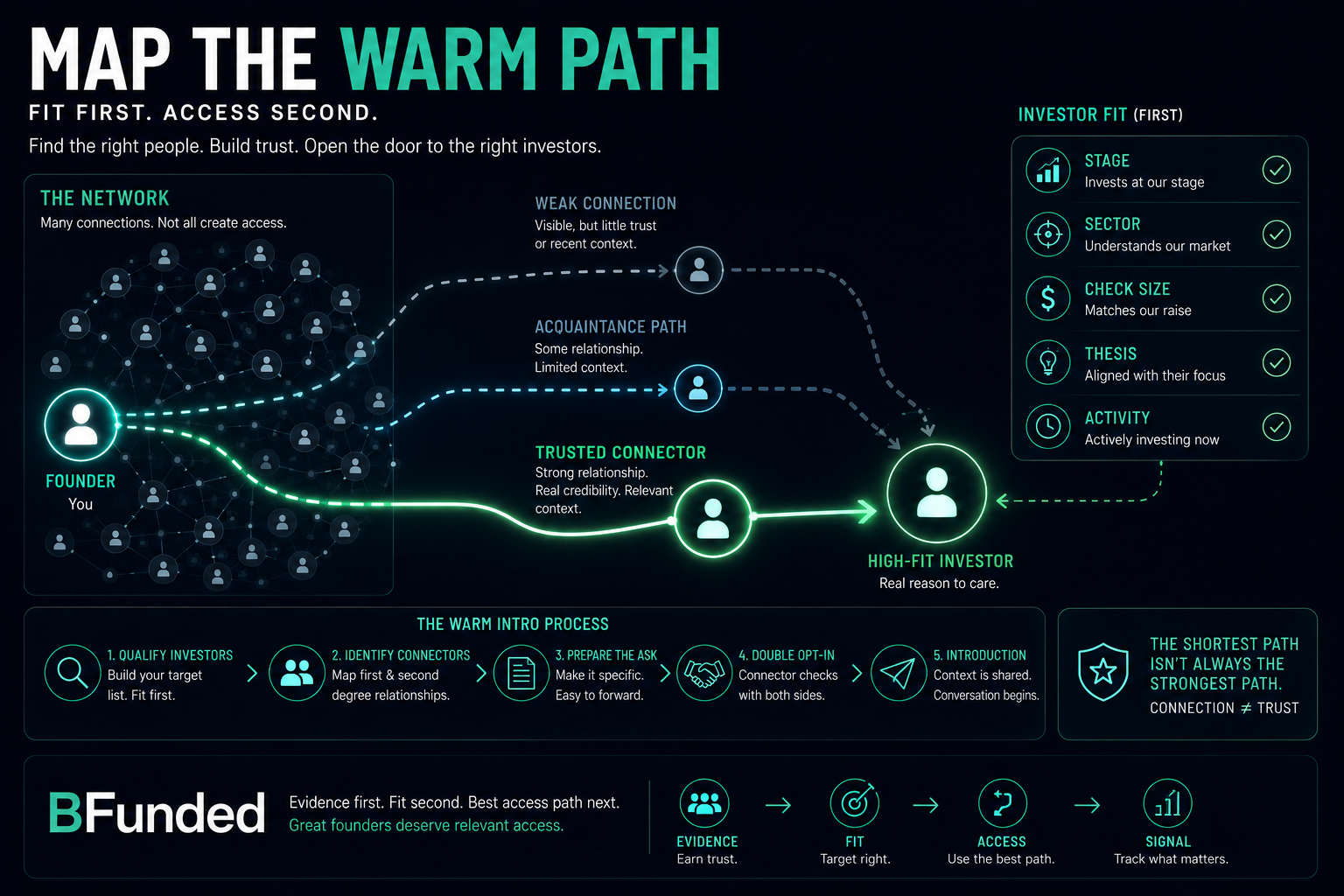
How to Find Warm Paths to the Right Startup Investors
Learn how to find warm paths to startup investors by qualifying investor fit first, mapping trusted connectors, creating forwardable intro requests, and tracking introductions through the raise.
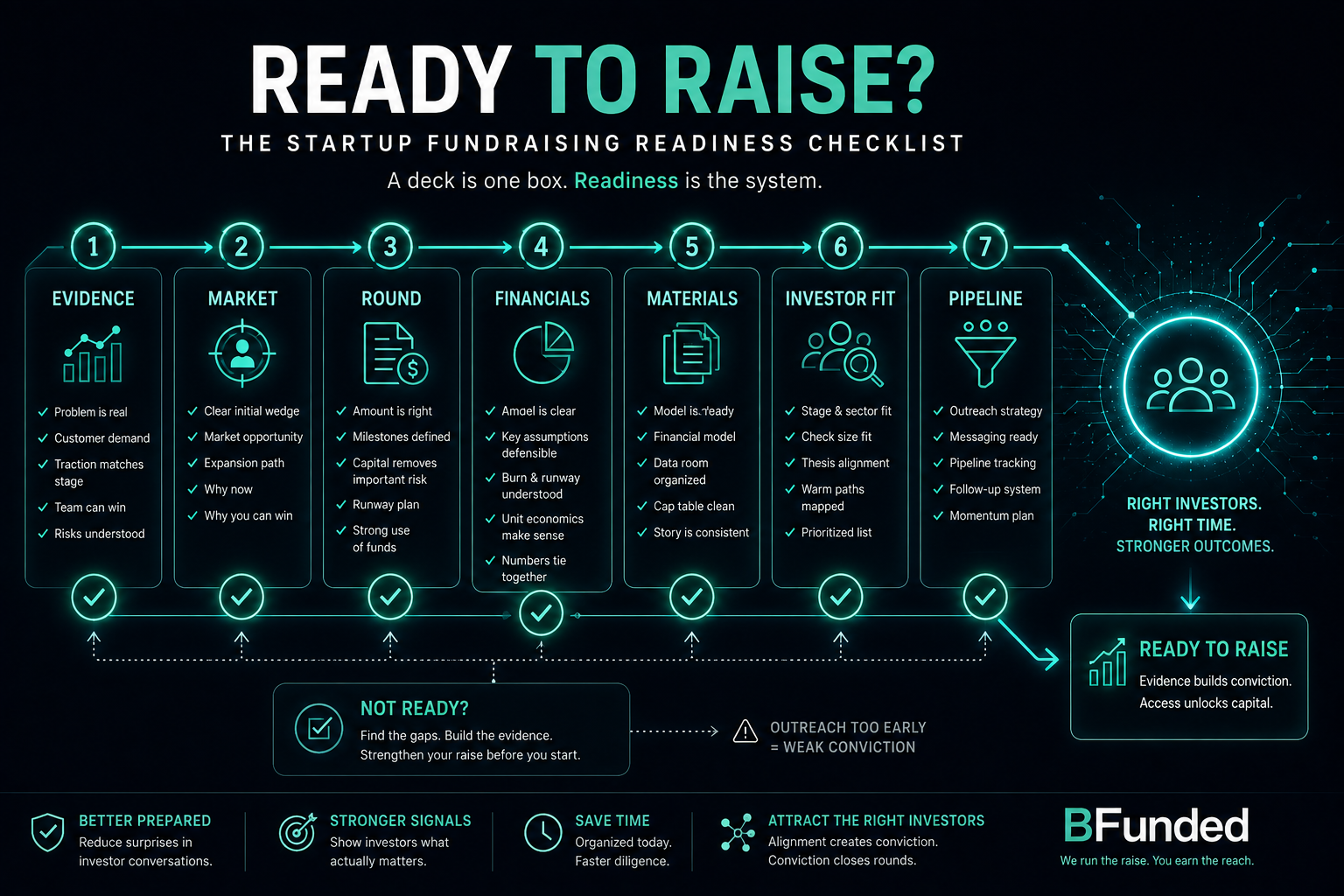
Startup Fundraising Readiness Checklist: Are You Actually Ready to Raise?
Use this startup fundraising readiness checklist to assess your evidence, pitch, financials, data room, investor strategy and fundraising process before outreach begins.