How to Follow Up With Investors Without Chasing Them Blind
Learn how to follow up with investors after outreach, meetings, diligence, and term discussions using context, investor signals, and clear next actions.
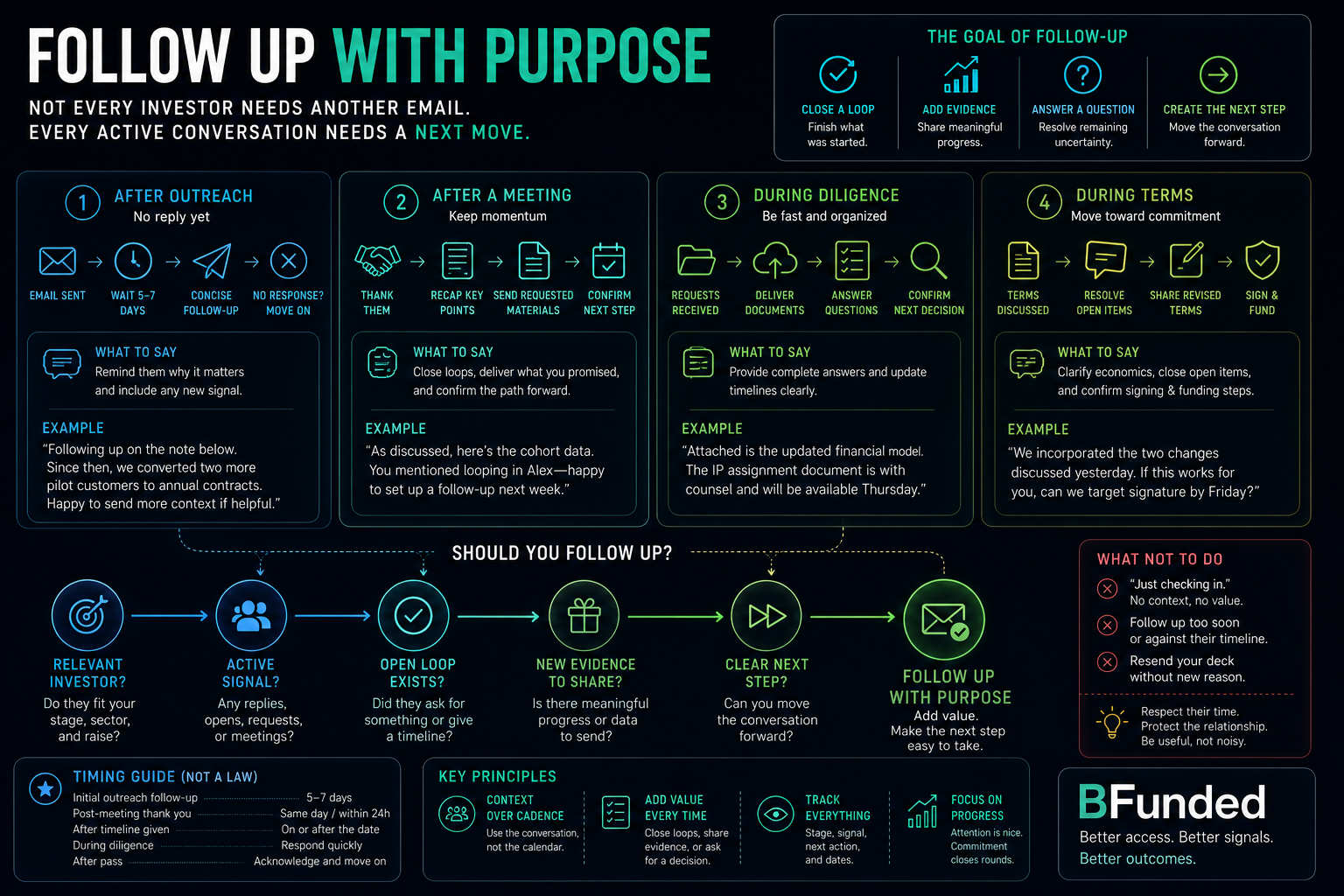
“Just checking in.”
It may be one of the most common phrases in fundraising.
It is also one of the least useful.
A good investor follow-up should not exist simply because several days have passed.
It should close an open loop, deliver something promised, provide relevant new evidence, or move the investor toward a clear next decision.
Investor follow-up is not about chasing attention. It is about creating the next useful step in an active fundraising conversation.
That distinction matters because different investors need different follow-ups.
An investor who never replied to your first email is not in the same situation as one who requested financials yesterday.
An investor who completed a first meeting is not in the same situation as one currently reviewing diligence materials.
And an investor who said “come back when you reach $50K MRR” should not receive the same generic email every week.
Good follow-up depends on:
context
stage
signal
and
the next decision required.
Why Investor Follow-Up Matters
Investors manage many conversations at the same time.
Emails get buried.
Meetings happen back-to-back.
Priorities shift.
Partners need additional information.
A company may be interesting without being the investor's most urgent task that day.
That means silence does not always provide a clean answer.
But repeatedly emailing someone without adding context does not create conviction either.
The goal of follow-up is to make it easier for the investor to answer:
What should happen next?
That might be:
review a metric
book another meeting
introduce a partner
examine financials
begin diligence
discuss allocation
pass
A clear no can be more useful than endless ambiguity.
Good follow-up creates movement or clarity.
Both are valuable.
There Is No Single Investor Follow-Up Cadence
Founders often search for a universal rule:
Follow up after three days.
Or five.
Or seven.
Or two weeks.
That is the wrong way to think about it.
The right timing depends on what happened immediately before the follow-up.
There are at least four different situations:
After Initial Outreach
The investor has not responded.
After a Meeting
The founder needs to close open loops and confirm next steps.
During an Active Process
The investor has requested something or is evaluating the company.
After a Pass or Delayed Decision
The relationship may remain relevant even though the current round does not move forward.
Each requires a different approach.
Scenario 1: Following Up After Initial Outreach
Suppose you sent a targeted investor email.
No response.
Do not immediately assume:
They are rejecting us.
But do not send another email the next morning either.
Give the investor reasonable time to process the first message.
Waveup's current 2026 outreach framework recommends one polite follow-up roughly five to seven days after the initial message before the founder moves on rather than repeatedly chasing a silent investor. (waveup.com)
A useful follow-up could be:
Hi Jane — following up on the note below. We're raising our $1M seed round for ExampleCo and recently converted two additional pilots into annual contracts. Given your work in vertical SaaS, I thought this might be relevant. Happy to send more context if useful.
Notice what it does not say:
Just checking in.
It reminds the investor:
why the company is relevant
what changed
what the ask is
Keep it short.
If there is still no response after a reasonable follow-up, keep the pipeline moving.
Do not let one investor consume the energy required to find ten others.
Scenario 2: Following Up After an Investor Meeting
A post-meeting follow-up serves a completely different purpose.
The investor already knows the company.
Now your job is to preserve context and close the loops created during the conversation.
Startups.com’s current follow-up guidance recommends sending the post-meeting recap the same day when possible and within 24 hours, with requested materials and a specific next step.
A strong post-meeting follow-up usually includes:
Thank Them
Briefly.
Reference Something Specific
Show that the message reflects the actual meeting.
Close Requested Actions
If they asked for cohort data, send it.
If they requested a model, attach it.
If you promised a customer reference, explain when it will arrive.
Address Important Open Questions
Do not ignore the hardest part of the meeting.
Confirm the Next Step
Who needs to meet next?
When should you reconnect?
What decision will happen?
The follow-up should make the second conversation easier to run than the first.
Example: Post-Meeting Investor Follow-Up
A practical structure:
Subject: ExampleCo — follow-up + cohort data
Hi Jane,
Thanks for the conversation today. Your question about expansion revenue was especially useful.
As promised, I've attached the cohort breakdown and updated ARR bridge.
The key point from the data: 72% of our Q1 accounts have expanded since onboarding, with average contract value increasing from $14K to $21K.
You mentioned discussing the company with Alex, who covers enterprise software on your team. Happy to coordinate a follow-up with both of you next week.
Thanks again,
[Founder]
This is not simply polite.
It advances the process.
Follow Up on What the Investor Actually Asked
One of the simplest ways to make follow-ups better is to stop guessing what investors want.
They already told you.
During the meeting, record:
key questions
objections
missing evidence
promised documents
people they need to involve
expected timing
stated next step
Then build the follow-up around those points.
If the investor spent fifteen minutes questioning retention, do not send them a product-launch announcement as your main follow-up.
Send the retention evidence.
If their concern was market size, address the market.
If they asked how the round gets the company to Series A, show the milestones.
The best follow-up reduces the uncertainty the investor already revealed.
Every Follow-Up Should Do at Least One Job
Before sending, ask whether the message does at least one of these:
Close a Loop
Send something you promised.
Add Evidence
Share meaningful progress.
Answer a Question
Resolve uncertainty.
Confirm Timing
Clarify when something happens.
Ask for a Decision
Move the investor toward a yes, no, or next stage.
Create the Next Meeting
Advance the conversation.
If the email does none of these, ask whether it needs to be sent at all.
Use Investor Signals to Decide Where to Follow Up
Not every silent investor deserves equal attention.
Consider two investors.
Investor A
Opened the deck once.
No reply.
Investor B
Opened the deck three times.
Forwarded it.
Held a first meeting.
Requested the financial model.
These should not receive the same follow-up strategy.
Our investor signals guide explains why a deck open, second meeting, diligence request, and terms discussion should not trigger the same follow-up.
Signals can help founders prioritize.
But do not turn engagement tracking into mind reading.
An investor viewing a deck twice does not mean they are ready to invest.
It simply provides more context than having no engagement information at all.
OpenVC’s 2026 investor-outreach guide recommends using engagement context for follow-up without overanalyzing minor deck-view differences.
The purpose is better timing.
Not fake certainty.
Follow-Up Should Match the Pipeline Stage
A useful way to think about follow-up is:
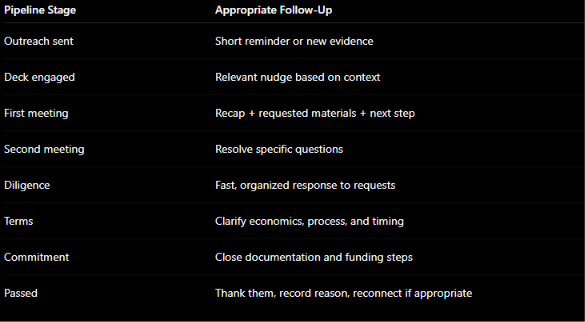
Our startup fundraising pipeline guide explains how to track each investor’s stage, last activity, and next move throughout the raise.
The important thing is that the follow-up fits where the investor actually is.
Do Not Follow Up Only Because the Calendar Says So
Automated reminders are useful.
Blind automation is not.
Imagine the CRM says:
Follow up Wednesday.
But Tuesday afternoon the investor opens your data room and forwards the deck.
The context changed.
Or imagine the investor said:
We're discussing this at partner meeting next Monday. I'll come back to you afterward.
Sending:
Just bumping this to the top of your inbox.
on Friday does not help.
A calendar should prevent conversations from disappearing.
It should not replace judgment.
Timing should follow context whenever context is available.
Respect Investor Timelines
If an investor says:
Give us until next Friday.
do not follow up Wednesday simply because a generic sequence told you to.
Record:
Next action date: Friday
and follow the agreed process.
If Friday passes without an answer, a concise Monday follow-up is reasonable.
For example:
Hi Jane — you mentioned the partnership would review ExampleCo on Friday, so I wanted to close the loop. Happy to answer anything that came up during the discussion.
Specific.
Contextual.
Easy to answer.
Follow-Up Is Stronger When the Company Has Changed
The most useful follow-up often contains new evidence.
Examples:
New customer
We signed our first enterprise customer in healthcare.
Revenue
ARR crossed $500K.
Retention
Q2 net revenue retention reached 118%.
Product
The enterprise product launched.
Team
We hired the VP of Sales we discussed.
Round
The first $250K is now committed.
Partnership
The distribution agreement we discussed is signed.
This gives the investor a reason to reconsider the opportunity.
The message is no longer:
Please respond.
It is:
The investment case has changed.
That is a much stronger reason to reopen a conversation.
Do Not Manufacture Updates
Not every week contains meaningful news.
Do not turn minor activity into exaggerated fundraising theater.
Weak:
Exciting update! We redesigned our landing page.
Stronger:
Since we spoke, three of the four pilots converted to annual contracts.
The investor cares about evidence that changes the investment case.
Not every company event deserves a fundraising email.
What to Do When an Investor Goes Silent After a Meeting
Silence becomes more frustrating after the investor has already engaged.
The founder may start wondering:
Did we say something wrong?
Did the partner hate the market?
Are they still discussing us?
Should we email again?
First, look at what was agreed.
If There Was a Specific Timeline
Wait for it.
Then follow up.
If They Requested Something
Make sure you delivered it.
If There Was No Clear Next Step
That was the first mistake.
Ask directly.
For example:
Hi Jane — following up from our conversation last Tuesday. You mentioned discussing ExampleCo internally after reviewing the retention data. Is there anything else useful from us before that discussion, and should we reconnect next week?
Now the investor can respond with:
yes
no
not yet
pass
send something else
All are more useful than ambiguity.
What to Do After Multiple Unanswered Follow-Ups
At some point, repeated silence becomes information.
Do not send:
Follow-up #6.
Follow-up #7.
Follow-up #8.
The goal is not to win a persistence contest.
OpenVC's follow-up documentation currently treats two unanswered automated follow-ups as sufficient to move a non-responsive investor toward an ignored status in its CRM. (docs.openvc.app)
You do not need to copy that exact rule.
But the principle is useful.
Your pipeline needs a point where silence stops receiving active founder attention.
You can always reconnect later if:
traction materially improves
the next round begins
the investor re-engages
market conditions change
For now, keep moving.
Do Not Ask “Any Thoughts?”
Weak follow-up:
Any thoughts on the deck?
This creates work for the investor.
What kind of thoughts?
On what decision?
By when?
Better:
You mentioned retention was the main open question. I've attached the cohort analysis through August. Does this resolve enough of the concern to move to a partner meeting?
Now the investor knows exactly what decision you are asking about.
Good follow-up reduces cognitive load.
Do Not Re-Pitch the Entire Company
An investor who has already taken a meeting does not need the original cold email again.
The conversation should become more specific over time.
Early:
Here's why the company may fit.
Later:
Here's the evidence you requested.
Later:
Here's how we resolved the concern.
Later:
Here's the proposed allocation and timeline.
As the investor advances, the communication should advance too.
Repeatedly sending the full company story can signal that the founder is not listening to the actual evaluation process.
Follow-Up During Due Diligence
Diligence follow-up should be particularly disciplined.
Investors may request:
corporate documents
financial statements
customer contracts
cohort analysis
cap table
IP information
legal materials
references
Respond quickly, but do not sacrifice accuracy.
If something needs time:
We have the financial statements ready today. The updated IP assignment document is with counsel and should be available Thursday.
Now the investor knows:
what is done
what remains
when it will arrive
Avoid unexplained delays.
Diligence is partly an evaluation of the company.
It can also become an evaluation of how the team operates.
Follow-Up During Terms
Once terms are being discussed, vague communication becomes expensive.
Track:
proposed check
round allocation
valuation or cap
instrument
rights
outstanding issues
decision-maker
expected signing date
funding date
The next action should be explicit.
For example:
We've incorporated the two changes discussed yesterday and attached the revised SAFE side letter. If this resolves the outstanding points, can we target signature by Thursday?
Terms follow-up should move toward closure.
Not toward another indefinite conversation.
Follow-Up After a Verbal Commitment
A verbal commitment is encouraging.
It is not the same as a funded investment.
If someone says:
We're in for $100K.
record it appropriately.
Then clarify:
documentation
allocation
signing
verification where applicable
funding mechanics
target date
The conversation should move from:
interest
to:
execution.
Do not stop managing the investor simply because they said yes verbally.
The round closes when the required documentation and capital are actually complete.
Following Up After an Investor Pass
A pass does not always mean:
never speak to us again.
Sometimes the reason is:
too early
fund timing
insufficient traction
geography
check-size mismatch
another portfolio investment
current round structure
Record the reason.
If the issue could genuinely change, the relationship may be worth preserving.
For example:
Thanks for the direct feedback. Your point about enterprise retention makes sense. We'll keep you updated as the current cohorts mature and reconnect if the data changes materially.
Then move on.
Do not try to debate the investor into reversing a clear no.
A respectful close can protect the relationship for a future round.
Use “No” as Pipeline Data
Pass reasons become useful when they repeat.
One investor says:
Too early.
Interesting.
Ten investors say:
Too early.
Pattern.
One investor questions gross margins.
Five investors question gross margins.
Pattern.
One investor thinks the round is too large.
Eight investors say the same thing.
Pattern.
Follow-up and pass data can reveal where the raise is breaking:
Targeting?
Evidence?
Terms?
Timing?
Story?
That information should feed back into the fundraising strategy.
Keep Investor Follow-Up Inside the Pipeline
Do not manage investor follow-up with inbox memory.
Every active conversation should contain:
investor
current stage
last interaction
last interaction date
promised materials
investor questions
next action
next-action date
owner
signal
pass reason if relevant
Then the team can answer:
Who needs action today?
instead of:
Who haven't we emailed recently?
Those are very different operating questions.
One Investor, One Next Move
One of the simplest pipeline disciplines is to force every active investor conversation into a single next action.
Not:
Follow up.
But:
Send retention cohort Friday.
Ask Sam for introduction Monday.
Book partner meeting.
Send cap table today.
Wait for IC decision September 12.
Confirm $250K allocation.
Specificity prevents conversations from quietly stalling.
How BFunded Approaches Investor Follow-Up
BFunded's current product is designed around this idea of visible next actions rather than disconnected investor communication.
The current BFunded Raise Engine is built around one next move at a time, while tracking opens, forwards, meetings, and confirmed investments across the raise.
The platform currently describes examples such as:
a deck being forwarded
a meeting being booked
an investment being confirmed
a score increasing
additional investor reach unlocking
and then surfaces what the founder should do next. (bfunded.io)
The important point is not automation for its own sake.
It is context.
The follow-up after:
Deck forwarded
should be different from:
Meeting booked
which should be different from:
Investment confirmed.
That is what it means to run a raise instead of simply sending reminders.
Frequently Asked Questions
How long should I wait before following up with an investor?
It depends on the previous interaction. After cold outreach, several current fundraising guides suggest waiting roughly five to seven days before a concise follow-up. After an investor meeting, send promised materials and a recap much sooner—often the same day or within 24 hours. If the investor gives you a specific timeline, follow that timeline.
What should I say in an investor follow-up email?
Reference the actual context, close any promised actions, provide relevant evidence, and include a specific next step. Avoid sending a message that only says “just checking in.”
How many times should I follow up with an investor?
There is no universal rule, but repeated unanswered messages should eventually stop receiving active founder attention. Some fundraising systems use one or two follow-ups before moving a silent investor out of the active pipeline.
Should I follow up after an investor views my pitch deck?
A deck view can provide useful context but does not automatically require immediate outreach. Consider fit, prior communication, repeat engagement, and the existing pipeline stage before deciding what to do.
What should I send after an investor meeting?
Send the materials you promised, answer important questions raised during the meeting, summarize any agreed actions, and clarify the next decision or meeting.
Should I follow up after an investor says no?
Usually acknowledge the pass professionally. If the reason could change with future traction or timing, record it and consider reconnecting when something material changes.
What if an investor stops replying during diligence?
Check whether all requested materials were delivered, identify any open questions, and send a direct process-oriented follow-up. Ask whether additional information is needed and what the next decision point is.
Should investor follow-ups be automated?
Reminders and basic sequences can be automated, but context should influence the message. A generic cadence should not override specific investor requests, active diligence, new signals, or agreed timelines.
How do I keep track of investor follow-ups?
Use a fundraising pipeline or CRM containing current stage, last activity, investor questions, next action, next-action date, and commitment status.
The Bottom Line
Investor follow-up should not feel like chasing.
If it does, the message may be missing a purpose.
Good follow-up says:
Here is what you asked for.
Here is what changed.
Here is the question we resolved.
Here is what should happen next.
Not:
Please pay attention to us again.
The best founders do not follow up because seven days passed.
They follow up because the conversation has a next move.
And when there is no next move left, they stop chasing and keep the raise moving.
Keep reading
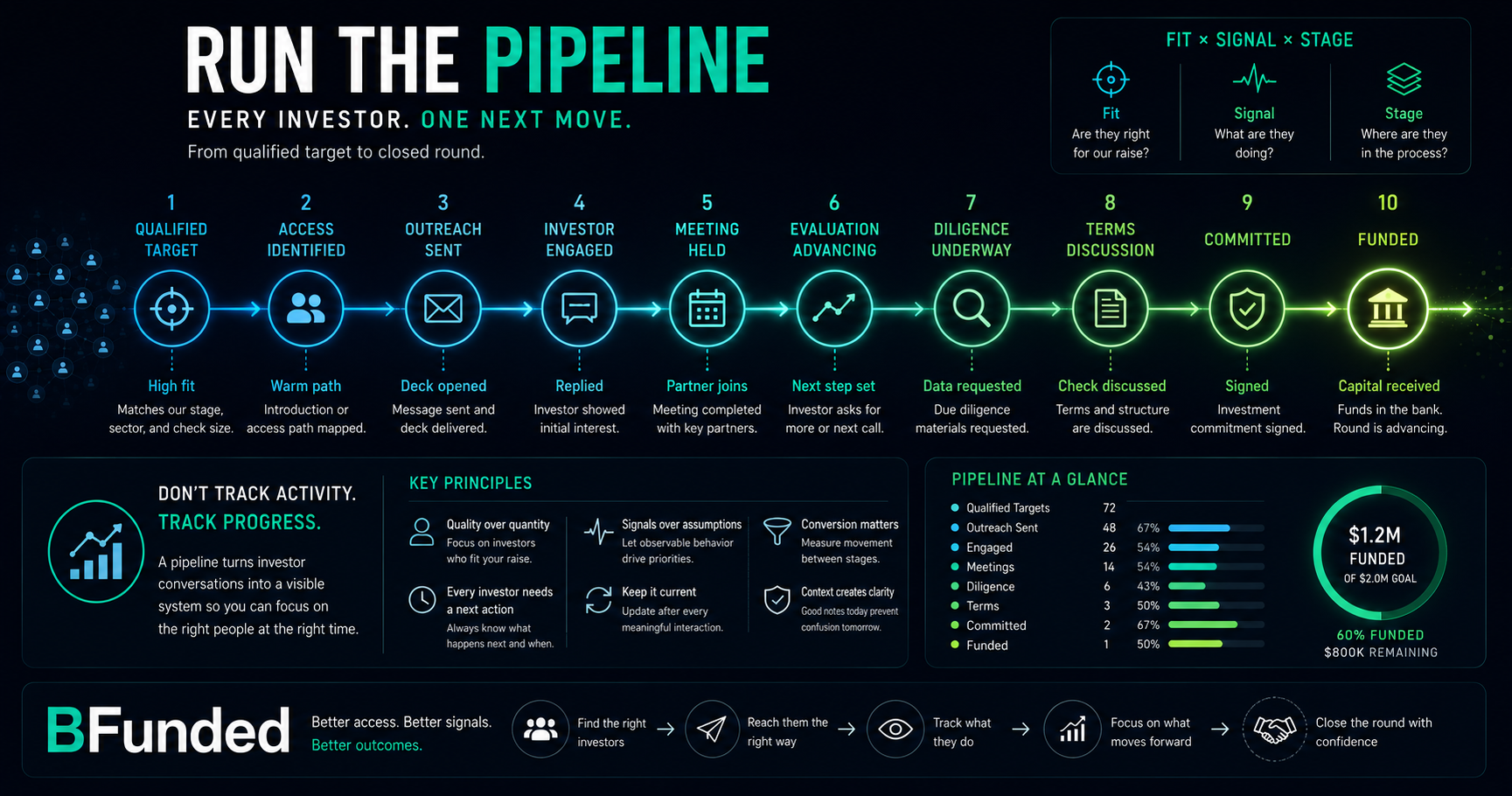
The Startup Fundraising Pipeline: From Investor Target to Closed Round
Learn how to build a startup fundraising pipeline that tracks qualified investors from outreach and meetings through diligence, terms, commitment, and funded capital.
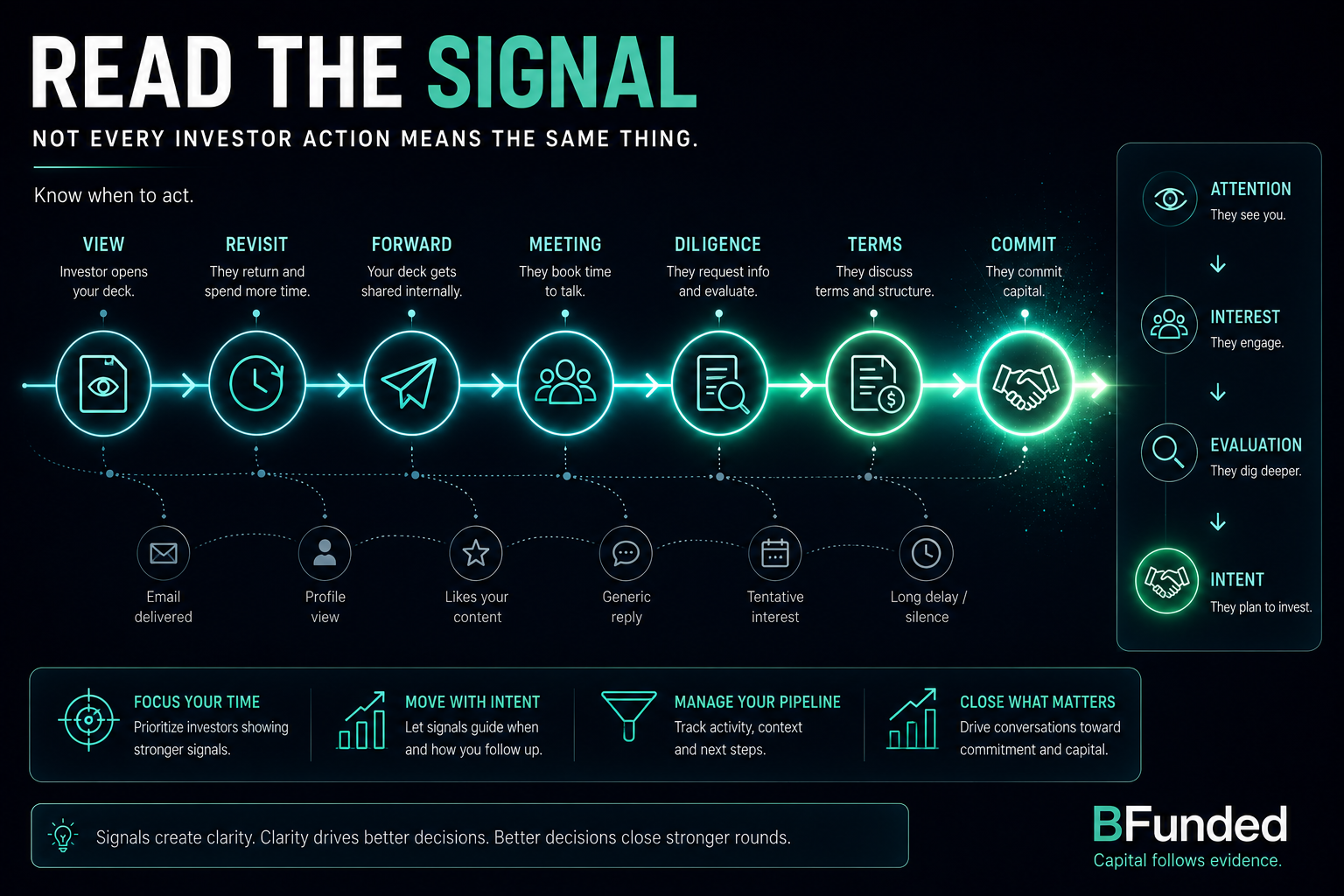
Investor Signals: How to Know When an Investor Is Actually Interested
Learn how to read investor signals during a startup raise, from pitch deck views and repeat engagement to meetings, diligence, terms, and actual commitments.
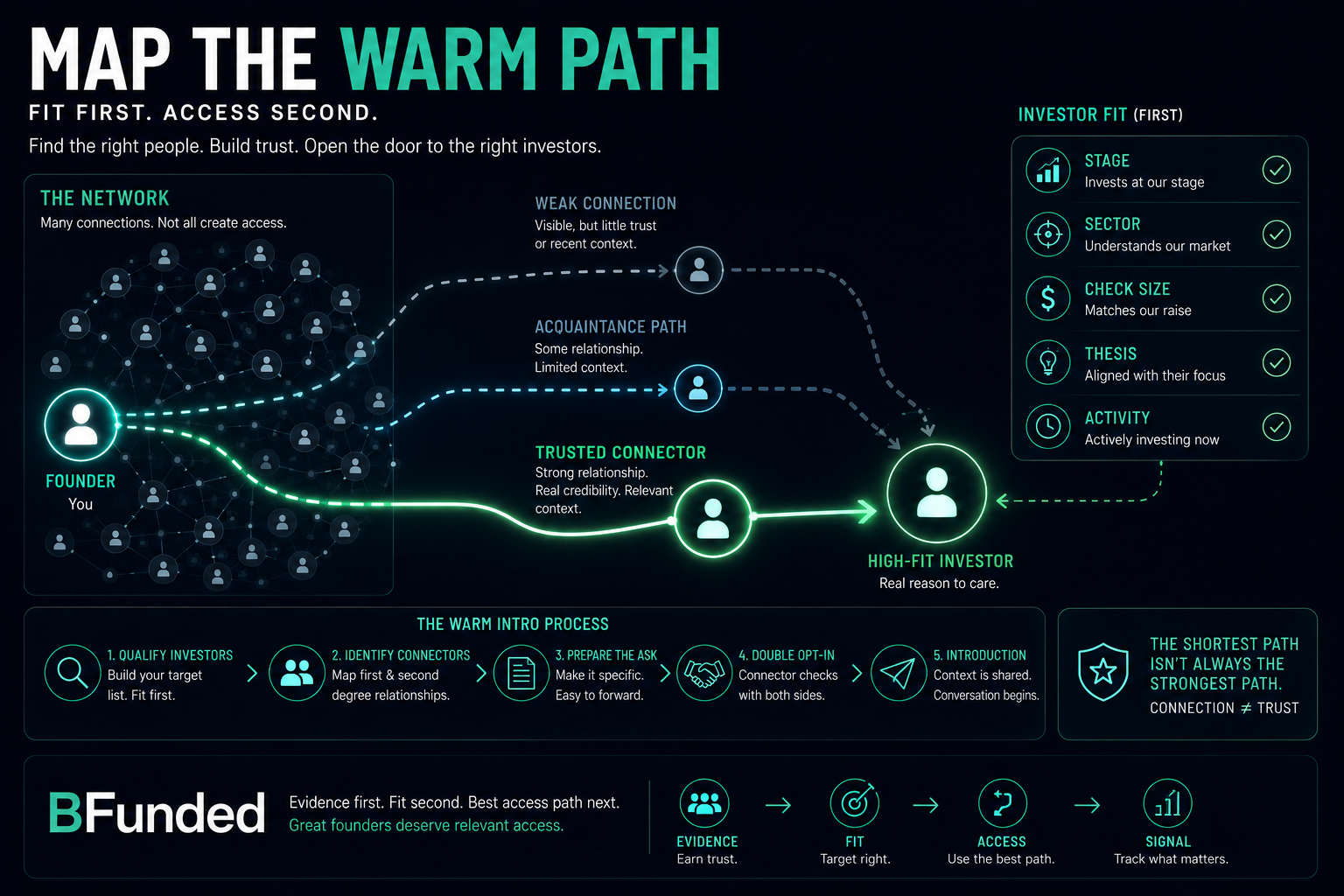
How to Find Warm Paths to the Right Startup Investors
Learn how to find warm paths to startup investors by qualifying investor fit first, mapping trusted connectors, creating forwardable intro requests, and tracking introductions through the raise.