What Is Startup Fundability? How Investors Decide If You’re Ready to Raise
A great pitch deck can earn attention, but it cannot make a company fundable. Learn what startup fundability means and what evidence investors look for before backing a raise.
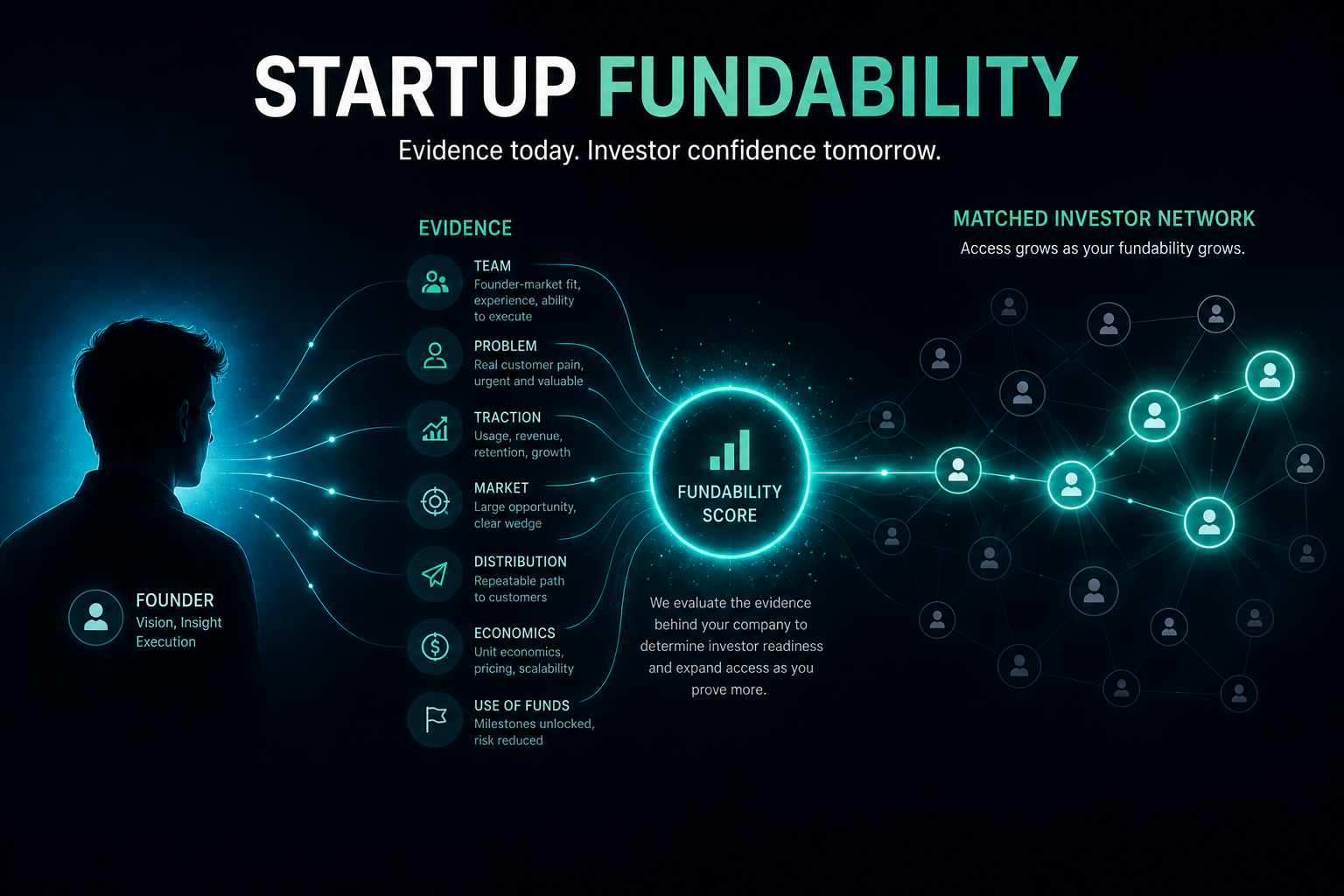
What Is Startup Fundability?
A startup can have a polished pitch deck, an ambitious market opportunity and a compelling story — and still struggle to raise capital.
That is because being ready to pitch and being fundable are not the same thing.
Startup fundability is the strength of the evidence that makes an investor willing to seriously evaluate — and potentially back — a company at its current stage.
It is not a guarantee that a round will close. Different investors have different mandates, risk tolerances, sectors, stages and investment theses.
A more useful question is:
Has this founder proved enough, relative to the stage of the company, to make the remaining risk worth investigating?
Early-stage investing is inherently uncertain. Investors are not waiting for startups to become risk-free. They are looking for enough credible evidence to understand the opportunity, assess the remaining risks and decide whether further diligence is worthwhile.
That evidence can come from the founder, the market, customers, product usage, revenue, technical milestones, distribution, partnerships or other signals appropriate to the stage of the company.
Fundability Is More Than a Pitch Deck
A pitch deck communicates the investment case.
It does not create the investment case.
A redesigned traction slide cannot create retention.
A better market graphic cannot create customer demand.
A sharper team slide cannot manufacture founder-market fit.
And a more persuasive financial model cannot replace actual learning about how the economics of the business work.
The purpose of good fundraising communication is to make the underlying evidence easier for investors to understand.
That distinction sits at the centre of BFunded's approach to fundraising. BFunded evaluates the founder and the evidence behind the company rather than treating the pitch deck itself as the primary signal.
You can read more about that philosophy on the BFunded About page.
What Makes a Startup Fundable?
There is no universal formula.
A pre-product AI startup should not be judged against the same evidence as a seed-stage SaaS company with two years of customer data.
Instead, fundability should be evaluated relative to the company's stage and the risks that still need to be resolved.
Six areas are particularly useful.
1. Founder and Team Evidence
At the earliest stages, the company may have limited traction.
That puts more weight on the people building it.
Investors may look for:
relevant industry experience
technical capability
founder-market fit
unusual customer insight
previous execution
speed of learning
recruiting ability
access to a market or network competitors do not have
The question is not simply:
Is this founder impressive?
The stronger question is:
What does this founder know, have or do that increases the probability of this company working?
At an early stage, founder evidence can be one of the strongest signals available.
2. Evidence That the Problem Is Real
A large theoretical market does not prove that customers have an urgent problem.
Founders need evidence that people actually care enough to change behaviour.
Weak evidence might include general enthusiasm or positive survey responses.
Stronger evidence can include:
customers already paying for an imperfect alternative
repeated customer interviews revealing the same painful problem
active pilots
users repeatedly returning to the product
customers changing an existing workflow
buyers committing time, money or resources
The stronger the behaviour, the stronger the evidence.
Someone saying, “I like this idea,” is very different from someone paying to solve the problem.
3. Evidence of Demand and Traction
Traction does not always mean revenue.
What matters depends on the startup.
For SaaS companies, investors might examine:
revenue
retention
paid pilots
conversion
account expansion
For consumer startups:
repeat usage
cohort retention
referrals
frequency of use
For deep-tech businesses:
technical validation
commercial pilots
regulatory milestones
strategic partnerships
The underlying principle is the same:
Evidence becomes stronger when real-world behaviour supports the founder's claim.
That is why founders should be careful with vanity metrics.
Downloads, impressions, press coverage or a large waitlist can attract attention.
They do not necessarily prove that customers will stay, pay or change their behaviour.
Wefunder's current investor education similarly distinguishes between surface-level indicators and stronger behavioural evidence when explaining what investors look for in startups.
4. Market and Growth Logic
Investors are not only evaluating whether the business works today.
They also need to understand what happens if it works extremely well.
That means a startup needs both:
a credible starting point
and
a meaningful expansion opportunity.
Simply putting a multibillion-dollar TAM number in a pitch deck is rarely enough.
Founders should be able to explain:
which customers they can win first
why those customers need the product
why the company has an advantage in that segment
how success there creates a path into a larger market
A specific initial wedge can make a very large ambition more credible.
5. Distribution and Economic Evidence
A strong product can still be difficult to fund if nobody can explain how customers will discover, trust and buy it.
At an early stage, investors may not expect perfectly optimised unit economics.
But they generally want to know that the founders understand the commercial mechanism.
Questions include:
Where do customers come from?
Which acquisition channels have been tested?
What has the company learned about conversion?
Why do customers stay?
How might margins change with scale?
Which assumptions have already been validated?
A credible founder does not need to pretend every variable has been solved.
They need to demonstrate that they understand which variables matter and are systematically reducing uncertainty.
6. A Round That Buys Meaningful Progress
Investors also need to understand what their capital changes.
“Raise $1 million to grow” communicates very little.
A stronger raise connects capital to specific milestones.
For example, the round could fund enough runway to:
complete a technical milestone
convert pilots into recurring customers
validate a repeatable acquisition channel
make a critical senior hire
expand into a second market
reach the evidence required for the next financing stage
A useful question is:
What uncertainty will this capital allow the company to remove?
A good round should move the company from its current evidence base to a stronger one.
Strong Evidence vs Weak Evidence
Fundability becomes easier to understand when claims are separated from the evidence supporting them.
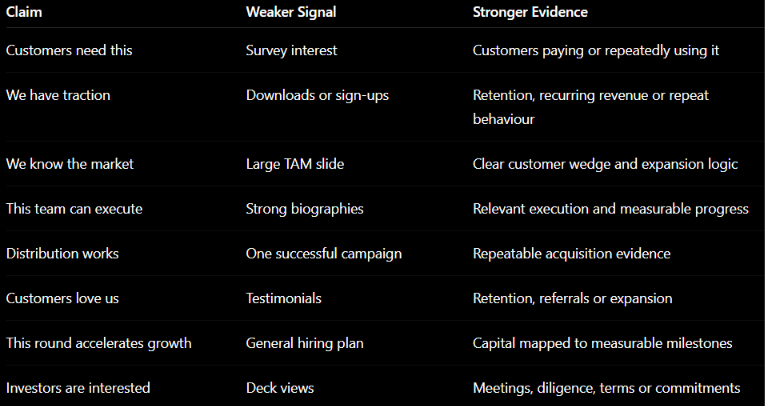
Weak signals are not necessarily useless.
They simply prove less.
The goal is to understand:
what the evidence proves, what it does not prove, and what stronger evidence should come next.
Fundability Is Not the Same as Fundraising Readiness
These ideas overlap, but they describe different problems.
Fundraising readiness asks whether you are prepared to run the raise.
That can include:
pitch deck
financial model
cap table
data room
use of funds
fundraising narrative
investor research
outreach infrastructure
Fundability asks whether there is enough substance behind those materials to create investor conviction.
A founder can therefore be operationally ready to fundraise while still lacking the evidence investors need.
For example, a startup might have a polished deck, organised investor list and perfect CRM.
But if customers are not retaining, the go-to-market strategy remains unclear and the founder cannot explain what the round will prove, better fundraising administration will not solve the underlying problem.
The opposite can happen too.
A startup may have strong evidence but run the raise poorly by:
targeting irrelevant investors
missing warm introduction paths
failing to follow up
presenting strong evidence badly
approaching investors at the wrong stage
Strong fundraising requires both fundability and execution.
Fundability Changes With Stage
One of the easiest mistakes founders make is comparing themselves with startups at a different maturity level.
A pre-product founder cannot show mature revenue retention.
A startup with meaningful revenue should not expect investors to evaluate it primarily on vision.
The evidence should evolve as the company evolves.
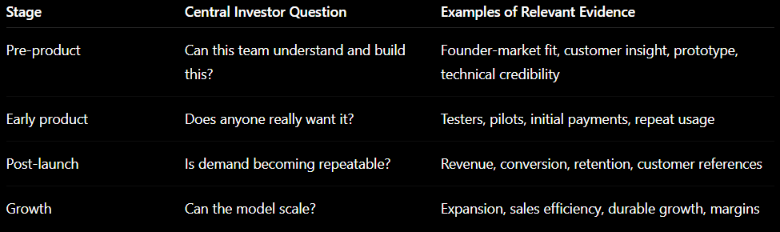
This is why:
“How much traction do I need?”
is often the wrong question.
A better one is:
What is the largest unresolved risk at our current stage, and what evidence could reduce it?
Can You Improve Startup Fundability?
Yes.
Fundability should not be treated as a permanent label.
Founders improve fundability by reducing important uncertainties.
Before automatically launching another wave of investor outreach, ask:
What does an investor still need to believe?
Which of those beliefs are supported by evidence?
What is the largest unresolved risk?
What could we prove in the next 30, 60 or 90 days?
Are we targeting investors whose stage, sector and cheque size actually fit?
Will this round create enough progress to justify taking capital now?
Sometimes the right fundraising decision is to improve the raise.
Sometimes it is to improve the company before running the raise harder.
Knowing the difference can save months.
How BFunded Approaches Fundability
BFunded starts from a simple principle:
Capital should follow evidence, not access.
Rather than treating every company with a deck as equally ready for the same investor network, BFunded uses a progressive fundraising model.
Founders begin by providing company information and fundraising materials.
BFunded then evaluates the company, helps identify relevant investors and progressively expands access as stronger evidence emerges throughout the raise.
You can see how that process works in the BFunded Raise Engine.
The purpose is not to claim that a score can guarantee which startup will succeed.
No fundability score can do that.
The purpose is to make the evidence behind the founder and raise easier to evaluate — and use that information to improve which investors the company should reach.
That is also what separates fundability from popularity.
A founder does not need every investor.
They need enough evidence to earn serious attention from investors who actually understand the opportunity.
Fundability Before Fundraising
Fundraising can quickly become an activity problem.
More investor names.
More outreach.
More meetings.
More follow-ups.
But more activity does not necessarily strengthen the investment case.
Before asking:
How many investors can we reach?
ask:
What have we proved?
The answer influences which investors fit, how much conviction they can build, what questions they will ask next and whether the company should be raising at all.
A pitch deck can start the conversation.
Evidence determines how far that conversation can go.
Keep reading
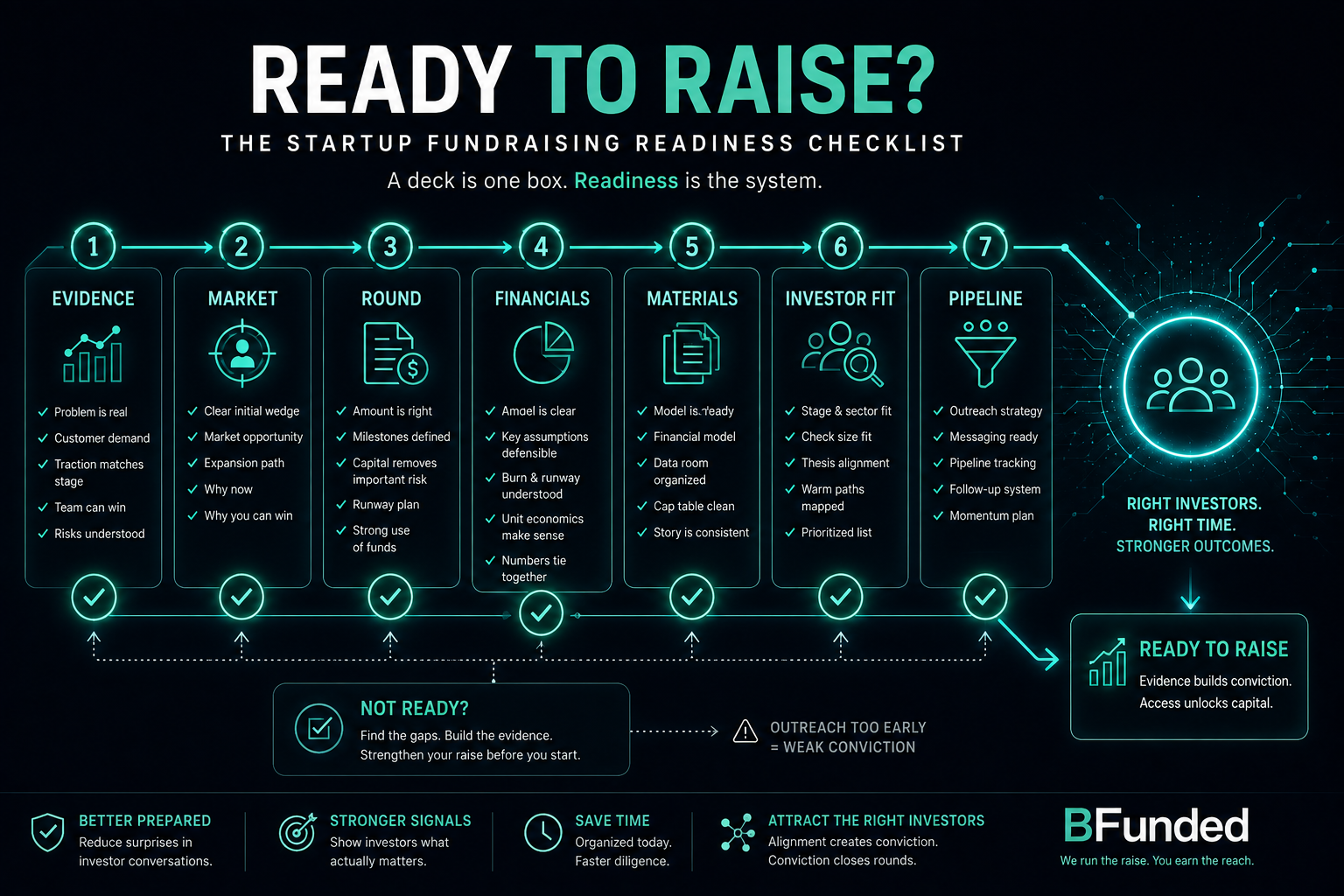
Startup Fundraising Readiness Checklist: Are You Actually Ready to Raise?
Use this startup fundraising readiness checklist to assess your evidence, pitch, financials, data room, investor strategy and fundraising process before outreach begins.
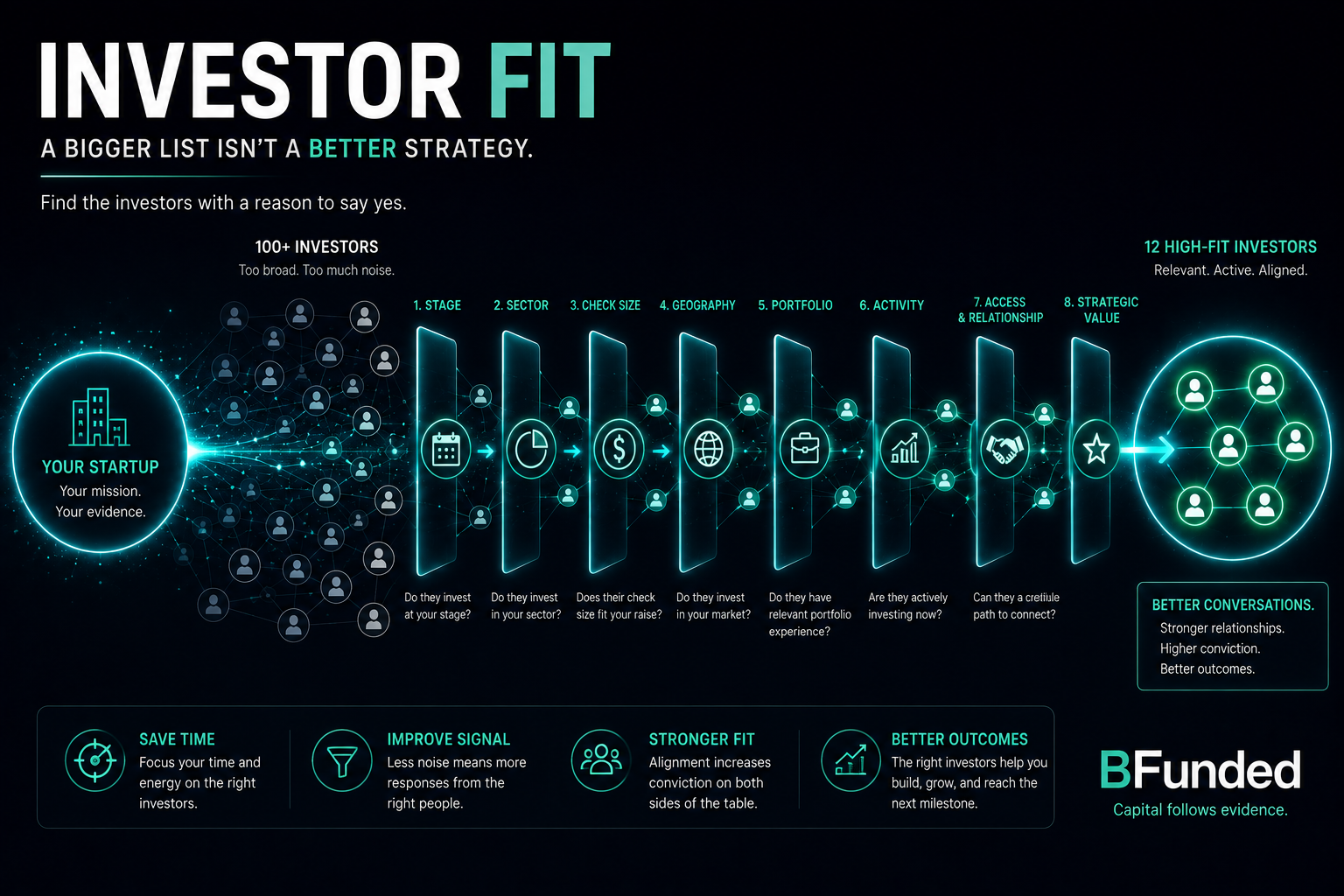
Investor Fit: How to Know Whether an Investor Actually Fits Your Startup
Investor fit goes beyond finding names. Learn how to evaluate startup investors by stage, sector, check size, thesis, portfolio, activity, access and long-term value.
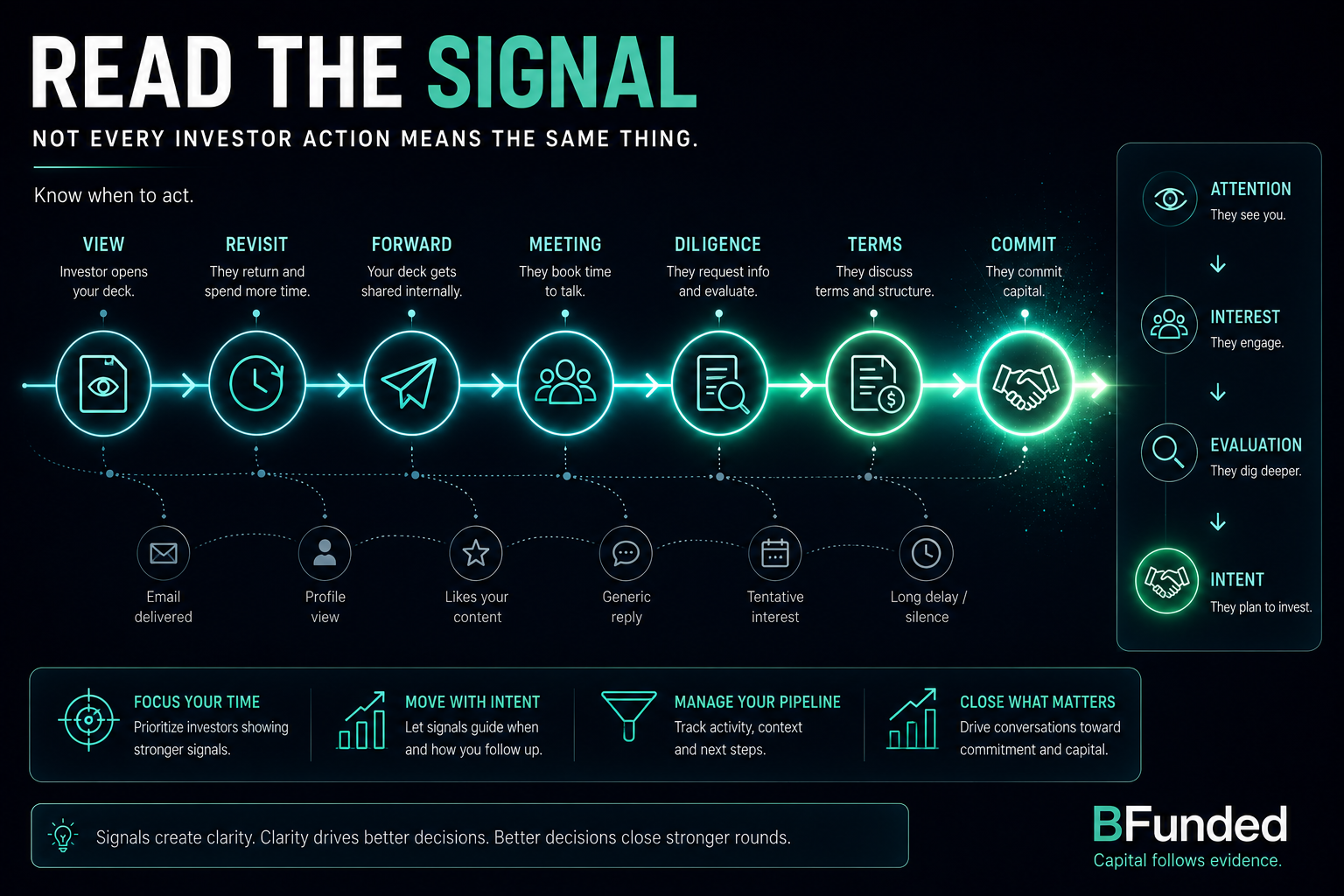
Investor Signals: How to Know When an Investor Is Actually Interested
Learn how to read investor signals during a startup raise, from pitch deck views and repeat engagement to meetings, diligence, terms, and actual commitments.