The BFunded Founder Score: What It Measures and Why It Matters
Learn how the BFunded Founder Score turns startup evidence into a fundraising signal, how the Five Tests unlock investor reach, and what the score does — and does not — mean.
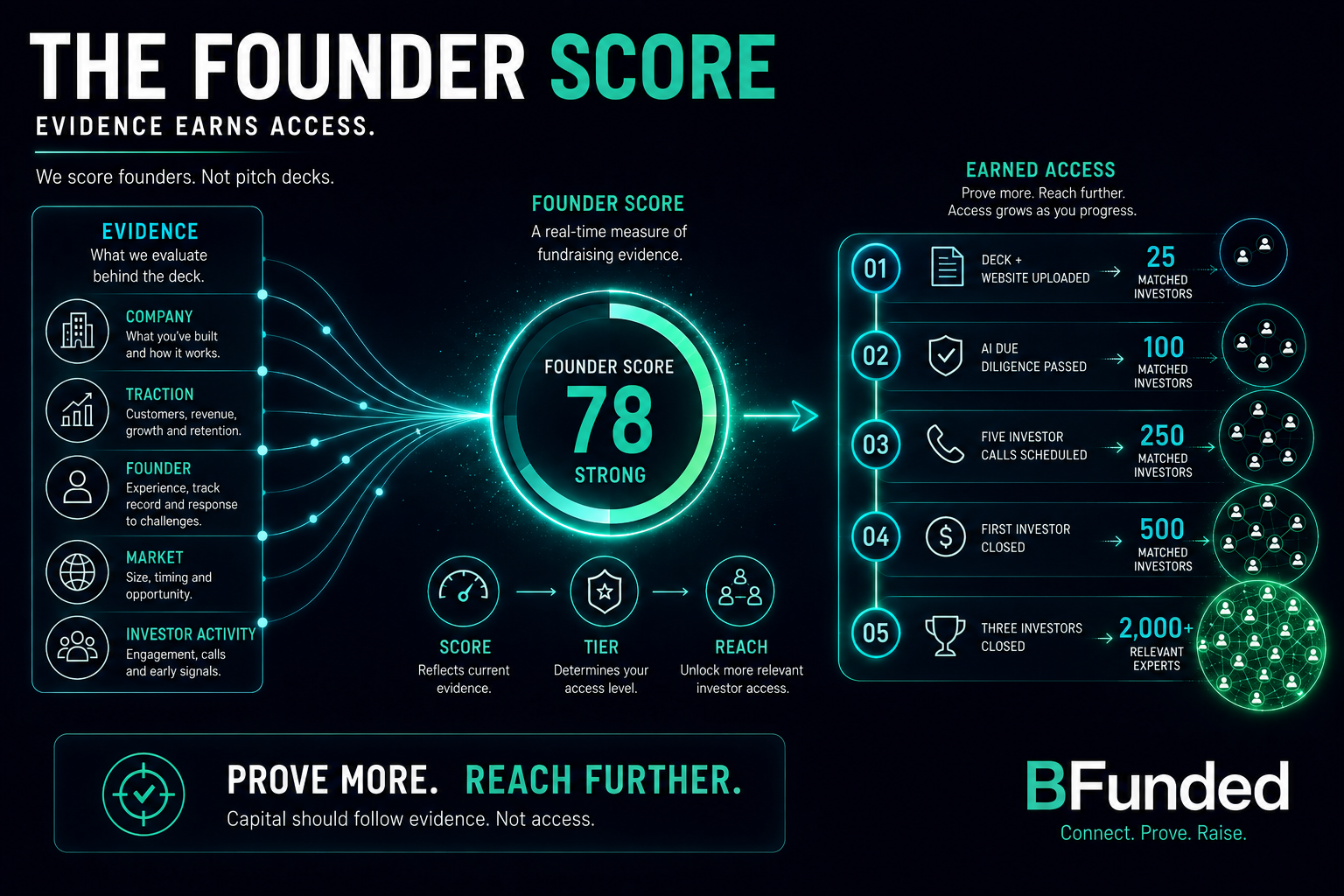
Most fundraising systems start by evaluating the pitch.
BFunded starts by evaluating the founder.
That difference matters because two startups can present similar markets, similar traction, and similarly polished decks while producing completely different fundraising outcomes.
The deck communicates the opportunity.
It does not capture everything behind it.
The BFunded Founder Score is designed to turn founder evidence into a structured fundraising signal — then use that signal to determine how much relevant investor reach a company earns.
It is not meant to replace investor judgment.
It is not a guarantee that a startup will raise.
And it should not be confused with a score for how attractive a pitch deck looks.
The purpose is much simpler:
Make the evidence behind a founder easier to evaluate, then let stronger evidence unlock more opportunity.
What Is the BFunded Founder Score?
The Founder Score is part of BFunded's fundraising infrastructure for seed and pre-seed companies.
A founder sets up the raise, provides information about the company, uploads fundraising materials, and receives a score alongside an initial level of investor access.
BFunded's live product describes the Founder Score, investor matching, and Raise Page as outputs created from the information founders enter during onboarding.
The score is not presented as a static label.
As more evidence develops through the raise, BFunded says the founder's score, tier, and free investor reach can increase.
That creates a different model from simply giving every founder the same investor database on day one.
Access is earned through evidence.
Why Score the Founder Instead of the Deck?
Pitch decks are useful.
They compress a complicated company into something an investor can understand quickly.
But that also creates a problem.
A deck is a presentation.
The company behind it is reality.
Two founders can use:
the same deck structure
similar market-size slides
similar revenue numbers
similar financial projections
equally polished design
and still be very different fundraising opportunities.
BFunded's About page explains that the company's scoring philosophy came from years of seeing founders with apparently similar fundraising materials produce dramatically different outcomes.
The questions underneath the deck are often more revealing:
What has the founder actually built?
Who has paid for it?
What evidence supports the claims?
Who will vouch for the founder?
How does the founder respond when something goes wrong?
Is meaningful progress continuing during the raise?
That is closer to how serious investor evaluation works.
The deck helps communicate those answers.
It should not substitute for them.
What Does the Founder Score Measure?
BFunded's public site does not currently publish the complete scoring formula or weighting methodology.
That is important.
We should not invent a formula the product has not publicly disclosed.
What BFunded does publicly describe is the broader assessment philosophy and the evidence-based progression surrounding the score.
The About page says BFunded evaluates what founders have built, who has paid them, who will support their credibility, and how they have responded to difficult situations.
The Raise Engine also uses company inputs such as:
stage
raise size
sector
traction
company information
fundraising materials
to build the founder's fundraising environment, investor matches, and score.
So a useful way to understand the Founder Score is:
not as one metric, but as a structured summary of fundraising evidence.
The Founder Score and the Five Tests Are Related — But Not Identical
This distinction is important.
The Founder Score is the evaluation output.
The Five Tests are BFunded's public progression system for earning more investor access.
The current BFunded homepage describes the system as:
Five tests. Access is earned.
The publicly listed progression is:
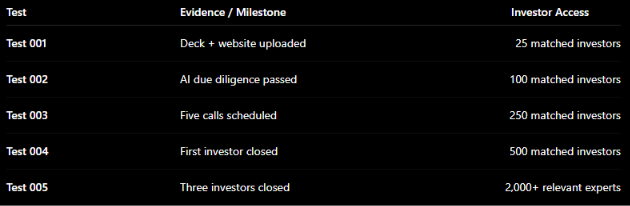
These are the current public access milestones BFunded shows on its site.
They should not automatically be interpreted as the full mathematical formula behind the Founder Score.
Instead, they show the principle behind the system:
as the founder produces stronger evidence, more of the network becomes available.
Test 001 — Can the Opportunity Be Evaluated?
The first test begins with the company's deck and website.
This is the starting evidence.
It allows BFunded to understand the basic shape of the raise:
company
sector
stage
traction
raise
positioning
The Raise Engine says BFunded extracts information such as sector, stage, raise, and traction from the uploaded materials and then uses that information to create the investor-matching profile.
At this stage, the founder has not yet proved the entire investment case.
They have provided enough structured information for evaluation and matching to begin.
That is why initial access is deliberately limited.
Test 002 — Does the Company Survive Deeper Evaluation?
The next step adds due diligence.
The purpose of diligence is not to make the company risk-free.
Early-stage companies are inherently risky.
It is to ask whether the evidence holds up once someone starts examining the claims more seriously.
That may involve questions around:
founder credibility
company evidence
traction
financial assumptions
market claims
team
product
business model
fundraising structure
A polished narrative gets attention.
Diligence asks whether the underlying company supports it.
That is a materially stronger fundraising signal.
Test 003 — Does Investor Interest Become Conversation?
A company can look promising on paper and still fail to create investor engagement.
That is why scheduled investor calls add another kind of evidence.
The market is beginning to respond.
This does not prove the company will raise.
But it tells us something new:
relevant investors are willing to spend time evaluating the opportunity directly.
This is where fundraising evidence begins moving beyond internal company claims.
Investor behavior becomes part of the signal.
Our guide to investor signals explains why meetings, repeated engagement, diligence, and commitments should not all be treated as equivalent stages of investor interest.
Test 004 — Can Interest Convert Into Investment?
The first investor close represents a much stronger form of evidence.
Someone has moved beyond:
viewing
asking questions
meeting
evaluating
and has committed capital.
That does not mean every other investor will follow.
Different investors have different mandates and judgments.
But a first close changes the evidence base.
The company is no longer saying only:
Investors are interested.
It can now say:
An investor has acted.
That distinction matters.
Test 005 — Can Conviction Repeat?
One investment can happen for many reasons.
Repeated investment commitments are more informative.
By the fifth public test, BFunded uses three closed investors as the milestone for unlocking substantially broader expert reach.
The principle is not that three investments mathematically guarantee a successful round.
They do not.
The principle is that repeated behavior from independent investors can create stronger evidence than one isolated event.
Conviction becomes more credible when it repeats.
Why Does the Score Control Investor Reach?
This is one of the most distinctive parts of the BFunded model.
Traditional investor databases often work like this:
Pay → search → contact investors.
BFunded's model is different:
Prove → score → unlock relevant reach.
The current About page says founders cannot buy their way higher in the queue and that stronger evidence progressively opens more of the network.
Why structure it this way?
Because unlimited access creates two problems.
Problem 1 — Founders Can Waste Time on Investors Too Early
A founder may contact hundreds of investors before the investment case is strong enough.
That burns:
relationships
time
attention
potential introductions
founder momentum
A smaller initial network forces the raise to develop alongside the evidence.
Problem 2 — Investors Receive Too Much Low-Quality Deal Flow
The other side of fundraising has the opposite problem.
Investors do not need more random decks.
They need better-filtered opportunities.
The Founder Score creates a mechanism where investor access expands as the founder demonstrates more evidence.
The intention is to improve both sides of the marketplace.
Founder Score Does Not Replace Investor Fit
A high-quality founder does not automatically fit every investor.
The company still needs the right:
stage
sector
geography
check size
thesis
portfolio context
That is why BFunded combines founder evaluation with investor matching.
The Raise Engine currently says it scores 5,800 investors and firms based on how well they fit an individual raise.
Our Investor Fit framework explains why a smaller group of relevant investors can be more valuable than a large database with weak alignment.
The sequence becomes:
Founder evidence
↓
Founder Score
↓
Investor Fit
↓
Relevant Access
↓
Investor Signals
↓
Commitment
The score helps answer:
How strong is the evidence behind this founder and raise?
Investor matching answers:
Who should see that evidence?
Those are different problems.
Both matter.
Founder Score Is Not the Same as Fundraising Readiness
A founder can be operationally ready to raise without being highly fundable.
They may have:
a deck
financial model
data room
investor CRM
target list
but weak evidence behind the business.
A Founder Score is closer to the second question:
How convincing is the evidence supporting this raise?
That distinction is covered in more detail in our guide to startup fundability.
Fundraising readiness is still important.
But organization should not be confused with investment evidence.
Why Use a Score at All?
A reasonable question is:
Why reduce something as complicated as founder evaluation to a number?
Because fundraising decisions already involve scoring — even when nobody calls it that.
Investors compare:
traction
founder quality
market
risk
timing
team
economics
fit
They simply do it using different systems, mental models, and judgment.
A score can make part of that process more visible.
It can help founders understand:
where the raise currently stands
whether new evidence has changed the picture
what type of progress matters
how much network reach has been earned
what the next meaningful milestone is
The value is not the number by itself.
The value is the decision framework around it.
Founder Scores Should Not Be Treated as Predictions
No founder score can tell you with certainty which company will become successful.
Startup outcomes depend on too many variables.
Markets change.
Teams change.
Products fail.
New competitors appear.
Investors make subjective decisions.
Even other fundability platforms explicitly make this distinction.
OpenVC's current Fundability Test says its score measures signals investors commonly look for but does not predict whether the business will ultimately succeed.
That is a useful standard for interpreting any fundraising score.
Use it to structure decisions.
Do not treat it as destiny.
Fundability Scores Are Becoming a Broader Fundraising Category
BFunded is not the only company trying to make investor readiness more measurable.
Other platforms are experimenting with scoring models that combine multiple fundraising signals.
For example, InPaceline's August 2026 investor-readiness framework uses five broad pillars — traction, financials, team, market, and pitch materials — to create a weighted readiness assessment.
The exact frameworks differ.
That matters.
A score is only as useful as:
what it measures
how transparent the assumptions are
what action the score changes
whether the founder understands its limitations
For BFunded, the important difference is that the Founder Score is not presented only as feedback.
It changes access.
Evidence affects the score.
The score affects reach.
Reach creates new investor interactions.
Those interactions create additional evidence.
That creates a feedback loop.
The Founder Score Is Designed to Change
A score that never changes would not be very useful for an active raise.
The company itself is changing.
So is the fundraising evidence.
A founder may:
add traction
schedule investor meetings
close an investor
improve financial evidence
strengthen the company
generate stronger market validation
The BFunded product explicitly shows evidence moving the founder's score, tier, and free investor reach over time.
That makes the score less like a grade and more like a fundraising state.
The question is not:
What score did we get?
It is:
What evidence would make the investment case stronger next?
How Founders Should Use the Founder Score
The wrong way to use the score is:
I got a number. Therefore investors should fund me.
The better use is diagnostic.
Ask:
What Is Already Strong?
Which parts of the investment case are supported by credible evidence?
What Is Still Assumption?
Where is the founder asking investors to believe something that has not yet been demonstrated?
What Is the Next Meaningful Proof Point?
Could the company:
secure a customer
improve retention
complete a technical milestone
schedule relevant investor calls
close the first investor
add measurable traction
Has New Evidence Changed the Raise?
As the company progresses, investor targeting and access should evolve too.
The score creates one mechanism for making that progression visible.
How BFunded Uses the Founder Score Inside the Raise
The Founder Score is not designed as a standalone quiz.
It sits inside the larger fundraising system.
The current BFunded Raise Engine connects company setup, investor matching, the Founder Score, network access, a tracked Raise Page, introductions, and investor engagement inside one workflow.
That matters because fundability without distribution creates one problem.
Distribution without fundability creates another.
The intended sequence is:
Evaluate the founder.
Match the investors.
Earn the reach.
Read the signals.
Move the raise forward.
This is what BFunded means when it says:
Capital should follow evidence. Not access.
Frequently Asked Questions
What is the BFunded Founder Score?
The BFunded Founder Score is an evidence-based fundraising signal used within BFunded's platform to evaluate the founder and raise, assign a tier, and help determine how much matched-investor reach becomes available.
Is the Founder Score based only on the pitch deck?
No. BFunded's public positioning explicitly says it scores founders rather than pitch decks, and the product uses broader company and fundraising information as part of the setup and evaluation process.
Does BFunded publish the Founder Score formula?
BFunded's public site currently describes the assessment philosophy, progression, and Five Tests, but does not publish the complete score weighting or mathematical formula.
Does a high Founder Score guarantee investment?
No. A fundraising score should be treated as a decision-support signal, not a guarantee of investment or startup success. Investors still make independent decisions based on their own mandate, diligence, judgment, and fit.
What are BFunded's Five Tests?
The current public progression begins with uploading a deck and website, followed by AI due diligence, five investor calls, the first investor close, and then three investor closes. Each milestone unlocks progressively broader matched-investor access.
Can the Founder Score improve?
Yes. BFunded's product describes the score, tier, and free investor reach changing as stronger evidence is added during the raise.
Is Founder Score the same as investor readiness?
They overlap, but they are not identical. Investor readiness can include operational preparation such as the pitch deck, data room, and financial model. Founder Score is focused on the evidence supporting the founder and raise within BFunded's system.
Why does BFunded limit investor access?
BFunded's model is designed around earned access. Founders progressively unlock more relevant investor reach as stronger evidence is demonstrated rather than receiving unrestricted access to the entire network immediately.
The Bottom Line
A score is not valuable because it turns a founder into a number.
It is valuable if it makes the next decision clearer.
What have you proved?
What remains uncertain?
Which investors fit?
What should you prove next?
The BFunded Founder Score is built around those questions.
Evidence moves the score.
The score moves the reach.
And stronger reach creates the opportunity to produce the next piece of evidence.
Keep reading
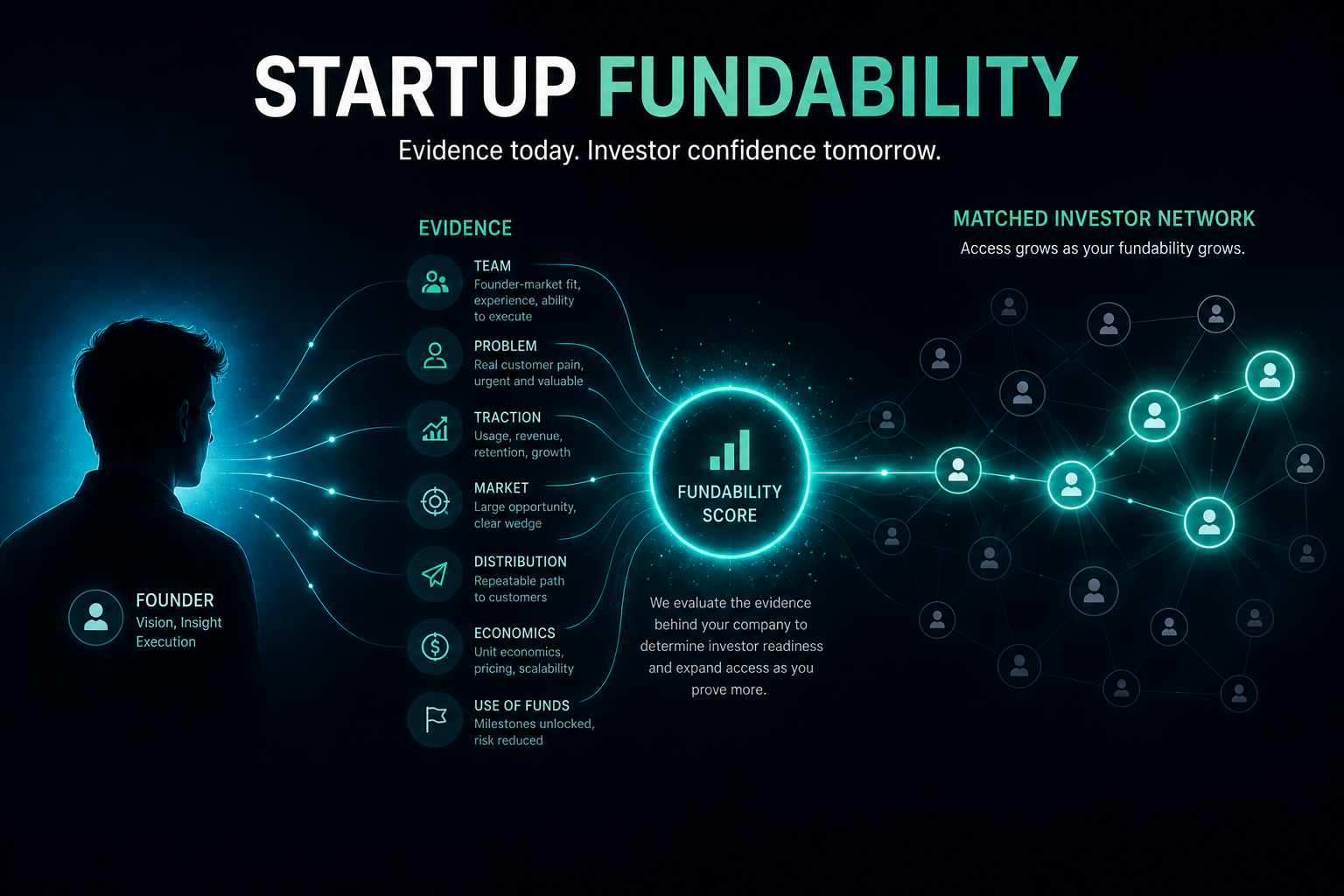
What Is Startup Fundability? How Investors Decide If You’re Ready to Raise
A great pitch deck can earn attention, but it cannot make a company fundable. Learn what startup fundability means and what evidence investors look for before backing a raise.
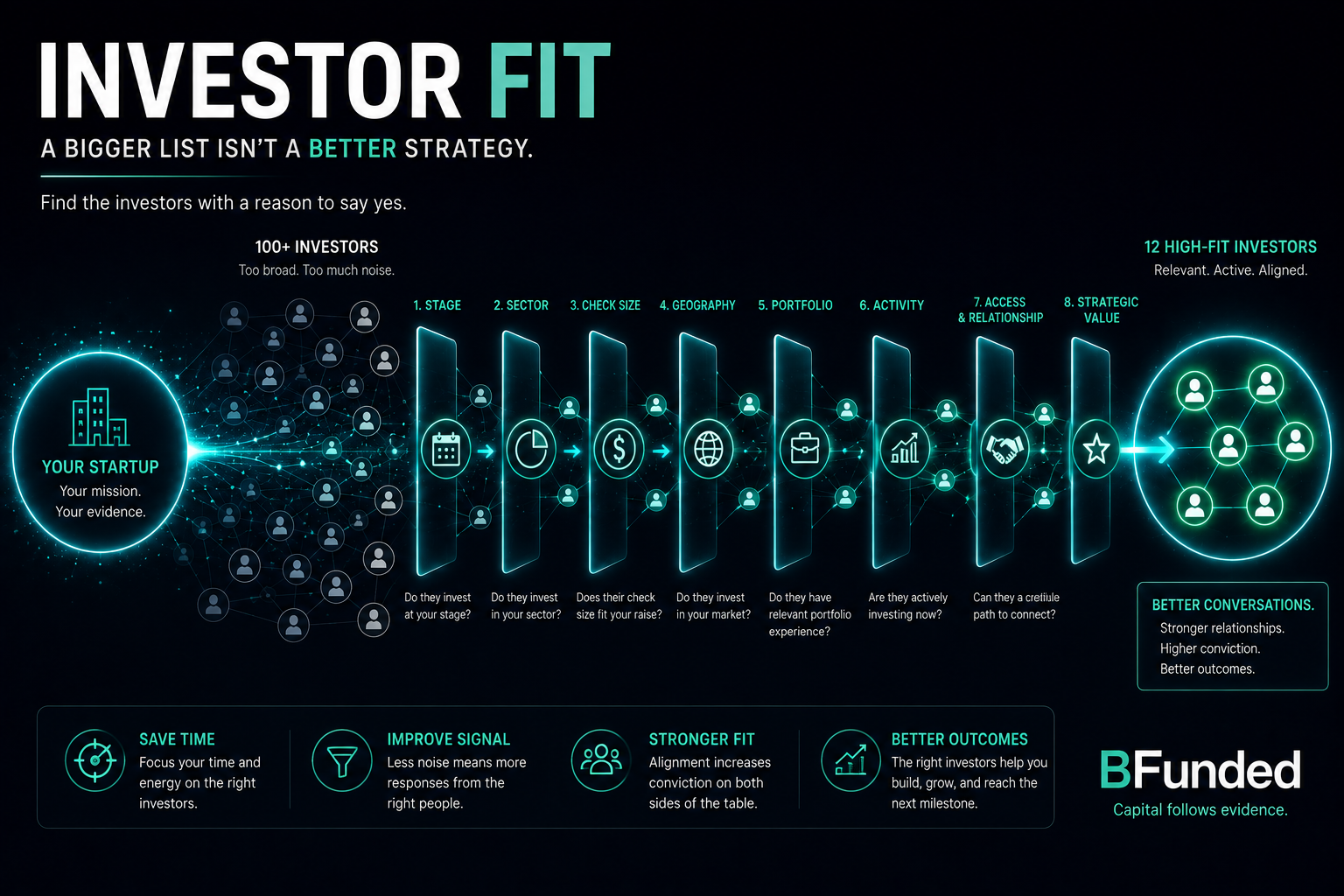
Investor Fit: How to Know Whether an Investor Actually Fits Your Startup
Investor fit goes beyond finding names. Learn how to evaluate startup investors by stage, sector, check size, thesis, portfolio, activity, access and long-term value.
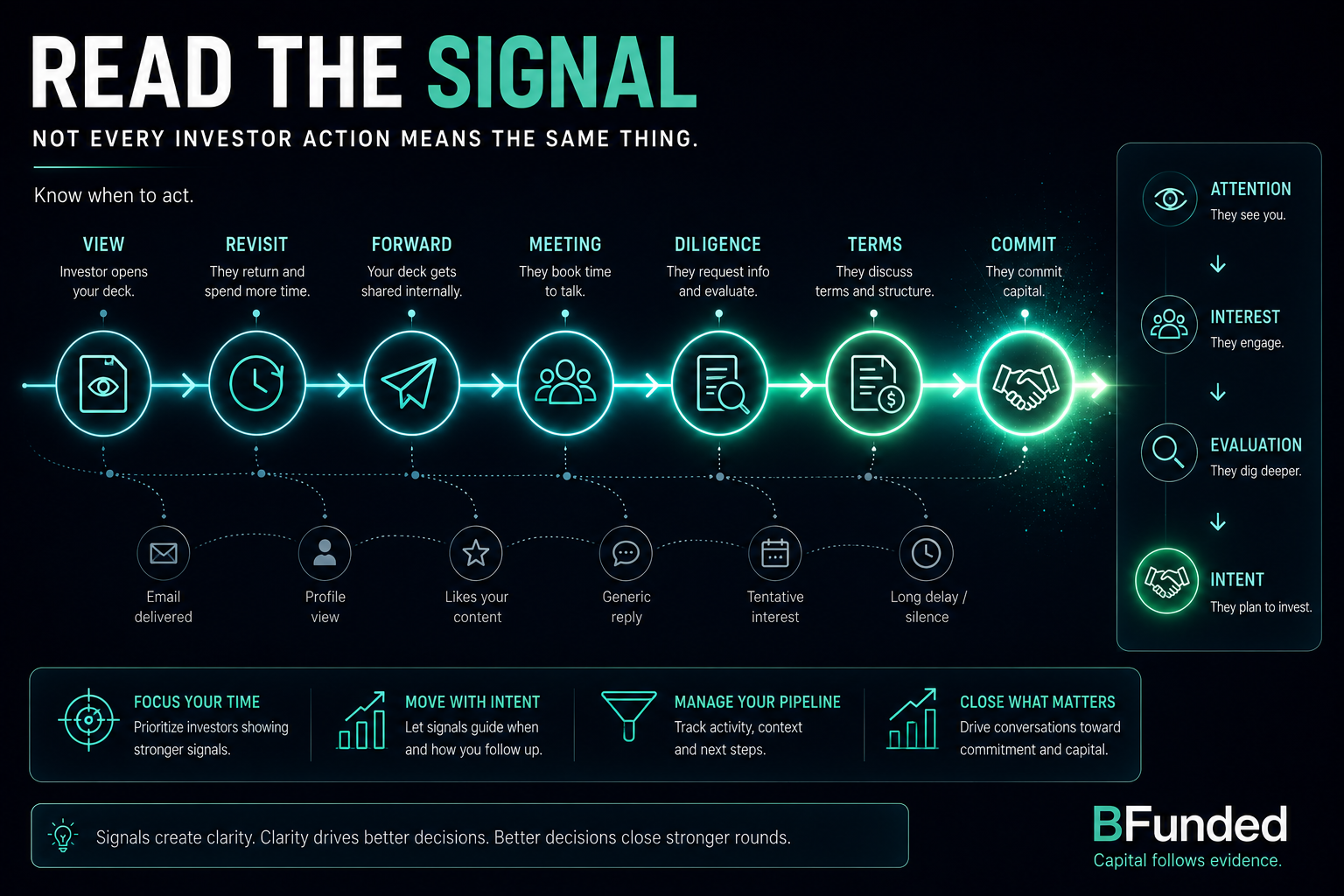
Investor Signals: How to Know When an Investor Is Actually Interested
Learn how to read investor signals during a startup raise, from pitch deck views and repeat engagement to meetings, diligence, terms, and actual commitments.